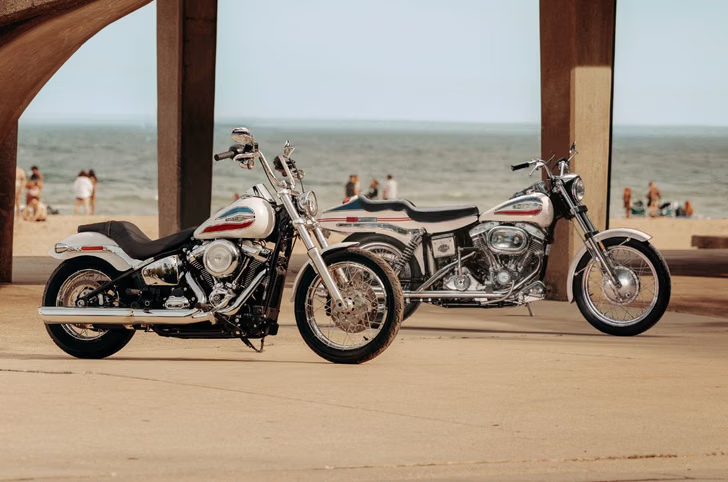
A forgotten Harley name has suddenly roared back into the spotlight in 2026 — but not everyone is cheering.
The return of the Super Glide isn’t just another nostalgia play. It’s a tightly controlled, 2,500-unit revival locked to North America, built on a modern Street Bob platform — and it’s already raising questions about whether Harley-Davidson is celebrating its past… or carefully monetising it.
And that’s where things get interesting.
Table of Contents
ToggleWhat Happened
The 2026 Super Glide has officially been unveiled by Harley-Davidson as a limited-production motorcycle inspired by one of its most important historical nameplates.
Only 2,500 units will be made, and they are reserved exclusively for the US and Canadian markets.
At its core, the bike is not a ground-up reinvention. It is based on the current-gen Street Bob — but heavily reimagined through design and branding cues from the original 1971 Super Glide.
Key highlights include:
- White base paint with red and blue stripes, echoing the original ’71 livery
- A numbered plaque placed below the speedometer
- Larger 18.9-litre fuel tank (up from Street Bob’s 13.2L unit)
- Single-piece seat design for rider + passenger authenticity
- Cross-spoke wheels offered as standard
But visually familiar doesn’t mean mechanically simple.
Under the surface, it uses the Milwaukee-Eight 117 (1,923cc) V-twin engine producing 98hp and 162Nm of torque — the same performance family as its Street Bob sibling.
Why It Matters
This isn’t just a motorcycle launch — it’s a branding strategy with emotional weight.
Harley is tapping into a very specific moment in its history, when the original Super Glide helped bridge the gap between entry-level Sportsters and heavyweight cruisers during a financially unstable era.
Now, in 2026, that name is being used again — but with modern underpinnings, tighter exclusivity, and a noticeably higher price tag.
That contrast is what’s fueling debate.
Because while the bike looks retro, everything about its rollout feels modern, calculated, and scarcity-driven.
Must Read: 2026 Navnit Motors Maserati Mumbai Shift Sparks Big Questions
Market Impact: Nostalgia Meets Pricing Pressure
Here’s how the Super Glide positions itself against its base:
| Feature | Super Glide (2026) | Street Bob |
|---|---|---|
| Engine | Milwaukee-Eight 117 | Same |
| Seat height | 665mm | 680mm |
| Fuel tank | 18.9L | 13.2L |
| Weight | 297kg | 293kg |
| Price (US) | $15,999 | $14,999 |
Even though it shares most mechanical components, the Super Glide commands a premium — roughly $1,000 more in the US.
That pricing gap has already triggered debate among enthusiasts who see it as “heritage tax pricing.”
Industry Reaction
Inside the motorcycle community, reactions are split.
On one side, long-time Harley fans are calling it a respectful revival — especially because it preserves the original color identity and keeps the bike visually rooted in its 1971 inspiration.
On the other side, critics argue this is simply a re-skinned Street Bob with limited production hype layered on top.
The biggest talking point isn’t even performance — it’s identity.
Is this a true revival… or just a nostalgia badge placed on an existing platform?
And that question is dominating forums, dealer discussions, and early buyer chatter.
Hidden Problem: Exclusivity Limits the Story
There’s a quiet tension in the rollout strategy.
By restricting the Super Glide to just 2,500 units in North America, Harley is making it instantly collectible — but also geographically narrow.
That creates a paradox:
- It boosts desirability in the US and Canada
- But shuts out global enthusiasts entirely
- And risks turning the bike into a “regional memory product” rather than a global revival
For a brand built on global cultural symbolism, that’s not a small decision.
Contrarian View
Here’s the uncomfortable take few want to say out loud:
This might not be a revival at all — it might be optimisation.
The Super Glide doesn’t introduce new engineering, platform innovation, or performance breakthroughs. Instead, it leverages an existing architecture, repackaged through heritage storytelling.
In other words, it’s not about reinventing the motorcycle.
It’s about reinventing the perception of the motorcycle.
And that’s exactly why some enthusiasts are uneasy — because nostalgia is being treated like a product feature, not a legacy.
What Happens Next
The Super Glide will likely sell out quickly — that much seems almost guaranteed given Harley-Davidson’s demand patterns and the limited 2,500-unit cap.
But the bigger question is what this signals for future launches.
If this model succeeds commercially, it may set a pattern:
- More heritage revivals
- More limited-run “nameplate returns”
- More platform-sharing disguised as emotional storytelling
And that could reshape how Harley’s future lineup is perceived — not as purely new motorcycles, but as cycles of memory-driven reinvention.
Final Thought
The 2026 Super Glide isn’t just asking riders to look back.
It’s asking a more complicated question — how much of a motorcycle’s identity comes from engineering, and how much comes from the story we’re told about it?
And in a world where heritage itself is becoming a strategy, that question may define Harley-Davidson’s next chapter more than any spec sheet ever will.
Disclaimer: This article is based on publicly available information. No facts, specifications, or figures have been fabricated. Interpretations reflect editorial analysis and may evolve as new details emerge.