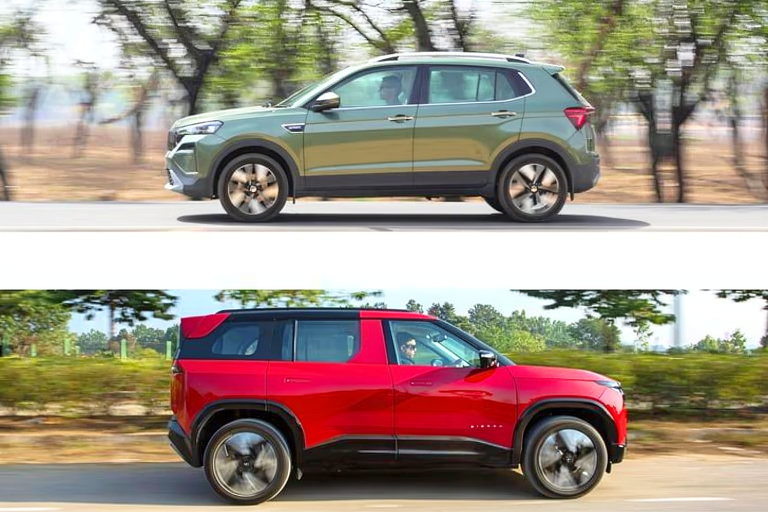
A simple fuel test has just exposed a gap that many didn’t expect in 2026.
Two turbo-petrol SUVs. Same engine size. Similar ambition.
Yet the real-world efficiency story is anything but equal.
When the Skoda Kushaq and Tata Sierra were pushed through identical real-world conditions, the results didn’t just differ—they raised eyebrows across the midsize SUV space.
Table of Contents
ToggleWhat Happened: Same Segment, Very Different Outcomes
On paper, both SUVs look closely matched. Both use 1.5-litre turbo-petrol engines and automatic gearboxes. But the efficiency numbers tell a sharper story.
Key specs snapshot:
| SUV | Power | Torque | Gearbox | Weight |
|---|---|---|---|---|
| Kushaq | 150 hp | 250 Nm | 7-speed DCT | 1,322 kg |
| Sierra | 160 hp | 255 Nm | 6-speed torque converter | 1,552 kg |
The Sierra brings more power. The Kushaq brings less weight and a dual-clutch setup.
And that difference quietly changes everything.
Why It Matters: The Fuel Economy Reality Check
Official ARAI numbers already hinted at a gap:
- Kushaq: 18.72 kpl
- Sierra: 15.3 kpl
But the real-world test widened the conversation far beyond lab ratings.
Real-world fuel efficiency results:
| Condition | Kushaq | Sierra |
|---|---|---|
| City mileage | 9.55 kpl | 7 kpl |
| Highway mileage | 15.29 kpl | 13.7 kpl |
| Average mileage | 12.42 kpl | 10.35 kpl |
| Tested range | 621 km | 517.5 km |
That’s a 2.07 kpl average gap in real-world conditions.
And in practical terms?
The Kushaq travels over 100 km farther per tank.
That’s not a small difference—it’s a full road-trip gap.
Must Read: 2026 Honda Hornet & Transalp E-Clutch Shock India With Massive Price Jump
The Hidden Factor: Weight, Tech… and a Small Efficiency Edge
At first glance, both SUVs feel evenly matched. But three factors quietly tilt the balance:
- The Kushaq is 230 kg lighter
- It uses cylinder deactivation technology
- It runs a dual-clutch transmission (DCT) tuned for efficiency
That combination helps it stretch every litre further, especially in mixed driving.
Meanwhile, the Sierra leans on a torque converter gearbox and higher output—great for smoothness and power delivery, but less efficient in stop-go conditions.
Market Impact: Why Buyers Are Suddenly Re-evaluating Choices
This isn’t just about numbers on a test sheet.
Fuel efficiency still plays a massive role in India’s midsize SUV buying decisions. And now, the gap between expectation and reality is visible in a way that’s hard to ignore.
For many buyers, the equation now looks like this:
- More performance (Sierra) → higher fuel cost over time
- More efficiency (Kushaq) → lower running cost but less power advantage
The emotional tension is real:
Do you pick comfort and power—or long-term fuel savings?
And this is where the segment gets complicated.
Contrarian View: The Efficiency Story Isn’t That Simple
Here’s where things get interesting—and slightly controversial.
On paper, the Kushaq wins the efficiency battle. But not everyone would call it the “better” real-world car.
Why?
Because efficiency doesn’t exist in isolation.
The Tata Sierra counters with:
- More power (160 hp vs 150 hp)
- Stronger torque output
- A smoother torque-converter driving experience in traffic
- Heavier build that some buyers associate with stability
So while it burns more fuel, it also delivers a different kind of driving comfort—especially in urban stop-go traffic where DCTs can feel less relaxed compared to torque converters.
In other words:
The “winner” depends entirely on what you value more—fuel bills or driving feel.
And that’s exactly why this comparison is dividing opinions.
What Happens Next: The Bigger Question for Buyers
The real question this test raises isn’t just about these two SUVs.
It’s about where the midsize SUV market is heading.
Because the gap between:
- claimed mileage
and - real-world efficiency
is still significant for both models.
And buyers are becoming more aware of it.
Key takeaway:
- Kushaq: more efficient, lighter, longer range
- Sierra: more powerful, heavier, more comfort-focused drive
But neither escapes the real-world efficiency drop from ARAI claims.
Final Thought
This comparison doesn’t crown a simple winner—it exposes a trade-off that modern SUV buyers can’t avoid anymore.
Do you prioritise efficiency that saves you 100 km per tank?
Or do you accept higher fuel consumption for stronger performance and comfort?
The answer, increasingly, is shaping how India chooses its SUVs in 2026.
And the industry is watching closely.
Disclaimer: This article is based on publicly available test data and specifications. No facts, figures, or outcomes have been altered or fabricated. Interpretations reflect analysis of the provided information and may evolve with future updates or testing.