A quiet government notification could end up becoming one of the biggest automotive developments of 2026.
Without much public noise, India has removed a key regulatory hurdle that has long stood between advanced vehicle safety technology and mass adoption. The decision could make everything from smarter crash-avoidance systems to future self-driving technologies easier, faster and cheaper to bring to Indian roads.
And considering India recorded more than 177,000 road deaths in nearly half a million accidents in 2024, the timing is hard to ignore.
But that’s only part of the story.
Table of Contents
ToggleWhat Exactly Changed?
The Indian government has exempted certain automotive communication technologies from radio spectrum licensing requirements.
Two important frequency bands are affected:
| Technology | Frequency Band | Purpose |
|---|---|---|
| Automotive Radar | 77GHz–81GHz | ADAS and safety systems |
| Vehicle-to-Everything (V2X) | 5.9GHz | Vehicle communication networks |
In simple terms, manufacturers no longer need spectrum licenses to deploy these technologies.
That may sound technical.
The implications are not.
These are the very systems that power many of the advanced features now becoming common in global markets.
Think:
- Autonomous Emergency Braking
- Adaptive Cruise Control
- Blind-Spot Monitoring
- Collision Warning Systems
- Future Self-Driving Functions
For years, regulatory complexity added friction to deployment. Now, one major barrier has been removed.
And that’s where things become interesting.
Must Read: 2026 Shocking E85 vs E20 Test Reveals a Costly Reality for Flex Fuel Bike Owners
Why Automakers Are Paying Attention
The move brings India closer to regulatory frameworks already followed in the United States and Europe.
That matters because automakers prefer building one global technology platform rather than creating market-specific hardware for every country.
With licensing requirements removed, companies may be able to deploy globally developed radar and communication systems in India with fewer modifications.
The result?
Potentially lower costs.
Faster rollout timelines.
And wider availability of advanced safety features.
For an industry constantly balancing technology ambitions with affordability, that combination is powerful.
The Hidden Technology Most Drivers Never See
Modern vehicles increasingly rely on radar sensors rather than just cameras.
Unlike cameras, radar can continue functioning effectively in conditions where visibility becomes challenging.
These sensors continuously monitor the environment around a vehicle and help support critical driver-assistance functions.
Many consumers associate ADAS with premium vehicles.
That perception may not hold forever.
As deployment becomes easier, the technology could gradually spread beyond luxury segments into more mainstream products.
And that possibility has manufacturers watching closely.
Key Takeaway
India has not mandated ADAS or self-driving technology.
What it has done is remove a regulatory hurdle that could make adoption easier and potentially more cost-effective in future vehicles.
That’s an important distinction.
Winners Could Include Luxury Brands—and Local Manufacturers
Global premium brands such as Mercedes-Benz and BMW already offer sophisticated radar-based driver assistance systems in international markets.
The new regulatory framework could make it easier for similar technologies to reach Indian customers.
But the bigger story may involve domestic players.
Companies such as:
- Maruti Suzuki
- Tata Motors
- Mahindra
could also benefit as advanced safety features become more practical to deploy across broader vehicle lineups.
The impact isn’t limited to automakers either.
Technology suppliers including Bosch, Continental and Qualcomm are also expected to gain from a regulatory environment that is now more aligned with global standards.
The Bigger Safety Question
India’s road safety challenge remains enormous.
According to government data cited by Reuters, the country recorded over 177,000 road fatalities in 2024.
No technology can eliminate human error entirely.
But systems that can detect hazards, monitor surroundings and react faster than a distracted driver have increasingly become part of the global road-safety conversation.
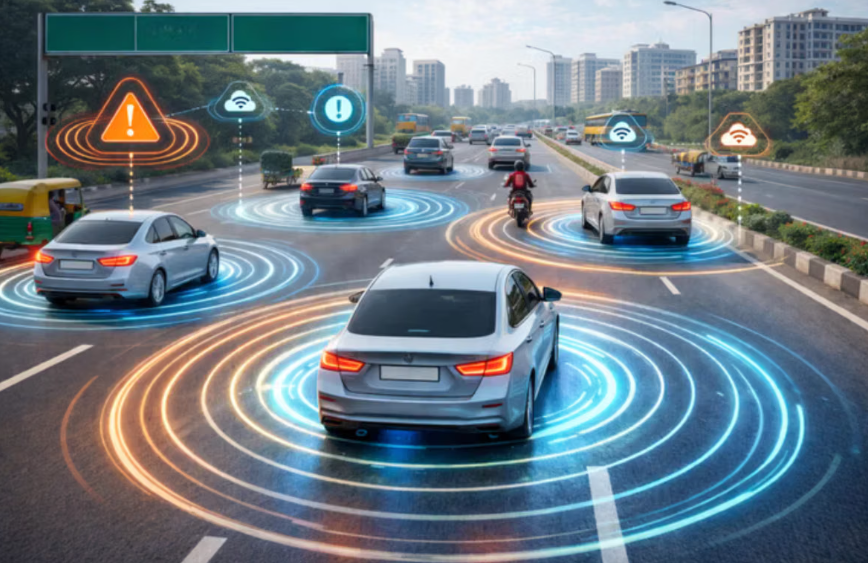
The newly exempted 5.9GHz communication band could support Vehicle-to-Everything (V2X) systems, allowing vehicles to communicate with each other and with roadside infrastructure.
That opens the door to warnings about:
- Vehicles braking ahead
- Hazards beyond visibility range
- Traffic disruptions
- Approaching emergency vehicles
In theory, vehicles become part of a connected safety network rather than isolated machines.
But Not Everyone Is Convinced
Contrarian View: Technology Alone Won’t Fix India’s Roads
Supporters see the move as a major step toward safer and smarter transportation.
Critics, however, may argue that advanced technology addresses only one piece of a much larger puzzle.
Road infrastructure quality, enforcement, driver behavior, traffic discipline and vehicle maintenance continue to play major roles in accident prevention.
A vehicle equipped with cutting-edge radar still operates in a complex real-world environment.
In other words, better technology can help—but it cannot single-handedly solve every road-safety challenge.
That debate is unlikely to disappear anytime soon.
What Happens Next?
The government’s notifications do not require automakers to install these technologies.
There is no immediate mandate.
No overnight transformation.
No instant arrival of self-driving cars.
Yet the direction of travel is becoming clearer.
By removing licensing requirements for automotive radar and connected-car communication systems, India has aligned itself more closely with major global automotive markets and created conditions that could accelerate the spread of advanced safety technologies.
The real question now is not whether the technology can come to India.
It’s how quickly automakers decide to bring it—and how much of it eventually reaches everyday drivers.
Editorial Disclaimer: This article is based entirely on publicly available information and reported government notifications referenced in the source material. No facts, outcomes, quotes, timelines, statistics or claims have been fabricated. Analysis and industry implications may evolve as additional information becomes available.