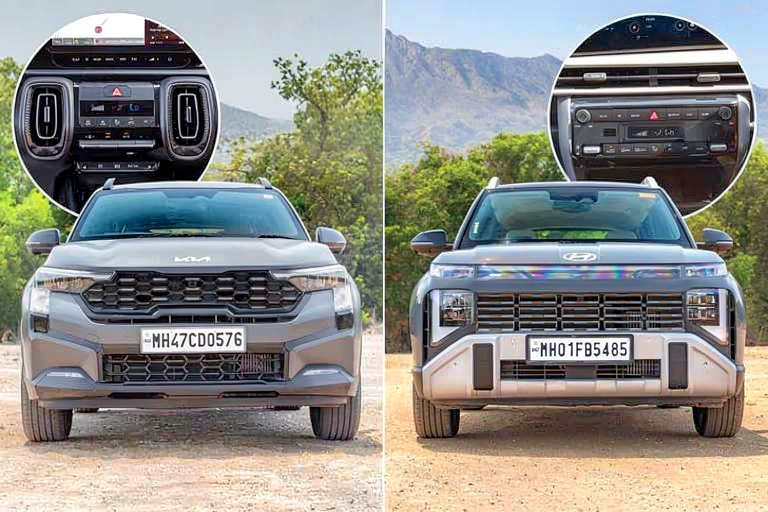
The heat didn’t ease up.
Even before the test began, both SUVs were already sitting inside what felt like ovens.
At 41.2°C ambient temperature, this wasn’t a normal comparison — it was a punishment test for two of India’s most popular compact SUVs from Hyundai and Kia.
And the results?
Not as close as many would expect.
Something subtle — but very real — separated the two Korean rivals once the AC systems were pushed into survival mode.
Table of Contents
ToggleWhat Happened Inside the Heat Test
Both the Hyundai Venue and Kia Sonet were soaked under direct sunlight for two hours. Windows shut. Sunroof shades closed. Cabin heat built up aggressively before anyone even stepped in.
Then came the real test.
ACs set to:
- Maximum cooling
- Full blower speed
- Recirculation mode
And then… the countdown began.
Starting point (inside cabin heat soak)
- Venue: 53.2°C (front), 52.2°C (rear)
- Sonet: 50.2°C (front), 50.5°C (rear)
Already, the Venue was starting from a hotter baseline.
But what happened next is where the gap started forming.
Must Read: Skoda Sales Shock 2026: Kylaq Drop, Kushaq Surge & 5,760 Units Raise Questions
The First 60 Seconds Changed the Tone
After just one minute of idling:
- Venue dropped sharply to 40.7°C (front)
- Sonet cooled to 42°C (front)
That early cooling burst matters more than it sounds. It sets the rhythm for the entire drive.
Then came steady driving at 50–60 km/h.
Cooling progression (key readings)
| Time | Venue (Front) | Sonet (Front) |
|---|---|---|
| Start | 53.2°C | 50.2°C |
| 1 min idle | 40.7°C | 42°C |
| 5 min drive | 30.7°C | 33.2°C |
| 10 min drive | 30.2°C | 32.5°C |
| 15 min drive | 31°C | 31.7°C |
Rear seat results followed a similar pattern — with Venue consistently cooler or equal in key phases.
Inside the Venue, cabin spread was also noticeably more even, with better airflow distribution across both rows.
But that’s only part of the story.
Why It Matters More Than Just Numbers
In real Indian summers, the difference between 30°C and 33°C inside a cabin isn’t just comfort — it’s fatigue, sweat, and long-drive stress.
And this is where the Venue quietly pulled ahead.
The test observations noted:
- Wider vent spread in the Venue
- Stronger overall cabin coverage
- More consistent cooling across front and rear
Meanwhile, the Sonet held its ground — but slightly less aggressively.
Even though both SUVs eventually stabilised around the low 30s, the journey there mattered.
The Hidden Detail Most People Miss
There’s a twist buried in the Sonet’s behavior.
While driving:
- Rear seats in Sonet were sometimes slightly cooler than the front
- Cabin airflow felt more vertically directed due to vent design
But once the vehicle returned to idle after the drive, temperatures climbed again:
- Front: 34.5°C
- Rear: 34.8°C
That rebound effect suggests the cooling consistency under stop conditions is weaker compared to the Venue.
Contrarian View: Is the Venue Really “Better”?
Here’s where things get interesting — and slightly controversial.
The Venue wins on raw cooling aggression and cabin coverage.
But the Sonet isn’t necessarily “worse.”
In fact:
- Its rear cooling balance during motion was slightly more stable at times
- Vertical vent design distributes airflow differently, not always worse — just less direct
- Cabin temperature differences were often just around 1–2°C in many phases
So depending on usage, especially city crawling vs highway driving, some drivers may not even notice a meaningful gap.
And that raises a fair question:
Is “faster cooling” always more important than “balanced cooling”?
What the Industry Angle Suggests
Tests like these from Autocar India highlight a key truth:
AC performance in India isn’t about luxury anymore. It’s a core usability factor.
Especially in compact SUVs — where:
- Cabin size is similar
- Engine outputs are comparable
- Buyers cross-shop heavily between brands
Even a 1–2°C advantage becomes a talking point.
And that’s exactly what separates these two Korean rivals.
What Happens Next
The Hyundai Venue leaves this test with a clearer edge in extreme heat performance, especially in early cooling and sustained cabin control.
But the Kia Sonet doesn’t fall behind dramatically — it stays competitive, just slightly less aggressive in peak conditions.
The bigger question now is how future updates will respond. Will Kia prioritise stronger compressor tuning? Will Hyundai refine airflow balance further?
Because in India’s increasingly brutal summers, AC performance is no longer a feature.
It’s a battlefield.
And both SUVs know it.
Editorial Disclaimer
This article is based on publicly available test data and reporting. No facts, figures, or outcomes have been fabricated. Interpretations reflect analysis of the referenced material and may evolve with future updates or additional testing.