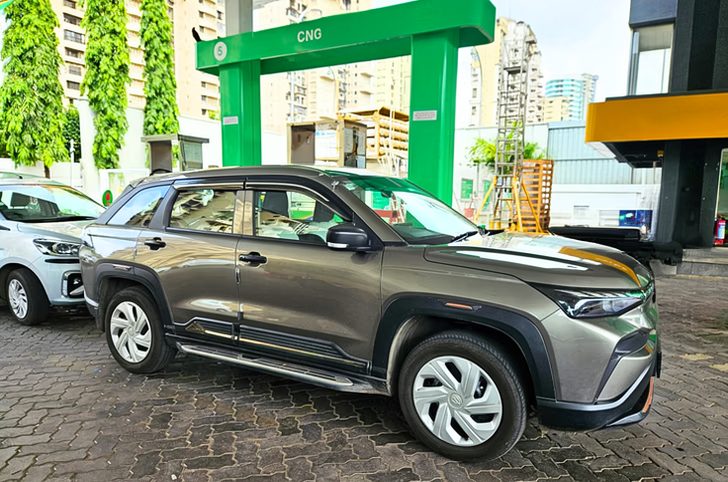
The numbers are in — and they’re surprisingly close to the brochure claims.
But there’s a twist in how the Maruti Victoris CNG behaves in the real world that’s now splitting opinions.
Because while efficiency looks impressive on paper… the way it’s achieved raises fresh questions for everyday buyers.
Table of Contents
ToggleWhat Happened: Victoris CNG Put Through Real-World Stress
Maruti Suzuki offers the Victoris with multiple powertrains — petrol manual/automatic, strong hybrid, AWD automatic, and CNG. Among them, the 1.5-litre petrol-CNG manual has become one of the most talked-about variants.
In controlled real-world testing, the CNG version of the Maruti Victoris delivered:
- 18 km/kg in city conditions
- 26 km/kg on highways
- Claimed figure: 27.02 km/kg
That highway number is what caught attention — it nearly mirrors the official claim, something rarely seen in real-world SUV testing.
But the story doesn’t end there.
The Range Reality: Why Numbers Feel Bigger Than They Look
The Victoris CNG runs a 55-litre tank mounted underbody, which typically holds 7.4 to 8 kg of gas depending on conditions.
Based on test results, that translates into:
Real-world driving range: ~180 km per full CNG fill
On paper, efficiency looks strong. In practice, the usable range is what matters — especially for daily commuters who expect predictable refuelling cycles.
And this is where things start getting interesting.
Must Read: Skoda’s 600km Peaq EV Move in 2026 Raises 3 Big Questions
Why It Matters: The City vs Highway Split Changes Everything
The test conditions revealed a sharp behavioural difference between city and highway driving:
- City average speed: 18 kph → 18 km/kg
- Highway average speed: 55 kph → 26 km/kg
- Test method: controlled loops, AC at 22°C, single occupant, standard tyre pressure
This means the Victoris CNG behaves almost like two different vehicles depending on traffic flow.
Quick snapshot
| Condition | Efficiency |
|---|---|
| City use | 18 km/kg |
| Highway use | 26 km/kg |
| Claimed peak | 27.02 km/kg |
That near-closing gap between tested highway and claimed figures is what makes this SUV stand out in the CNG segment right now.
The Hidden Detail Most Buyers Miss
The testing wasn’t done using a traditional full-tank method.
Instead, evaluators:
- Emptied the tank
- Refilled with 2 kg CNG
- Ran city and highway loops separately until depletion
Why? Because CNG filling is inconsistent due to:
- Ambient temperature
- Pump pressure variation
This method gives a more stable measurement — but also highlights a deeper issue: CNG real-world consistency is not as predictable as petrol or diesel.
Contrarian View: Is This Efficiency Actually “As Good As It Looks”?
Here’s where opinions start to split.
On one side, supporters argue:
- 26 km/kg highway efficiency is genuinely strong
- Running costs remain significantly lower than petrol
- Maruti’s tuning clearly prioritizes economy
But critics point to something more uncomfortable:
The usable driving range is only around 180 km per fill.
And that changes perception completely.
Because while km/kg looks impressive, frequent refuelling may become a real-world inconvenience — especially outside metro areas where CNG stations are not evenly distributed.
So the debate isn’t about efficiency anymore.
It’s about practical ownership experience vs headline numbers.
What Makes the Victoris CNG Stand Out Anyway
Despite the debate, a few things are hard to ignore:
- Strong highway efficiency close to claimed figures
- Predictable city mileage for a midsize SUV
- Lower running costs compared to petrol variant (premium ~₹1 lakh over petrol trims)
- Part of a wide powertrain lineup (including hybrid and AWD automatic)
But that versatility also raises expectations — and scrutiny.
What Happens Next: The Bigger Question for CNG SUVs
The Victoris CNG is not just another variant — it reflects a larger trend in India’s SUV market: fuel diversity vs infrastructure reality.
As buyers shift toward multi-fuel options, one question becomes unavoidable:
Is efficiency still the main metric — or is convenience now the real deciding factor?
Because the answer may decide how future CNG SUVs are designed, sold, and even marketed.
Key Takeaway
The Victoris CNG delivers strong real-world efficiency — especially on highways — but its limited practical range introduces a contradiction between impressive numbers and everyday usability.
And that contradiction is exactly what’s driving the debate.
Disclaimer
This article is based on publicly available test data and reported specifications. No facts, figures, or outcomes have been independently altered or fabricated. Interpretations may evolve as additional real-world data becomes available.