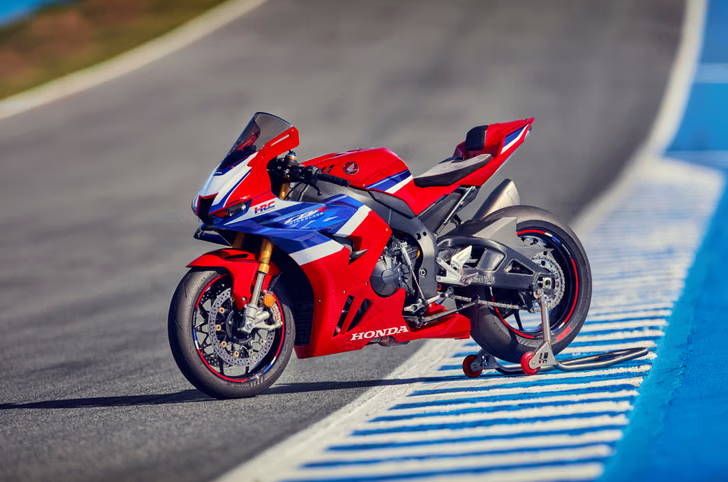
A superbike that briefly disappeared… has returned with a price jump that’s hard to ignore.
The 2026 Honda CBR1000RR-R Fireblade SP is back in India — unchanged mechanically, but suddenly far more expensive.
And that alone is enough to shake up the litre-class conversation.
Table of Contents
ToggleWhat Happened
Honda has officially reintroduced the Honda CBR1000RR-R Fireblade SP in India as part of its updated BigWing lineup.
But here’s the twist:
- It returns unchanged mechanically
- Still powered by a 999cc inline-four engine
- Producing 217.5hp and 113Nm
- Comes only in the range-topping SP trim
- Now priced at Rs 33.50 lakh (ex-showroom)
That’s a Rs 4.51 lakh jump compared to its earlier Rs 28.99 lakh return price — within less than a year.
No engine tweaks. No major redesign. Just a sharper price tag.
And that’s where things start getting interesting.
Why It Matters
The Fireblade SP isn’t just another superbike. It sits at the very top of Honda’s performance pyramid, backed by MotoGP-derived engineering and track-focused intent.
Key hardware still remains extreme:
- Öhlins Smart EC 3.0 electronic suspension
- Brembo Stylema R brakes
- Akrapovič titanium exhaust (standard)
- Six-axis IMU-based electronics suite
But in 2026, price perception matters more than spec sheets.
Because this bike now sits dangerously close to territory where rivals offer newer tech, sharper power delivery, or stronger brand hype.
Must Read: 2026 Hyundai i20 Leak Sparks Shock: SUV Look That No One Saw Coming
Market Impact: The Price War Just Got Tense
The litre-class superbike segment in India is already brutally competitive.
Here’s how the Fireblade SP now stacks up:
- BMW S 1000 RR – ~Rs 23.25 lakh onwards
- Kawasaki Ninja ZX-10R – ~Rs 20.79 lakh
- Ducati Panigale V4 S – ~Rs 39 lakh
Now the Fireblade SP sits awkwardly in between:
- Much more expensive than BMW and Kawasaki
- Still cheaper than Ducati
- But not obviously newer or more powerful than either direction of rivals
That “middle-but-premium” positioning is what makes this launch controversial.
Industry Reaction: Silence, But Signals Are Loud
Honda’s strategy here appears less about aggression and more about repositioning exclusivity.
The Fireblade SP now feels like:
- A track-first halo product
- A low-volume flagship
- A machine aimed at brand prestige rather than volume sales
At the same time, Honda has also been busy updating its BigWing ecosystem, including models like:
- Honda CB750 Hornet
- Honda XL750 Transalp
Both now getting feature upgrades like E-Clutch technology, suggesting Honda is sharpening its premium narrative across segments — not just superbikes.
Hidden Problem: Price vs Perception Gap
Here’s the uncomfortable truth:
The Fireblade SP hasn’t changed mechanically.
So the question becomes: what exactly is the buyer paying for in 2026?
- Same engine
- Same output
- Same electronics package
- Same chassis philosophy
But a significantly higher entry barrier.
In a market where buyers compare every horsepower and every rupee, stagnation can feel like inflation.
And inflation, in enthusiast segments, is rarely welcomed quietly.
Contrarian View: Maybe This Is the Point
Not everyone sees this price hike as a negative.
There’s a counterargument emerging quietly:
- Limited availability increases desirability
- Higher pricing reinforces exclusivity
- Honda may be protecting brand positioning vs mass-market superbikes
- The Fireblade SP is now more “collector-tier” than “volume performance machine”
From this angle, the price jump isn’t a mistake — it’s a filter.
If BMW and Kawasaki are “performance value kings,” Honda may be trying to position the Fireblade SP as something rarer, more intentional, and less compromised by price wars.
But that strategy only works if buyers agree.
What Happens Next
The real test isn’t launch day — it’s demand.
Three outcomes are now possible:
- Steady niche demand from loyal Honda performance buyers
- Shift toward BMW and Kawasaki due to stronger value perception
- Luxury pivot acceptance, where exclusivity justifies pricing
Much will depend on whether Honda keeps updating the Fireblade platform or leaves it largely unchanged again in the next cycle.
Because in today’s superbike market, standing still can feel like moving backward.
Key Takeaway
The 2026 Fireblade SP isn’t trying to win the value war — it’s trying to redefine its place in it.
But whether buyers follow that logic is still an open question.
Final Thought
If performance hasn’t changed but price has, what exactly defines “value” in the litre-class superbike world anymore?
That’s the debate this Fireblade SP quietly reignites.
Disclaimer: This article is based on publicly available information from the reported launch details. No facts, specifications, or outcomes have been altered or fabricated. Interpretation and market analysis may evolve as new information becomes available