Something unexpected just happened in the hatchback world.
Hyundai has unveiled an all-new i20 in Brazil, and it looks nothing like the familiar i20 many buyers know today. Bigger, sharper, packed with technology and loaded with ADAS safety features, the fourth-generation model appears to be targeting customers who want far more than a conventional premium hatchback.
And that immediately raises a question: has the Hyundai i20 quietly evolved into something much bigger than its segment?
A Dramatic Design Shift
The first thing that grabs attention is the styling.
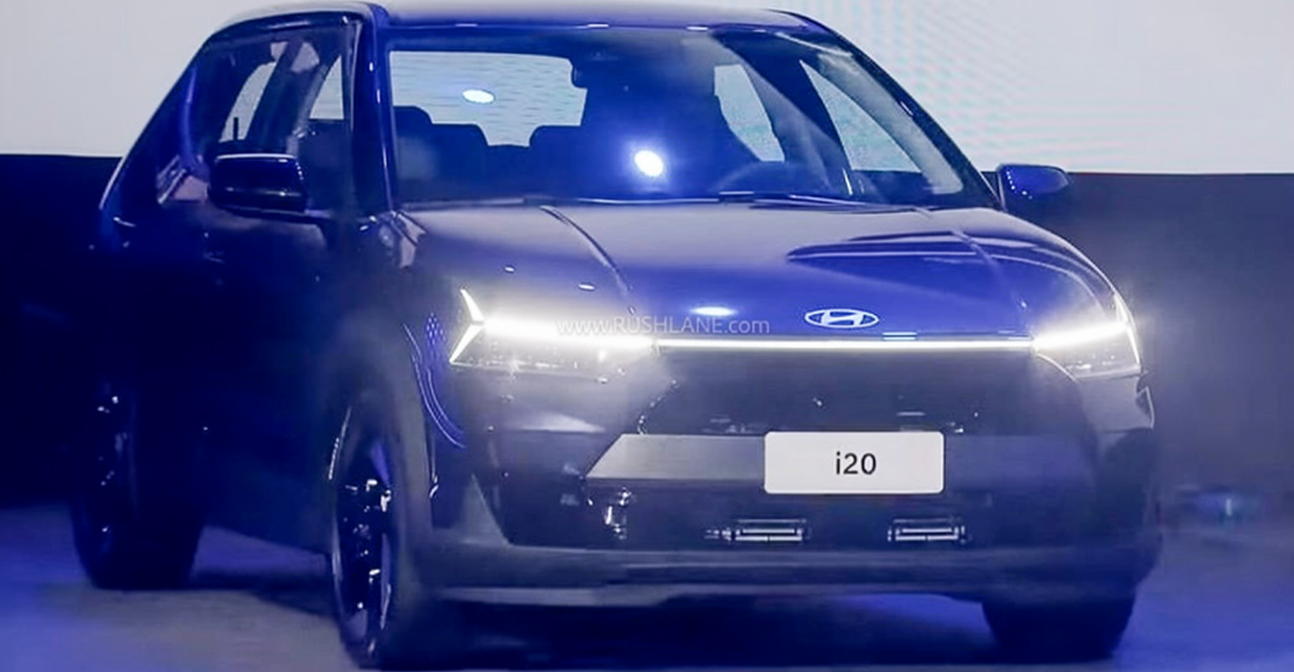
Hyundai has completely reworked the exterior, giving the new i20 a much stronger road presence. The design follows the brand’s latest global language and borrows visual cues seen on newer Hyundai products.
Up front, the standout elements include:
- H-shaped LED daytime running lights
- Full-width light bar
- Rectangular headlamp units
- Redesigned hexagonal grille
- Cleaner-looking bonnet design
The changes continue along the sides.
Circular wheel arches, prominent body cladding and 17-inch diamond-cut alloy wheels give the hatchback a more muscular appearance. Even the window design has changed, with sharper edges replacing the softer curves seen on many traditional hatchbacks.
At the rear, connected tail lamps add to the futuristic look.
For many buyers, the biggest surprise may simply be how substantial the new i20 appears.
Must Read: 2026 Royal Enfield Bullet 650’s Massive Accessory List Is Raising One Big Question
Key Dimensions
| Specification | Measurement |
|---|---|
| Length | 4,130 mm |
| Width | 1,780 mm |
| Wheelbase | 2,580 mm |
| Boot Space | 346 litres |
That 346-litre boot capacity is among the stronger figures in its class and should appeal to family-oriented buyers looking for practicality.
But that’s only part of the story.
The Cabin Takes a Huge Leap Forward
Step inside and the transformation becomes even more obvious.
The dashboard now features dual 12.3-inch displays, combining the infotainment system and digital instrument cluster into a modern cockpit layout.
Hyundai has also introduced a new multimedia system with embedded connectivity powered by a 5G chip.
Perhaps the most notable technology upgrade is support for over-the-air (OTA) updates — a first for a Hyundai model in Brazil.
Other highlights include:
- Hyundai Bluelink connected car technology
- Wireless phone charging
- Front and rear USB charging ports
- Electronic parking brake
- Paddle shifters
- Physical climate-control buttons
- Emergency SOS functionality
In an era where many manufacturers are moving basic controls into touchscreens, the retention of physical air-conditioning controls could be welcomed by many users.
And this is where things become even more interesting.
Hyundai Goes Big on Safety
The new i20 arrives with Hyundai SmartSense, bringing a comprehensive ADAS package to the hatchback.
Safety technologies include:
- Blind Spot Collision Avoidance Assist
- Forward Collision Avoidance Assist
- Lane Keeping Assist
- Lane Following Assist
- Leading Vehicle Departure Alert
- Intelligent Speed Limit Assist
Alongside these systems, Hyundai also offers:
- Six airbags
- Electronic Stability Control
- Vehicle Stability Management
- Hill Start Assist Control
- Tyre Pressure Monitoring System
The growing availability of advanced driver-assistance systems in mainstream vehicles signals how quickly buyer expectations are changing.
A New Platform Could Be the Bigger Story
While the design and technology will attract headlines, Hyundai’s biggest move may actually be underneath the body.
The fourth-generation i20 is based on Hyundai’s new third-generation K3 platform.
According to details shared during the Brazil unveiling, the architecture has been engineered to improve:
- Structural rigidity
- Crash protection
- Ride comfort
- Cabin refinement
- NVH performance
The platform also uses a greater proportion of high-strength steel and has been designed to accommodate future powertrain technologies, including turbocharged and hybrid systems.
That gives the new i20 a degree of future-readiness that could become increasingly important as regulations and customer expectations evolve.
Performance Remains Focused on Efficiency
In Brazil, Hyundai is offering the new i20 with a 1.0-litre TGDI flex-fuel three-cylinder engine.
Performance figures are as follows:
| Specification | Figure |
|---|---|
| Power | 115 hp |
| Torque | 172 Nm |
| Transmission | 6-speed Automatic |
| Top Speed | 184 km/h |
| 0-100 km/h | 11.7 seconds |
The setup prioritizes everyday usability rather than outright performance, aligning with the car’s role as a practical urban and family-focused hatchback.
The Contrarian View: Is Hyundai Making the i20 Too Sophisticated?
Not everyone may view these upgrades positively.
As vehicles gain larger screens, connected technologies, ADAS systems and increasingly complex electronic architecture, costs inevitably rise.
In Brazil, the new i20 starts at BRL 99,990 and stretches to BRL 139,990 for the top-spec Ultimate variant.
For some buyers, the question may be simple: when a hatchback starts approaching the technology and pricing territory of larger vehicles, does it still deliver the value proposition that originally made the segment popular?
It’s a debate that is unlikely to disappear anytime soon.
What Happens Next?
Hyundai says the fourth-generation i20 will sit between the HB20 and Creta in Brazil’s lineup rather than replace the HB20.
That positioning reveals Hyundai’s broader strategy.
Instead of treating hatchbacks as entry-level products, the company appears to be pushing them further upmarket with premium design, advanced safety technology and sophisticated connected features.
Whether buyers embrace that shift at scale remains to be seen.
But one thing is already clear: the 2026 Hyundai i20 is no longer playing by the old hatchback rulebook.
And as more manufacturers move in a similar direction, the real question may not be how much the hatchback segment has changed — but how much further it still has to go.
Editorial Disclaimer: This article is based entirely on publicly available information released regarding the Hyundai i20 launch in Brazil. No facts, figures, outcomes, quotes or timelines have been fabricated. Analysis and market interpretation may evolve as additional information becomes available.