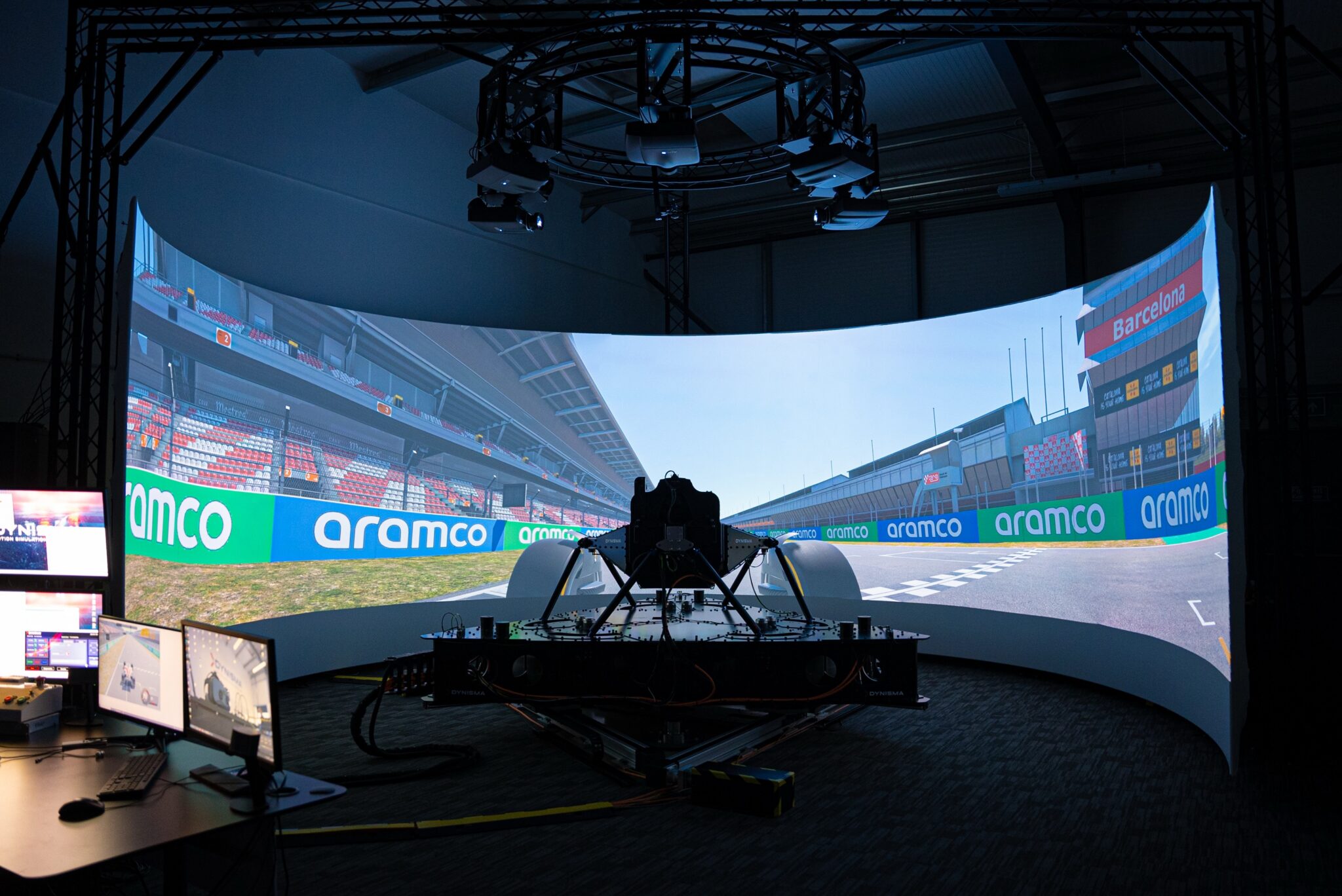
Something unusual is happening behind the scenes in Formula 1.
While fans focus on race weekends, team strategies, and driver battles, some of the sport’s most important work now happens inside simulator rooms that can cost as much as $10 million.
And the reason isn’t flashy graphics.
It’s a tiny measurement most people never think about: milliseconds.
For Formula 1 teams chasing fractions of a second, those milliseconds can make the difference between winning and losing.
Table of Contents
ToggleWhat Makes an F1 Simulator So Expensive?
At first glance, modern consumer racing simulators can look remarkably advanced.
High-end setups now feature motion platforms, ultra-wide displays, force-feedback steering wheels, and realistic cockpit environments.
But Formula 1 teams operate on an entirely different level.
According to Dynisma founder and CTO Ash Warne, the critical factor is latency.
A driver turns the wheel.
The car reacts.
The driver instantly feels that reaction and makes another decision.
That feedback loop happens continuously at extreme speed.
If a simulator introduces even a slight delay, elite drivers can detect it immediately.
Warne says the most advanced Formula 1 simulators operate with latency between 3 and 5 milliseconds from vehicle physics calculations to measurable simulator movement.
That’s roughly an order of magnitude faster than many advanced commercial flight simulators.
Must Read: NASA’s 2026 Deep Space Network Crisis Raises 1 Massive Question
Quick Numbers
| Metric | Formula 1 Simulator |
|---|---|
| Cost | Up to $10 million |
| Latency Target | 3–5 milliseconds |
| Motion Travel | Up to 5 meters (X and Y axes) |
| Rotation Capability | 360 degrees |
But that’s only part of the story.
Why Formula 1 Teams Obsess Over Latency
For professional drivers, realism isn’t a luxury.
It’s essential.
World-class racers develop an instinctive understanding of how a car should behave under braking, cornering, acceleration, and tire load.
Any mismatch between expectation and simulator response can reduce the usefulness of testing.
That’s where companies like Dynisma have carved out a niche.
Warne says he became convinced ultra-low-latency systems were achievable after working at both McLaren and Ferrari.
Interestingly, the first prototype wasn’t built with exotic motorsport hardware.
It relied on surprisingly accessible components.
The original concept used consumer-grade electronics, including an Arduino and Raspberry Pi, to prove the idea before evolving into today’s multimillion-dollar systems.
That detail highlights just how much innovation can begin with a simple experiment.
The Hidden Challenge: Making Tires Feel Real
If latency is one battle, tires are another.
And this is where things become interesting.
Formula 1 simulators don’t actually have tires touching asphalt.
Yet drivers must still feel what tires are doing.
According to Cadillac Formula 1 simulator driver Simon Pagenaud, reproducing tire behavior remains one of the industry’s biggest challenges.
Drivers need to sense:
- Suspension movement
- Tire deformation
- Surface bumps
- Vibrations
- Changes in grip
Without those sensations, crucial setup decisions become harder to evaluate.
That’s why simulator technology increasingly focuses on reproducing subtle vibrations and physical feedback rather than simply creating realistic visuals.
As Pagenaud explained, simulator technology has evolved dramatically since his first experience in 2008.
Visual quality has improved.
Motion systems have improved.
Hardware has improved.
But latency remains one of the most important factors teams continue fighting to reduce.
What Simulator Drivers Actually Do
Many fans imagine simulator driving as a glamorous version of gaming.
The reality sounds much more demanding.
Pagenaud’s job involves helping engineers understand how changes affect tire performance, grip levels, and overall vehicle behavior.
During race weekends, simulator drivers can work alongside engineers remotely, sometimes connected directly into team operations while races are underway.
Their responsibilities include:
- Correlating simulator data with track data
- Testing setup changes
- Evaluating performance adjustments
- Providing subjective driver feedback
- Helping optimize tire management
And the workload can be intense.
Pagenaud says engineers may ask him to evaluate dozens of different setup changes in a single session.
Sometimes that means testing as many as 50 performance items.
Consistency is critical.
Drivers must repeat laps within tight performance margins so engineers receive reliable data.
Crash during a test sequence?
The process often starts again.
The Bigger Issue May Be What Happens Next
Formula 1’s simulator arms race shows no signs of slowing.
Teams are investing heavily in technology that most fans never see.
Ferrari, Alpine, Cadillac, McLaren, and other organizations increasingly rely on virtual development to improve performance before cars ever reach a racetrack.
As regulations become tighter and testing opportunities become more restricted, simulator accuracy becomes even more valuable.
Every improvement in realism potentially translates into better decisions on race weekend.
Contrarian View: Are Simulators Becoming Too Important?
Not everyone sees the trend as entirely positive.
One question quietly hovering over modern motorsport is whether Formula 1 risks becoming increasingly dependent on expensive simulation technology.
As simulator costs climb into the millions, smaller organizations may face greater challenges keeping pace with better-funded competitors.
The technology undoubtedly improves development efficiency.
But it also raises ongoing questions about whether competitive advantages are increasingly being built inside engineering facilities rather than on racetracks.
That debate is unlikely to disappear anytime soon.
What Happens Next?
The pursuit of realism is pushing Formula 1 simulation technology into territory once reserved for aerospace and defense applications.
Teams continue chasing lower latency, better motion systems, more accurate tire modeling, and deeper integration with race operations.
The surprising reality is that some of Formula 1’s most important battles now happen long before drivers arrive at a circuit.
And as simulators become even more sophisticated, one question lingers:
How much of tomorrow’s Formula 1 victories will be won in a virtual cockpit before the lights ever go out on race day?
Editorial Disclaimer: This article is based entirely on publicly available information from the source material. No facts, quotes, statistics, timelines, outcomes, or claims have been fabricated. Analysis and industry interpretation may evolve as new information emerges.