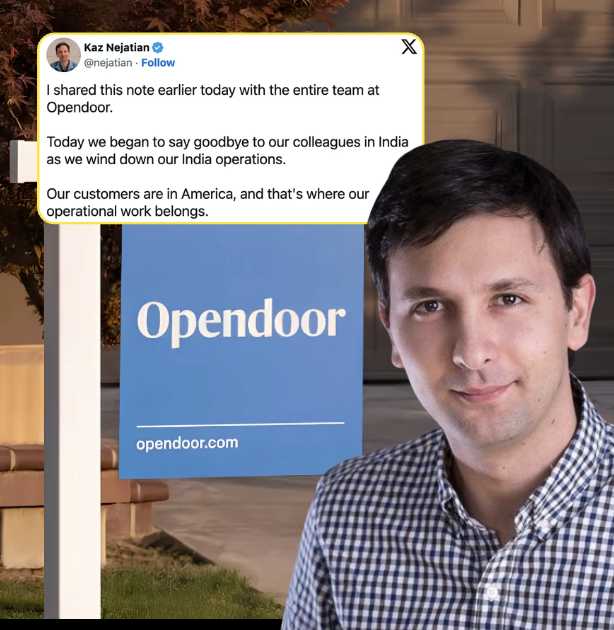
The announcement looked like a routine corporate update.
It quickly became something much bigger.
When U.S. real estate technology company Opendoor revealed it was shutting down its India operations, the reaction spread far beyond the company itself. Suddenly, investors, outsourcing experts, and startup founders were debating a question that has been hanging over the global workforce for months:
Is AI starting to change the economics of outsourcing?
And for India, that question carries enormous weight.
Table of Contents
ToggleWhat Happened?
Opendoor, the San Francisco-based online home-buying platform, is closing its India operations less than two years after expanding into the country.
In a message announcing the move, CEO Kaz Nejatian said the company wants to bring operational work closer to its U.S.-based customers while building smaller AI-native teams.
The company did not disclose how many employees were affected or specify how much AI influenced the decision.
But the wording caught attention almost immediately.
Because India isn’t just another overseas office location.
It’s one of the world’s biggest engines for global business operations.
Must Read: Anthropic’s Massive 2026 India Bet Could Reshape Enterprise AI
India by the Numbers
| Metric | Scale |
|---|---|
| Global Capability Centers | 2,100+ |
| Employees | ~2.36 million |
| Annual Revenue | Nearly $100 billion |
These centers handle everything from IT services and finance to research, engineering, and business operations for multinational companies.
That context is why Opendoor’s move sparked such an intense reaction.
Why This Story Hit a Nerve
Nejatian said Opendoor had built a significant India team to manage manual workflows across fragmented systems.
When the company opened offices in Chennai and Bengaluru in 2024, it employed nearly 250 people in India.
But that’s only part of the story.
Opendoor has been shrinking overall for years.
According to company filings:
- Global workforce fell from 1,470 employees to 1,042
- Non-U.S. workforce dropped from 342 employees to 184
- Cost-cutting efforts have continued amid challenges in the U.S. housing market
In other words, this wasn’t simply an India-specific reduction.
The company has been reducing headcount across its business.
Still, the AI angle became impossible to ignore.
And This Is Where Reactions Started Exploding
Some investors viewed the decision as an early signal of what AI could mean for labor-intensive work.
Sheel Mohnot, co-founder of Better Tomorrow Ventures, argued that as manual work becomes automated by AI, many jobs in India could eventually disappear.
Others saw something even bigger.
Keshav Lohia of Emergent Ventures described the development as a potential “watershed moment” for AI-driven operations.
The underlying concern is straightforward:
For decades, companies moved operational work to lower-cost markets because it was cheaper than hiring domestically.
But if AI dramatically reduces the amount of human labor needed, that entire equation starts changing.
And that could affect far more than one company.
Key Takeaway
The debate is no longer about jobs moving from one country to another.
The debate is whether fewer jobs are needed at all.
That’s a very different conversation.
The Hidden Shift Many Are Watching
Phil Fersht, CEO of HFS Research, believes the bigger story isn’t about India versus the United States.
Instead, he argues companies are redesigning operations around AI, automation, and leaner workflows.
According to Fersht, businesses increasingly want systems that combine:
- AI
- Software
- Human expertise
Without constantly adding new employees.
He describes this model as “Services-as-Software.”
If that approach spreads, organizations may be able to grow output without growing headcount at the same pace.
That possibility is exactly why the Opendoor announcement resonated so widely.
Contrarian View: Is Everyone Overreacting?
Not everyone believes Opendoor proves a massive AI-driven workforce shift is already underway.
And there are good reasons for caution.
Opendoor is not a company operating from a position of strength.
The online home-buying market has faced significant pressure from housing market challenges in the United States.
The company has been reducing staff broadly, not just in India.
That makes it difficult to isolate AI as the primary driver behind the decision.
In other words:
Opendoor may be an important signal. But it is not definitive proof that AI is suddenly replacing offshore work at scale.
The company could simply be another example of a business restructuring during a difficult period.
That’s an important distinction.
What Happens Next?
Even if Opendoor turns out to be a unique case, the conversation it triggered is unlikely to fade.
Investors are already asking whether AI could eventually reduce demand for labor-intensive services.
Industry analysts are watching whether more companies begin building smaller AI-native teams.
And India’s massive outsourcing ecosystem is now part of a debate that barely existed a few years ago.
For now, there is no evidence that Opendoor’s decision alone signals a broad collapse in offshore employment.
But it has exposed a growing uncertainty.
If AI continues improving rapidly, will companies keep expanding global workforces as they did in the past—or will they discover they simply need fewer people?
That may be the question executives, investors, and millions of workers will be watching most closely through the rest of 2026.
Editorial Disclaimer: This article is based entirely on publicly available information reported by TechCrunch and statements attributed to named individuals in the source material. No facts, statistics, quotes, outcomes, or timelines have been fabricated. Analysis reflects current publicly known information and may evolve as new details emerge.