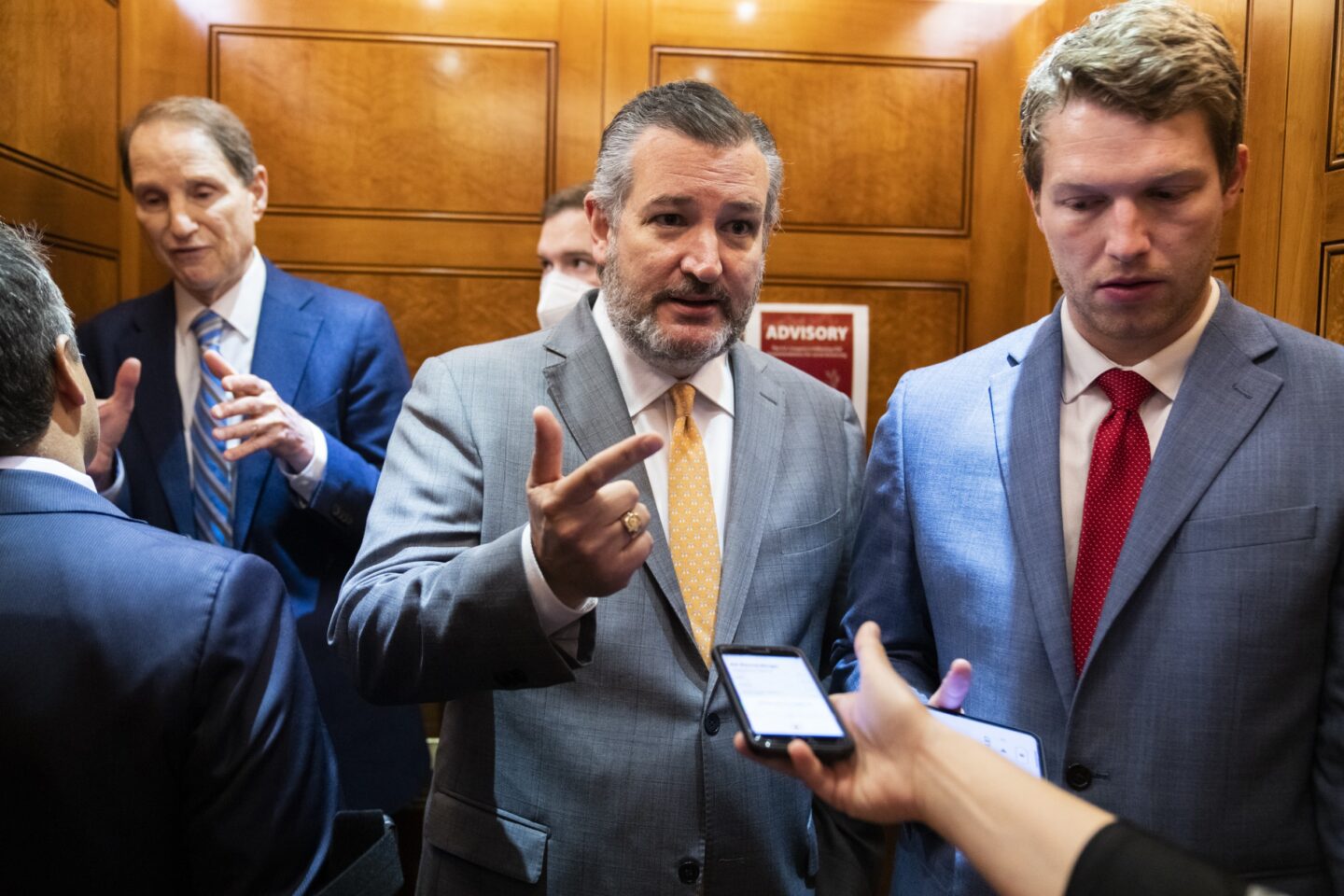
A rare alliance between Republican Senator Ted Cruz and Democratic Senator Ron Wyden is putting one of Washington’s most explosive debates back in the spotlight: government pressure on speech.
And this time, the proposed response could hit federal officials where it hurts most.
The newly introduced JAWBONE Act would give Americans the ability to sue government officials and agencies for allegedly pressuring broadcasters, social media platforms, or AI companies to suppress protected speech.
Supporters call it a major First Amendment safeguard.
Critics and legal observers will almost certainly scrutinize how broadly it could apply.
Either way, the proposal is already drawing attention because it targets a question that has fueled years of political battles:
When does government communication become government coercion?
What Happened
Cruz and Wyden unveiled the Justice Against Weaponized Bureaucratic Overreach to Networked Expression Act, better known as the JAWBONE Act.
The bipartisan legislation would prohibit federal agencies and employees from coercing—or attempting to coerce—broadcasters, online platforms, and AI service providers into changing, removing, or restricting content.
The proposal arrives after years of disputes involving government interactions with technology companies, broadcasters, and media organizations.
According to the senators, the goal is straightforward:
“Jawboning occurs when the government pressures private companies to censor speech protected by the First Amendment.”
But that’s only part of the story.
The bill does more than prohibit the behavior.
It creates new legal consequences.
The Provision Getting the Most Attention
Current legal standards can make censorship-related lawsuits difficult because plaintiffs often need to prove that government pressure successfully caused content to be removed or altered.
The JAWBONE Act seeks to change that.
Under the proposal:
- Individuals could sue over alleged government jawboning
- Victims could seek compensatory damages
- State attorneys general could bring civil enforcement actions
- Lawsuits could proceed even if the alleged pressure campaign failed to change content
Supporters argue this would create accountability that existing remedies do not provide.
The legislation would allow financial damages but not punitive damages.
That distinction matters because it limits potential payouts while still creating financial liability.
Must Read: 2026’s Massive Battery Battle: Why Tesla Suddenly Has Everyone Chasing Its Most Profitable Business
Why This Debate Has Become So Heated
The bill deliberately avoids framing the issue as belonging to one political party.
Cruz focused on allegations involving the Biden administration and government pressure on technology companies.
Wyden pointed in a different direction.
He highlighted what he described as President Donald Trump’s threats toward cable companies over programming and late-night television content.
That bipartisan criticism is one reason the proposal stands out.
Instead of targeting a single administration, supporters argue the bill addresses a recurring problem that can emerge regardless of who controls Washington.
Key Takeaway
| Issue | What JAWBONE Act Would Do |
|---|---|
| Government pressure on platforms | Prohibit coercion attempts |
| Lawsuits | Allow private legal action |
| Damages | Permit compensatory damages |
| Transparency | Require reporting of certain communications |
| Enforcement | Individuals and state attorneys general |
The Hidden Detail That Could Matter Most
One of the less-discussed sections may prove to be one of the most significant.
The bill would require certain communications between government agencies and broadcasters, social media companies, and AI firms to be submitted to a public portal.
Congress would receive full access.
Public summaries would also be available.
Supporters argue this addresses a major challenge in censorship-related disputes:
Many conversations happen behind closed doors.
According to the bill summary, people may not even know government officials communicated with companies about their speech.
If enacted, the reporting requirement could make those interactions far more visible.
And that is where things become interesting.
Because transparency itself could become a powerful deterrent.
Broad Support From Opposite Ends of the Spectrum
Few issues bring together organizations that often disagree.
Yet the JAWBONE Act has attracted support from groups across the ideological spectrum.
Among those backing the proposal:
- American Civil Liberties Union (ACLU)
- Americans for Tax Reform
- Foundation for Individual Rights and Expression (FIRE)
- Knight First Amendment Institute
- Public Knowledge
While each organization emphasized different concerns, they shared a common argument: government officials should not use public authority to pressure private entities into suppressing protected speech.
The Contrarian View
Not everyone views anti-jawboning proposals through the same lens.
Supporters see the bill as a necessary shield against government overreach.
A competing concern often raised in broader free-speech debates is whether officials could become reluctant to communicate with platforms about legitimate issues involving public safety, law enforcement, election integrity, or other legal matters.
The legislation attempts to address this by including exceptions for lawful investigations, warrants, and enforcement of federal or state laws.
Whether those safeguards strike the right balance could become one of the central questions if the bill advances.
What Happens Next?
The JAWBONE Act enters Congress at a moment when disputes over speech, content moderation, artificial intelligence, and government influence remain deeply contentious.
Supporters argue it creates long-overdue accountability.
Opponents and skeptics will likely examine how courts interpret key terms such as coercion and whether the proposal could produce unintended consequences.
One thing is already clear:
A bipartisan coalition is trying to redraw the line between government persuasion and government pressure.
And if that line shifts, the legal relationship between Washington, Big Tech, broadcasters, and AI companies could look very different in the years ahead.
The biggest unanswered question may be the simplest one:
How much government influence over private speech platforms is too much?
Editorial Disclaimer: This article is based entirely on publicly available information from the cited source material. No facts, quotes, outcomes, statistics, or events have been added or fabricated. Interpretations are limited to information contained in the source, and analysis may evolve as new information emerges.