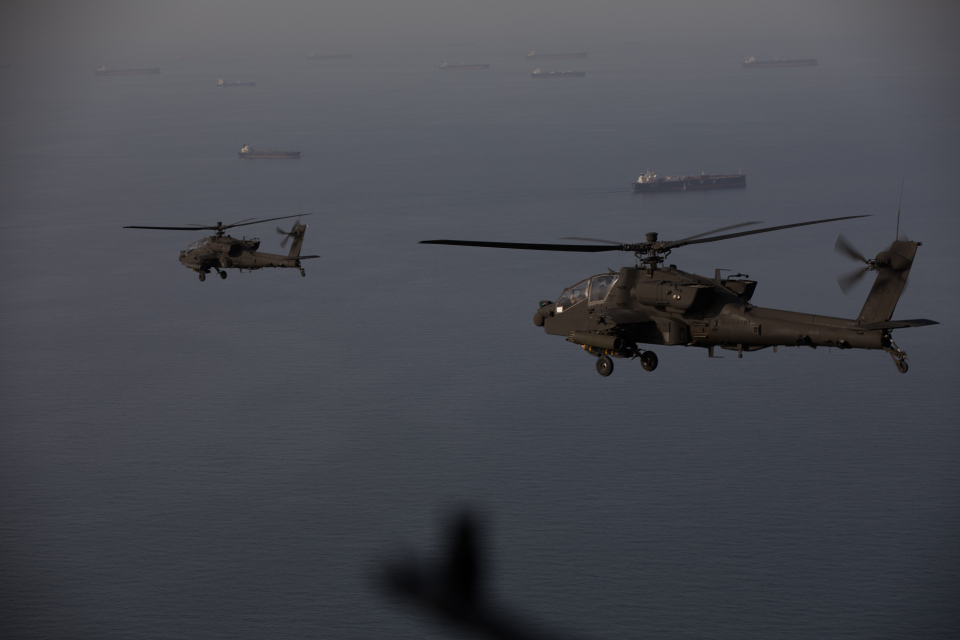
A low-cost Iranian drone may have just changed the rules of modern warfare.
A US Army attack helicopter worth tens of millions of dollars is down. And the suspected cause? A drone that costs less than a luxury car.
But what really happened over the Strait of Hormuz is still far from clear.
And that uncertainty is exactly what’s making this story explode across military circles.
Table of Contents
ToggleWhat Happened
A US Army AH-64 Apache went down near the Strait of Hormuz after being struck by an Iranian Shahed drone, according to unnamed US officials cited in multiple reports.
The drone is believed to be part of Iran’s widely deployed one-way attack fleet.
The incident occurred on June 8, 2026.
What’s still unclear:
- Was the strike intentional?
- Or was it a rare, almost accidental midair hit?
Officials say investigators are still trying to determine the exact chain of events.
The helicopter’s crew was successfully rescued after going into the water.
Must Read: 1 Court Ruling in 2026 Sparks Shock Over Google AI Search Liability
The Cost Shock No One Can Ignore
Here’s what makes this incident go viral inside defense circles:
| System | Estimated Cost |
|---|---|
| Iranian Shahed drone | ~$35,000 |
| US AH-64 Apache | ~$25,000,000 |
A single low-cost drone potentially bringing down a multimillion-dollar aircraft.
That imbalance is now dominating military discussions worldwide.
And it’s not an isolated trend.
Iran has reportedly used Shahed drones across the region since February 28, 2026, targeting both stationary and moving assets.
Why It Matters
This isn’t just about one helicopter.
It’s about whether cheap autonomous drones are rewriting air combat faster than traditional militaries can adapt.
US Central Command confirmed that “self-defense strikes” were launched on June 9 in response.
Targets reportedly included:
- Air defense systems
- Radar sites
- Ground control stations near the Strait of Hormuz
The Strait itself remains one of the world’s most sensitive shipping corridors—meaning every escalation has global ripple effects.
Industry Reaction: A System Under Pressure
Defense analysts say the bigger issue isn’t just the strike—it’s the uncertainty around it.
Some experts argue Shahed drones were never designed for moving aerial targets.
Mark Cancian of the Center for Strategic and International Studies suggested the drones typically rely on pre-programmed GPS guidance aimed at fixed locations.
But there’s a twist.
There are claims Iran may now be using modified versions capable of limited remote control—potentially improving targeting against moving systems.
That possibility changes everything.
Because it means:
- Low-cost drones may no longer be “dumb” weapons
- Air defense systems may face unpredictable threats
- Even fast-moving aircraft might not be safe
Key Takeaway
A $35,000 drone may have disrupted a $25 million war machine—but nobody yet knows if it was skill, luck, or something in between.
Hidden Problem: The Fog of Modern Drone War
This incident highlights a growing military blind spot: attribution.
When a drone strike happens in a crowded conflict zone like the Strait of Hormuz, even advanced militaries struggle to answer basic questions:
- Was it targeted?
- Was it accidental?
- Was it even fully autonomous?
That uncertainty itself becomes a strategic weapon.
And it’s already reshaping decision-making inside command centers.
The Wider Escalation Picture
This event didn’t happen in isolation.
Since early 2026, tensions have been rising after coordinated US-Israel strikes on Iran triggered a chain reaction of retaliation.
Iran has reportedly:
- Shot down US MQ-9 Reaper drones
- Claimed attacks on US bases in Bahrain and Kuwait
- Launched missile and drone salvos across Gulf states
The US, in turn, has carried out repeated strikes on Iranian air defense infrastructure.
Even the idea of a ceasefire—once referenced around April 8—now looks increasingly unstable.
Contrarian View: Was This Even a “Drone Kill”?
Not everyone agrees this was a clean drone victory.
Some defense voices argue:
- The strike could have been accidental debris impact
- Environmental factors may have contributed
- Or the helicopter may have already been compromised before the drone contact
In other words, the “cheap drone downed Apache” narrative might be too clean for a messy battlefield reality.
And that uncertainty matters.
Because militaries build strategy on patterns—not anomalies.
What Happens Next
US forces have already responded with targeted strikes, but the bigger shift is still unfolding quietly:
- Air defense doctrines may need rewriting
- Drone interception systems are under renewed scrutiny
- And cost imbalance in warfare is becoming harder to ignore
Meanwhile, investigators are still trying to answer the simplest question of all:
Was this a lucky hit—or the first glimpse of a new era in drone warfare?
Disclaimer: This article is based on publicly available reporting and statements from official and media sources. No facts or outcomes have been fabricated. Interpretations reflect current analysis and may evolve as new information emerges.