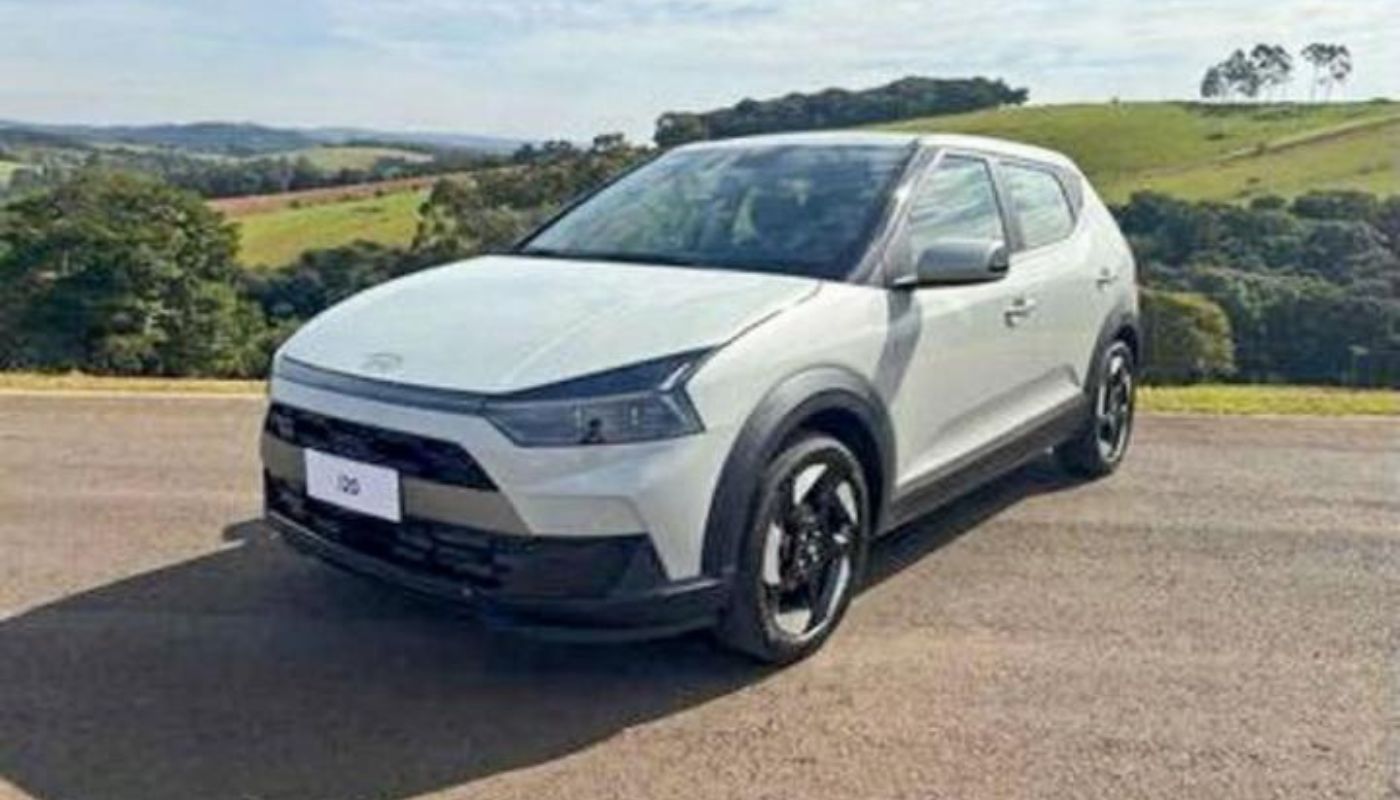
The next-generation Hyundai i20 has just surfaced online—and it doesn’t just look updated.
It looks like Hyundai quietly decided to change the car’s entire identity.
From hatchback to something far more SUV-like… this leaked design is already dividing opinions.
And the timing couldn’t be more intense for the premium hatchback segment in India.
Table of Contents
ToggleWhat Just Leaked — and Why It Feels Like a Reset
Images reportedly sourced from early previews and shared via automotive channels like Koreancarblog show a completely reworked Hyundai i20, expected to debut globally next month, with India following later.
But what stands out isn’t just a facelift.
It’s the philosophy shift.
The new i20 appears to move aggressively toward crossover styling, with chunkier proportions, black cladding, and a much taller visual stance.
Key design changes include:
- Slim headlamps linked by a full-width black trim
- Y-shaped LED lighting signatures inside the clusters
- More upright, SUV-like nose
- Heavy black cladding around wheel arches and doors
- Connected rear lighting with triangular tail lamps
- A bold rear black panel with silver bumper inserts
It’s still technically a hatchback—but visually, it’s trying very hard not to look like one.
And that’s where the debate begins.
Must Read: 12 Hero Two-Wheelers in 2026 Spark Massive EV Shift in India
Inside the Cabin: The Real Shock Isn’t Outside
If the exterior is controversial, the interior is where Hyundai clearly went all-in.
The leaked cabin shows a major technology leap that could reshape expectations in this segment.
At the center is a large curved display unit, merging:
- Digital instrument cluster
- Infotainment touchscreen
Below it sits a simplified layout with physical shortcut buttons still intact—a rare move in an era of full-touch dashboards.
Other highlights:
- Hyundai’s new-generation steering wheel design
- Vertical air-conditioning vents
- Rotary climate control dial
- Dual-tone black and beige interior theme
- Cleaner, minimalist center console layout
It feels less like a hatchback cabin and more like a compact SUV trying to punch above its weight.
Why It Matters for India’s Hatchback Market
The premium hatchback segment has been slowly shrinking under SUV pressure. And this design shift looks like Hyundai’s direct response.
The strategy seems clear:
Don’t fight SUVs—start looking like one.
Expected India-spec powertrains reportedly remain familiar:
- 1.2L naturally aspirated petrol (~83 hp, 114 Nm)
- 1.0L turbo petrol (~120 hp, 172 Nm)
- Manual and automatic gearbox options continue
So mechanically, evolution is mild.
Visually and digitally, it’s a leap.
Market Impact: A Hatchback Trying to Escape Its Category
This is where the story becomes bigger than just one car.
If Hyundai succeeds, the i20 could blur the line between:
- premium hatchbacks
- compact crossovers
- entry-level SUVs
That has serious implications for competitors like Maruti Suzuki Baleno and Tata Altroz, which still lean heavily into traditional hatchback design language.
Quick comparison snapshot:
| Element | Current i20 | New i20 (Leaked) |
|---|---|---|
| Design | Clean hatchback | Crossover-inspired |
| Lighting | Split LED | Connected Y-signature |
| Cabin | Dual-screen separate | Curved integrated display |
| Stance | Low | Taller, SUV-like |
The message is obvious: evolution is no longer subtle.
Industry Reaction: Excitement… and Confusion
Early reactions across automotive communities are split.
Some see it as a necessary evolution in a market obsessed with SUVs.
Others argue Hyundai is slowly erasing the identity of its hatchback lineup.
One sentiment keeps repeating:
“Is it still an i20—or just an SUV in disguise?”
That question might define how this launch is received in India.
Contrarian View: Is Hyundai Losing the Hatchback Soul?
Not everyone is convinced this direction is smart.
Critics argue that Hyundai risks diluting what made the i20 successful in the first place—its clean proportions, balanced driving character, and distinct hatchback identity.
By pushing SUV styling cues:
- It may overlap too much with compact SUVs
- It could alienate traditional hatchback buyers
- It risks becoming “neither here nor there” in positioning
But supporters counter that the market has already moved on.
In their view, staying traditional might be the bigger risk.
What Happens Next
The global reveal is expected soon, followed by India-specific details later, where minor design and feature tweaks are likely.
Depending on reception, Hyundai may have one of two outcomes:
- A category-defining redesign that reshapes hatchbacks
- Or a controversial styling experiment that splits opinion permanently
Either way, the i20 is no longer just evolving quietly in the background. It’s now part of a much bigger industry identity battle.
And the real question is no longer about features or engines.
It’s this:
Do buyers still want a hatchback… or have they already moved on without realizing it?
Editorial Disclaimer
This article is based on publicly available information, leaked images, and reported automotive industry details. No facts, outcomes, or timelines have been fabricated. Interpretations and analysis may evolve as official announcements are made.