India’s premium motorcycle scene just got a jolt.
Two of Honda’s most talked-about 755cc machines have returned — but with a twist riders didn’t fully see coming.
The catch? They’re now more expensive… by over ₹1 lakh each.
And the new “no-clutch-needed” E-Clutch tech is at the center of it all.
Table of Contents
ToggleWhat Happened
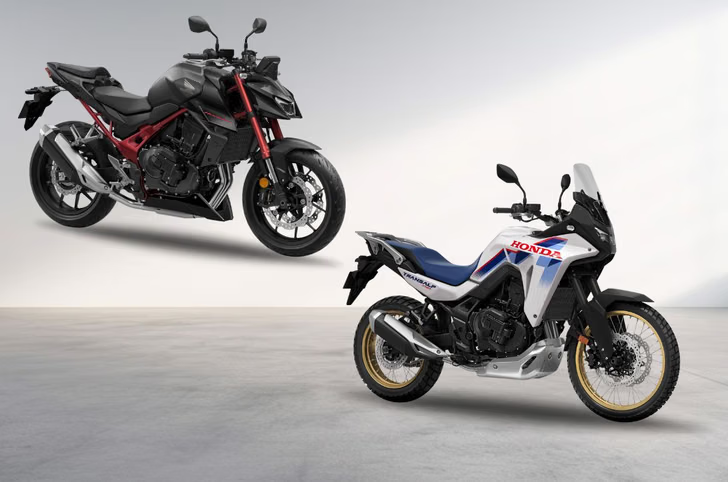
Honda Motor Company has officially expanded its BigWing lineup in India with E-Clutch versions of two heavy hitters:
- Honda CB750 Hornet
- Honda XL750 Transalp
Both bikes remain mechanically unchanged from their outgoing versions.
But they now get Honda’s E-Clutch system — a feature that lets riders shift gears and even come to a stop without touching the clutch lever at all.
That sounds futuristic. Almost too easy.
But there’s a trade-off.
The Price Shock (Ex-showroom, Gurugram)
- CB750 Hornet: ₹10.49 lakh (earlier ₹9.22 lakh)
- XL750 Transalp: ₹13.20 lakh (earlier ₹11.81 lakh)
That’s a jump of more than ₹1 lakh on both models — instantly reshaping how these bikes sit in India’s premium segment.
Why It Matters
This isn’t just a feature update.
It’s a positioning shift.
Honda is clearly betting that convenience tech can justify premium pricing — even in a market where buyers are extremely spec-sensitive.
And E-Clutch isn’t small tech either:
- No clutch lever use during shifting
- Can stop in gear without stalling
- Adds around 3 kg to kerb weight
That’s the entire “upgrade story” in one line:
Less effort, more automation, higher cost.
But the bigger question is already circulating among enthusiasts:
“Is removing the clutch lever worth a ₹1 lakh+ hike?”
Must Read: Rs 33.50 Lakh Fireblade SP Shock in 2026 Price Hike Raises Big Questions
Market Impact
The Indian 750cc segment is already crowded with aggressive pricing and performance-heavy rivals.
Honda’s move creates a split personality in the lineup:
| Model | Old Price | New Price | Key Change |
|---|---|---|---|
| CB750 Hornet | ₹9.22L | ₹10.49L | E-Clutch added |
| XL750 Transalp | ₹11.81L | ₹13.20L | E-Clutch + new colours |
And visually? Very little changes.
- Hornet: now only in black with red frame and fork accents
- Transalp: new white and grey colour options
So the “newness” is mostly under the skin — and on the invoice.
That’s where things start getting controversial.
Industry Reaction
Dealers have already opened bookings across Honda BigWing outlets nationwide.
But early sentiment is mixed.
Some see it as a natural step toward semi-automated riding — especially for long-distance touring and city traffic.
Others are less convinced.
Because for many riders, motorcycles aren’t about convenience. They’re about control.
And removing the clutch lever — even optionally — feels like a philosophical shift.
Hidden Problem
There’s a subtle tension here that Honda hasn’t addressed directly:
The bikes are unchanged mechanically… yet significantly more expensive.
That raises an uncomfortable question for buyers:
Are you paying for performance? Or just for convenience tech?
And unlike horsepower upgrades or chassis improvements, E-Clutch is invisible in motion — until you actually ride it.
That makes perceived value harder to justify in showrooms.
Contrarian View
Not everyone sees this as a price hike problem.
A growing group of riders argues the opposite:
- Clutch fatigue in city traffic is real
- Stall-free riding is underrated for beginners
- Touring comfort improves significantly with fewer inputs
From this perspective, the E-Clutch isn’t a gimmick — it’s an evolution.
And in a few years, manual clutch operation in mid-to-large bikes might feel outdated, much like kick-start systems did.
But right now? India is still deciding which side of that future it wants to be on.
What Happens Next
Honda has hinted at a broader rollout strategy.
The E-Clutch system has already been seen across multiple global platforms, including earlier 471cc and 755cc twins, and India may not be the last stop for this transition.
If demand holds, expect:
- E-Clutch becoming default on stock units once old inventory clears
- More Honda models adopting the system
- Pricing pressure across rival brands in the segment
But the real test isn’t technical.
It’s emotional.
Will riders embrace convenience… or reject the idea that motorcycles should ever feel “automatic”?
Final Takeaway
Honda hasn’t changed the Hornet or Transalp in the way most upgrades usually work.
Instead, it changed how you interact with them — and charged more for it.
Whether that feels like innovation or inflation depends entirely on who’s holding the throttle.
And the industry will be watching closely to see which way India leans next.
Disclaimer: This article is based on publicly available information. No facts, specifications, or outcomes have been fabricated. Interpretations and analysis may evolve as new details emerge.