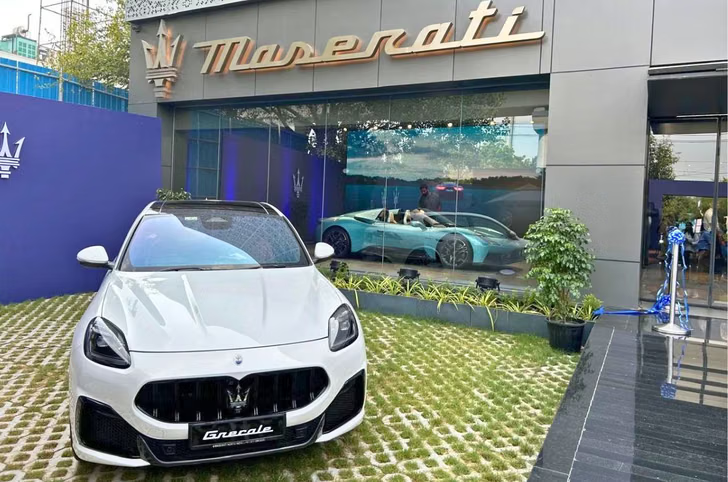
Mumbai’s ultra-luxury car scene is about to quietly undergo a shake-up that most buyers won’t notice at first—but dealers definitely will.
A major luxury distributor change is unfolding for Maserati in Western India, and it’s not just a routine dealership shuffle.
Behind the glossy showroom image of Italian performance cars sits a strategic realignment that could reshape how Maserati reaches India’s wealthiest buyers.
Table of Contents
ToggleWhat Happened
Luxury car dealer Navnit Motors is set to begin selling Maserati cars in Mumbai.
Sources indicate Navnit Motors will take over Maserati’s Western India dealership operations from the Petal Group.
That means one of India’s most established luxury dealer networks is stepping into one of the most exclusive European car brands—right in the heart of Mumbai.
At the same time, Maserati’s India operations remain split across regions:
- North India: handled by AMP Supercars Pvt. Ltd
- South India: handled by VST Group
- West India (Mumbai focus): shifting to Navnit Motors
And yes, the brand lineup stays unchanged—for now.
Maserati currently sells:
- Grecale (ICE and EV)
- GranTurismo (ICE and EV)
- GranCabrio (ICE and EV)
- MCPura combustion supercar
Prices still sit in the ₹1.31 crore to ₹5.12 crore range.
But the real story isn’t the cars—it’s the power shift behind them.
Must Read: 2026 Honda Gold Wing Price Shock: ₹44.30 Lakh Move Raises Big Questions
Why It Matters
This isn’t just a dealership change. It’s a rebalancing of India’s luxury car access points.
Navnit Motors already controls a powerful portfolio including:
- Ferrari
- BMW
- Mini
- Jaguar Land Rover
And mass-market giants like:
- Hyundai
- Kia
- Honda
- Maruti Suzuki
That combination matters.
Because Maserati is no longer entering a “new market”—it is entering an already tightly controlled luxury ecosystem run by one of Mumbai’s most connected dealer groups.
A key detail often missed: the outgoing Maserati dealership under Petal Group was located at the Taj Santacruz Hotel setup in Mumbai, a highly premium, boutique-style retail experience.
That raises a subtle question:
Will Maserati become more accessible—or more corporate?
Market Impact
Dealership control in luxury cars isn’t just logistics. It directly influences:
- Customer experience
- Test drive access
- Brand positioning
- Delivery timelines
- Even perceived exclusivity
Here’s what could shift in Mumbai’s luxury ecosystem:
Possible immediate changes
- New showroom location (yet to be revealed)
- Redistribution of high-net-worth customer base
- Stronger cross-selling with Ferrari, BMW, JLR buyers
- Potential consolidation of luxury buyers under fewer dealer umbrellas
And there’s another layer quietly building in the background:
The India–EU free trade agreement (FTA) could reduce import duties in phases, potentially lowering Maserati prices in India over time.
That combination—dealer shift + possible price adjustment—creates an unusual moment of uncertainty in a brand that thrives on exclusivity.
Industry Reaction
Within the luxury auto retail space, this move is being viewed less as expansion and more as consolidation.
Navnit Motors is already deeply embedded in Mumbai and Thane’s premium car buying ecosystem. Adding Maserati simply strengthens its “high-net-worth funnel”—where customers often move between Ferrari, BMW, JLR, and now Maserati within the same dealer network.
But not everyone sees this as purely positive.
Some observers point out that when too many premium brands sit under one dealership umbrella, differentiation can blur—especially for aspirational buyers who want distinct brand experiences.
Contrarian View
Here’s the uncomfortable argument being quietly discussed:
Instead of strengthening Maserati’s exclusivity in Mumbai, this move could dilute it.
Why?
Because Maserati is joining a dealership group that already handles multiple competing luxury brands.
Critics argue:
- Brand storytelling may get less distinct
- Customer experience could become standardized
- Maserati risks becoming “another luxury option” rather than a rare Italian standout
In other words, consolidation may improve efficiency—but reduce emotional exclusivity.
And for a brand like Maserati, emotion is the product.
What Happens Next
The biggest unknown now is location.
The previous Maserati showroom at Taj Santacruz Hotel set a very specific tone—luxury hospitality blended with automotive retail.
Navnit Motors has not yet revealed where the new Mumbai dealership will be placed.
What to watch next:
- Official showroom announcement
- Customer transition from Petal Group to Navnit Motors
- Pricing response if EU trade reforms progress
- Possible repositioning of Maserati’s India retail strategy
One thing is clear: this isn’t just a dealership swap—it’s a restructuring of how Maserati wants to be experienced in India’s most competitive luxury car market.
Final Thought
Mumbai’s luxury car scene rarely changes visibly—but when it does, it signals something deeper about where money, branding, and exclusivity are heading.
The question now isn’t just who sells Maserati in Mumbai.
It’s whether the brand becomes more exclusive—or simply more efficiently distributed.
And that answer is still unfolding.
Disclaimer: This article is based on publicly available information. No facts, outcomes, or figures have been fabricated. Interpretations and analysis may evolve as new details emerge.