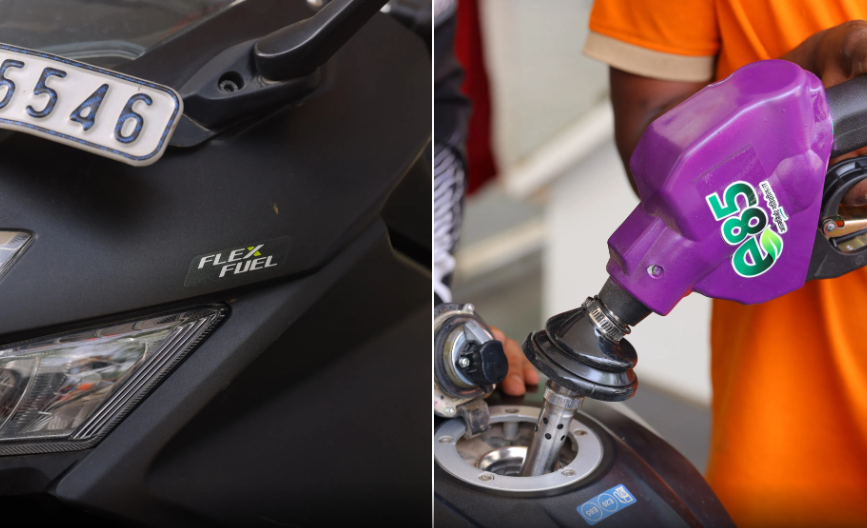
A cheaper fuel. A government-backed push. A motorcycle designed specifically to run on it.
So why did the numbers tell a completely different story?
A real-world mileage test on the Suzuki Gixxer SF 250 Flex Fuel has revealed an unexpected outcome that could leave many potential buyers questioning whether E85 fuel actually makes financial sense in 2026.
And the gap is bigger than many expected.
The Big Test That Everyone Was Waiting For
India recently introduced E85 fuel — a blend containing 85 percent ethanol and 15 percent petrol — at a significantly lower price than standard E20 fuel.
In Delhi, E85 currently costs Rs 82.12 per litre.
E20 costs Rs 102.12 per litre.
At first glance, the math appears simple.
Cheaper fuel should mean lower running costs.
But that’s where the story takes an interesting turn.
To find out what really happens in everyday riding conditions, a Suzuki Gixxer SF 250 FFV (Flex Fuel Vehicle) was put through a controlled real-world mileage test using both fuels.
The goal was straightforward:
Does E85 actually save money?
The answer wasn’t what many expected.
Must Read: 2026 Kia Carens Clavis Flex Fuel Test Mule Sparks Massive Questions About Kia’s Next Move
How The Test Was Conducted
To ensure fairness, the motorcycle’s fuel tank was completely drained before each test run.
The bike was then:
- Filled brim-to-brim
- Run on the same 80km route
- Tested under similar traffic conditions
- Ridden at roughly the same average speed
- Checked using the same fuel dispensers
The route combined:
- Open roads
- Faster-moving traffic
- Congested city sections
Average speed remained around 29kph throughout both runs.
In short, this was designed to replicate the kind of riding many urban commuters experience every day.
The Mileage Numbers Changed Everything
After completing the E85 run, the Suzuki required 2.79 litres to refill the tank.
That translated to:
28.81kpl
Then came the E20 test.
The same route.
The same rider.
The same conditions.
This time, the motorcycle consumed only 1.93 litres.
The result?
38.1kpl
Quick Comparison
| Metric | E85 | E20 |
|---|---|---|
| Mileage | 28.81kpl | 38.1kpl |
| Average Speed | 29kph | 29kph |
| Cost Per Km | Rs 2.85 | Rs 2.68 |
| Cost Per 10,000km | Rs 28,514 | Rs 26,803 |
The difference in fuel efficiency worked out to a substantial 24.4 percent.
And that’s where the economics started falling apart.
Why Is E85 Less Efficient?
The answer lies in basic energy density.
Ethanol contains less energy per litre than petrol.
Approximate energy content:
- Pure petrol: 32MJ/l
- E20: around 30.5MJ/l
- E85: around 23.5–24MJ/l
That means the engine must burn more fuel to produce similar performance.
The lower price at the pump helps offset this disadvantage.
But according to this test, it doesn’t offset enough.
And that creates a problem for consumers.
The Hidden Cost Nobody Talks About
Many buyers focus only on fuel prices.
But ownership costs tell a different story.
Based on the test:
- E20 running cost: Rs 2.68/km
- E85 running cost: Rs 2.85/km
Over 10,000km:
- E20 fuel cost: Rs 26,803
- E85 fuel cost: Rs 28,514
That’s an additional Rs 1,711 spent using E85.
Not saved.
Spent.
For a fuel specifically promoted as a cheaper alternative, that finding is likely to surprise many riders.
But That’s Only Part Of The Story
The motorcycle itself also costs more.
The Suzuki Gixxer SF 250 FFV is priced at Rs 1.98 lakh (ex-showroom Delhi).
The standard E20-compatible Gixxer SF 250 costs Rs 1.89 lakh.
That’s nearly a 5 percent premium before the bike even leaves the showroom floor.
In other words:
Owners pay more upfront.
And based on this test, they currently spend more on fuel too.
That raises an uncomfortable question.
Where exactly is the financial benefit today?
Contrarian View: Maybe Saving Money Was Never The Main Goal
Not everyone believes flex fuel vehicles should be judged purely on fuel bills.
Supporters argue that E85 is part of a much larger national strategy.
The objective includes:
- Reducing dependence on imported crude oil
- Supporting domestic ethanol production
- Strengthening India’s energy security
- Expanding alternative fuel ecosystems
From that perspective, slightly higher running costs may be viewed as a trade-off rather than a failure.
However, for everyday consumers making purchasing decisions, personal economics often matter more than national policy objectives.
And right now, the numbers remain difficult to ignore.
What Happens Next?
The government plans to significantly expand E85 and E100 fuel availability.
According to Petroleum Minister Hardeep Singh Puri, the initial rollout includes 50–100 dispensing stations across the Delhi-NCR and Mumbai-Pune-Nagpur corridors.
The target is:
- 500 stations by December 2026
- Around 5,000 stations across major Indian cities by the end of 2027
That expansion could change the equation over time.
If E85 pricing becomes more aggressive, flex fuel vehicles may eventually gain a meaningful running-cost advantage.
But based on this real-world Suzuki Gixxer SF 250 test, that moment has not arrived yet.
And that’s the takeaway many prospective buyers may find hardest to ignore.
The fuel is cheaper. The running cost isn’t.
Whether future pricing changes can reverse that reality remains one of the biggest questions hanging over India’s flex fuel push.
Editorial Disclaimer: This article is based entirely on publicly available information and test data reported from the source material. No facts, figures, outcomes, quotes, or timelines have been fabricated. Analysis and market implications may evolve as new information emerges.