Something unusual is about to happen in India’s car market.
For years, BYD has been known here as an electric vehicle brand. But by the end of 2026, the company plans to introduce something very different—the Seal U plug-in hybrid SUV powered by its DM-i technology.
And if BYD’s claims hold up, this system could challenge some of the biggest arguments against both conventional petrol cars and full EVs.
A claimed driving range of more than 1,200km.
Up to 126km of electric-only driving.
And a hybrid setup designed to behave very differently from what most drivers are used to.
That sounds impressive. But understanding why requires a closer look at what BYD is actually doing under the hood.
The Big Idea Behind BYD DM-i
DM-i stands for Dual Mode Intelligent.
Unlike many traditional hybrid systems where the petrol engine does most of the heavy lifting and the electric motor simply assists, BYD says its approach flips the formula.
The electric motor becomes the primary source of propulsion for much of the driving experience, while the engine steps into a supporting role when required.
It may sound like a small engineering detail.
In reality, it changes how the vehicle delivers efficiency, range and performance.
And that’s where things become interesting.
The Technology Powering It All
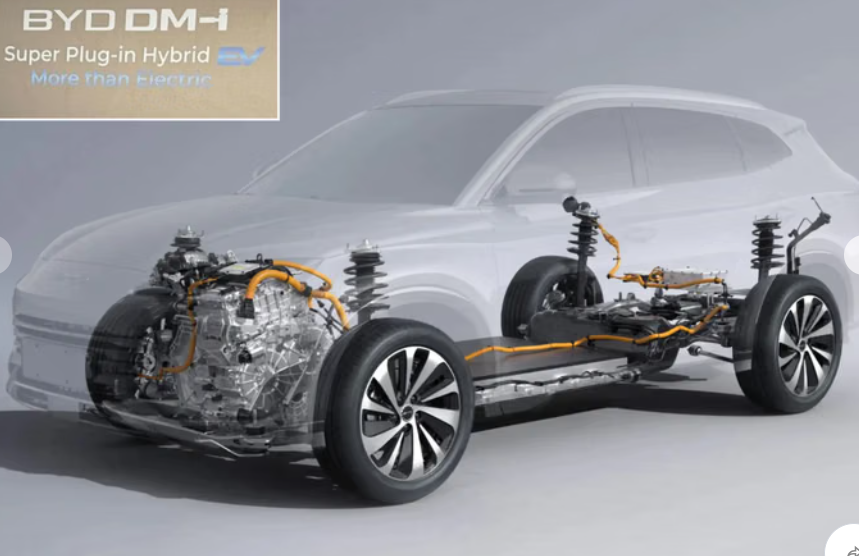
At the heart of the system is BYD’s Xiaoyun engine.
The company says this engine was specifically developed for hybrid applications and delivers a thermal efficiency of 43.04%, a figure BYD describes as the highest in the world.
Depending on the model and market, DM-i vehicles can use either naturally aspirated or turbocharged petrol engines.
The international version of the Seal U, for example, is offered with both 1.5-litre naturally aspirated and turbo-petrol options.
But the engine is only one piece of the puzzle.
BYD also uses an Electric Hybrid System (EHS), which manages:
• The traction motor that drives the wheels
• The starter generator
• Power flow between battery and drivetrain
The electric motors themselves are claimed to be 97.5% efficient.
Meanwhile, BYD has optimized its Blade Battery specifically for plug-in hybrid duty, enabling high charging and discharging performance while also powering systems such as air conditioning.
Must Read: 2026’s Massive Safety Shift: India Just Cleared the Way for Self-Driving Cars
Quick Snapshot
| Component | Function |
|---|---|
| Xiaoyun Engine | Hybrid-specific petrol engine |
| EHS System | Controls power distribution |
| Blade Battery | Stores and delivers electrical energy |
| Electric Motor | Primary drive source in many situations |
But the real story is how these components work together.
Three Modes, Three Different Personalities
BYD’s DM-i system continuously switches between operating modes automatically.
EV Mode
This is the mode many buyers will care about most.
The vehicle runs entirely on electric power.
The petrol engine stays off.
BYD says some DM-i models can travel up to 200km purely on electricity, depending on the vehicle and battery specification.
For daily commuting, that could mean many drivers rarely using petrol at all.
Series Mode
This works similarly to a range-extender EV.
The engine acts as a generator.
It charges the battery.
The electric motor continues driving the wheels.
BYD says this mode typically activates when battery charge falls below 25%.
This is also where the company claims a combined driving range exceeding 1,200km on a full tank of fuel.
Parallel Mode
Need more performance?
The system can allow both the petrol engine and electric motor to drive the vehicle together.
Unlike pure range-extender setups where the engine never powers the wheels directly, DM-i can do both.
That flexibility is one reason BYD believes the system can deliver strong efficiency without sacrificing performance.
Why the Seal U Matters for India
The upcoming Seal U could become one of BYD’s most important launches in India.
Internationally, the SUV is also sold as the Sealion 6 and was showcased at the 2025 Auto Expo.
Size-wise, it sits in the same broad category as the Mahindra XEV 9e.
Key figures include:
• Length: 4,775mm
• Width: 1,890mm
• Height: 1,670mm
• Wheelbase: 2,765mm
Depending on specification, combined output can reach:
• 323hp
• 550Nm torque
The all-wheel-drive version is claimed to sprint from 0-100kph in 5.9 seconds.
Meanwhile, BYD quotes an electric-only range of up to 126km using an 18.3kWh battery pack.
The battery can also charge from 30% to 80% in 35 minutes using an 18kW DC charger.
The Contrarian View
Not everyone will see DM-i as the perfect solution.
Plug-in hybrids occupy a middle ground between traditional petrol vehicles and fully electric cars.
Supporters view them as a practical bridge technology.
Critics often argue that they add complexity by combining two powertrains in one vehicle.
The success of DM-i in India may ultimately depend on whether buyers prioritize maximum flexibility or prefer moving directly toward pure EV ownership.
That debate is unlikely to disappear anytime soon.
What Happens Next?
Perhaps the most intriguing detail is that BYD engineers are reportedly continuing to refine the powertrain.
The company indicates future upgrades could be introduced globally, meaning the India-bound Seal U may not be identical to versions currently sold overseas.
And that raises a bigger question.
If BYD can successfully combine EV-like daily driving with petrol-powered long-distance freedom, could plug-in hybrids become the next major battleground in India’s rapidly evolving auto market?
The answer may arrive sooner than many expect.
Editorial Disclaimer: This article is based entirely on publicly available information from the cited source material. No facts, figures, outcomes, quotes, or timelines have been fabricated. Analysis and market implications may evolve as additional information becomes available.