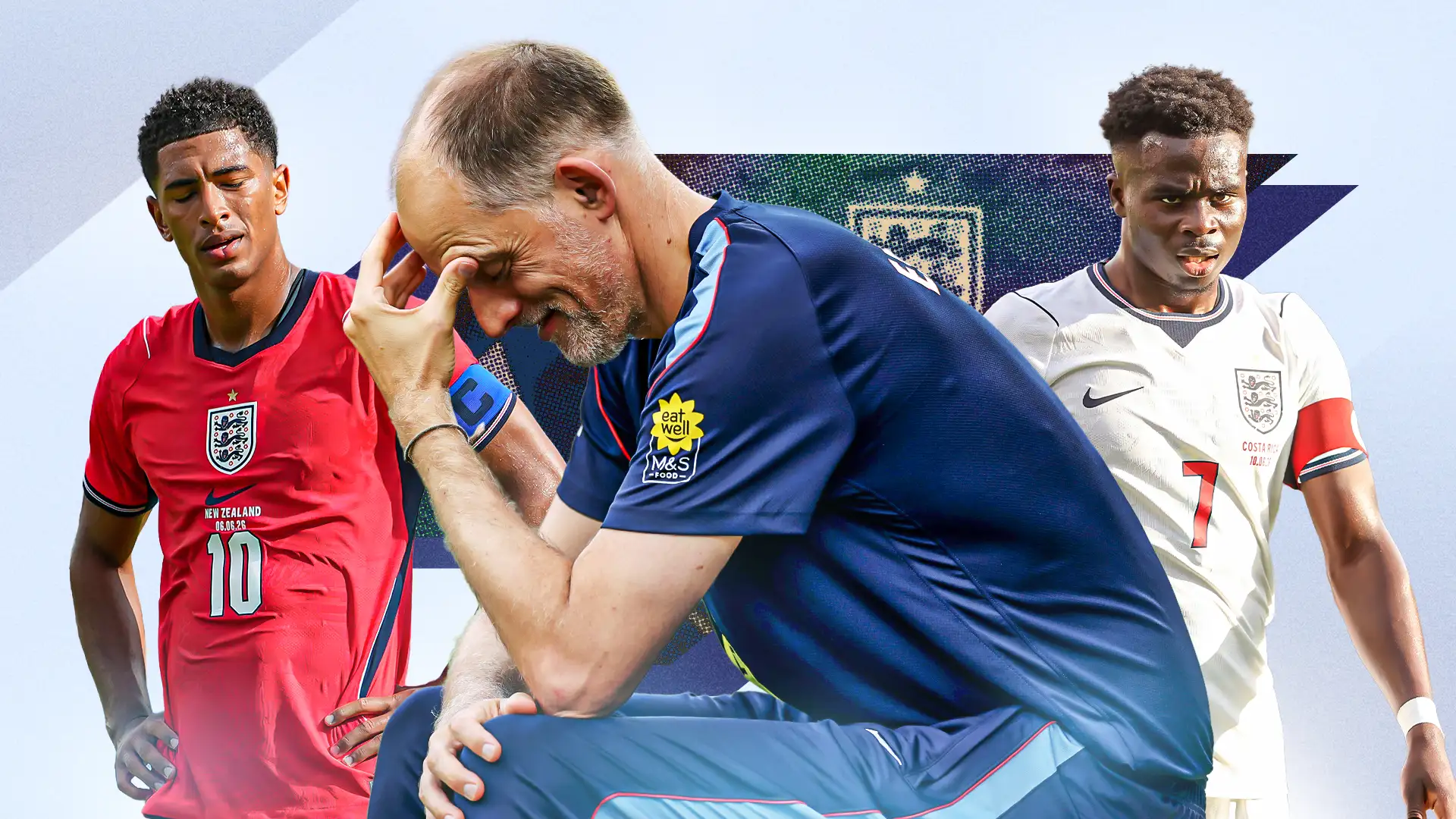
For months, England fans have been told this could finally be the year.
An unbeaten World Cup qualifying campaign. Eight clean sheets. A squad packed with stars. And a proven winner in Thomas Tuchel on the touchline.
So why does a growing number of observers still believe England won’t lift the trophy in 2026?
The answer lies beneath the impressive headlines.
Because while the Three Lions look strong on paper, several uncomfortable questions remain unanswered — and some of them could become major problems when the pressure reaches its peak.
The Defence Looks Strong… Until You Look Closer
England conceded zero goals during qualification.
That sounds reassuring.
But the reality may be far more complicated.
Thomas Tuchel has built his defensive plans around players whose availability has become a recurring concern.
- John Stones continues to battle injury issues.
- Reece James has struggled for fitness in recent seasons.
- England’s centre-backs are not known for elite recovery pace.
- Several backup options remain relatively inexperienced at international level.
Even the left-back situation raises questions.
Nico O’Reilly enjoyed a breakthrough season with Manchester City, but he naturally drifts into midfield rather than operating as a traditional full-back.
That tactical flexibility can be a strength.
It can also become a weakness against the world’s most dangerous attackers.
And that’s where things start getting uncomfortable.
Must Read: 2026 World Cup: Vinicius Jr Faces a Massive Legacy Test as Brazil Waits for a Defining Moment
America’s Brutal Conditions Could Become a Hidden Opponent
The football won’t be England’s only challenge.
The weather might be too.
Last summer’s Club World Cup offered a glimpse of what players could face across the United States.
Several participants described extreme heat and difficult playing conditions.
FIFA has already introduced cooling breaks during matches, highlighting just how significant temperatures could become.
The concern isn’t simply fatigue.
It’s style of play.
As matches become slower and more physically demanding, possession becomes even more valuable.
England have energy, athleticism and intensity.
But compared with some rivals, questions remain over whether they can control games for long periods when conditions become exhausting.
History offers another warning sign.
Only two European nations have previously won a World Cup outside Europe on another continent.
That is not an encouraging trend.
Bukayo Saka’s Fitness Is Suddenly a Serious Concern
This may be England’s biggest individual worry.
Bukayo Saka was arguably the team’s most dangerous attacking player during Euro 2024.
Yet heading into the World Cup, fitness concerns continue to linger.
Thomas Tuchel recently admitted the Arsenal star has not fully recovered from an Achilles issue suffered in March.
More concerning was the revelation that Saka has struggled to train on consecutive days.
For a player expected to carry enormous attacking responsibility, that is difficult to ignore.
If Saka isn’t operating at full capacity, England lose far more than goals.
They lose unpredictability.
They lose creativity.
And they lose one of the few players capable of changing a game in an instant.
Key Concern
| Issue | Potential Impact |
|---|---|
| Achilles discomfort | Reduced explosiveness |
| Limited training load | Match fitness concerns |
| Heavy tournament schedule | Increased injury risk |
But that’s only part of the story.
Where Are the Game-Changers?
England possess plenty of quality.
What they may lack is something different.
Tuchel left several high-profile names out of the squad, while others arrive after inconsistent club seasons.
Questions continue to surround the attacking depth behind the starters.
Marcus Rashford’s improved form is encouraging.
Anthony Gordon remains an option.
Noni Madueke offers pace.
But none arrive with the certainty that they can instantly transform a knockout match from the bench.
That debate intensified after teenager Rio Ngumoha impressed during England’s friendly victory over New Zealand.
His performance sparked conversations about whether England are missing an unpredictable wildcard capable of changing momentum late in games.
In tournaments, margins matter.
And sometimes one unexpected moment decides everything.
The Harry Kane Problem Nobody Wants to Discuss
England’s captain remains one of the world’s most reliable goalscorers.
That’s the good news.
The worrying news?
England may depend on him more than any other major contender depends on a single player.
Tuchel has publicly defended that reliance.
But the numbers tell their own story.
Kane contributes a huge share of England’s goals, experience and leadership.
Behind him, the alternatives simply don’t offer the same guarantees.
Ollie Watkins has delivered important moments.
Ivan Toney arrives after a prolific club season.
Yet neither carries Kane’s influence at international level.
If England lose Kane during the tournament, their entire attacking structure changes overnight.
That is a frightening scenario for any title challenger.
The Biggest Opponent Might Be England’s History
And then there is the factor nobody can measure.
Pressure.
England haven’t won a major tournament since 1966.
Generations of talented squads have arrived carrying enormous expectations.
Most left disappointed.
The recent record is encouraging.
Finalists at Euro 2020.
Finalists again at Euro 2024.
But those near-misses can create a different kind of burden.
The deeper England progress, the louder the questions become.
Can they handle a penalty shootout?
Can they beat elite opposition when everything is on the line?
Can they finally deliver when previous generations could not?
Contrarian View: Maybe These Fears Are Overblown
Not everyone agrees with the pessimism.
England remain one of the highest-ranked teams in world football.
They navigated qualification perfectly.
They possess world-class talent across multiple positions.
And Tuchel’s track record suggests he knows exactly how to manage knockout football.
Many of the concerns surrounding England have existed before previous tournaments.
Yet the Three Lions still reached consecutive European Championship finals.
That’s why writing them off completely may be just as risky as overhyping them.
What Happens Next?
England unquestionably have the talent to win the 2026 World Cup.
Few nations can match their combination of star power, experience and coaching pedigree.
But talent alone has never guaranteed success.
Fitness concerns, squad balance, tactical questions and decades of historical baggage continue to hover over this team.
The biggest question now isn’t whether England are good enough.
It’s whether they can finally overcome everything that has stopped them before.
And until they do, doubt will remain.
Editorial Disclaimer: This article is based entirely on publicly available information and statements referenced in the source material. No facts, statistics, quotes, outcomes or developments have been fabricated. Analysis and interpretation may evolve as new information emerges.