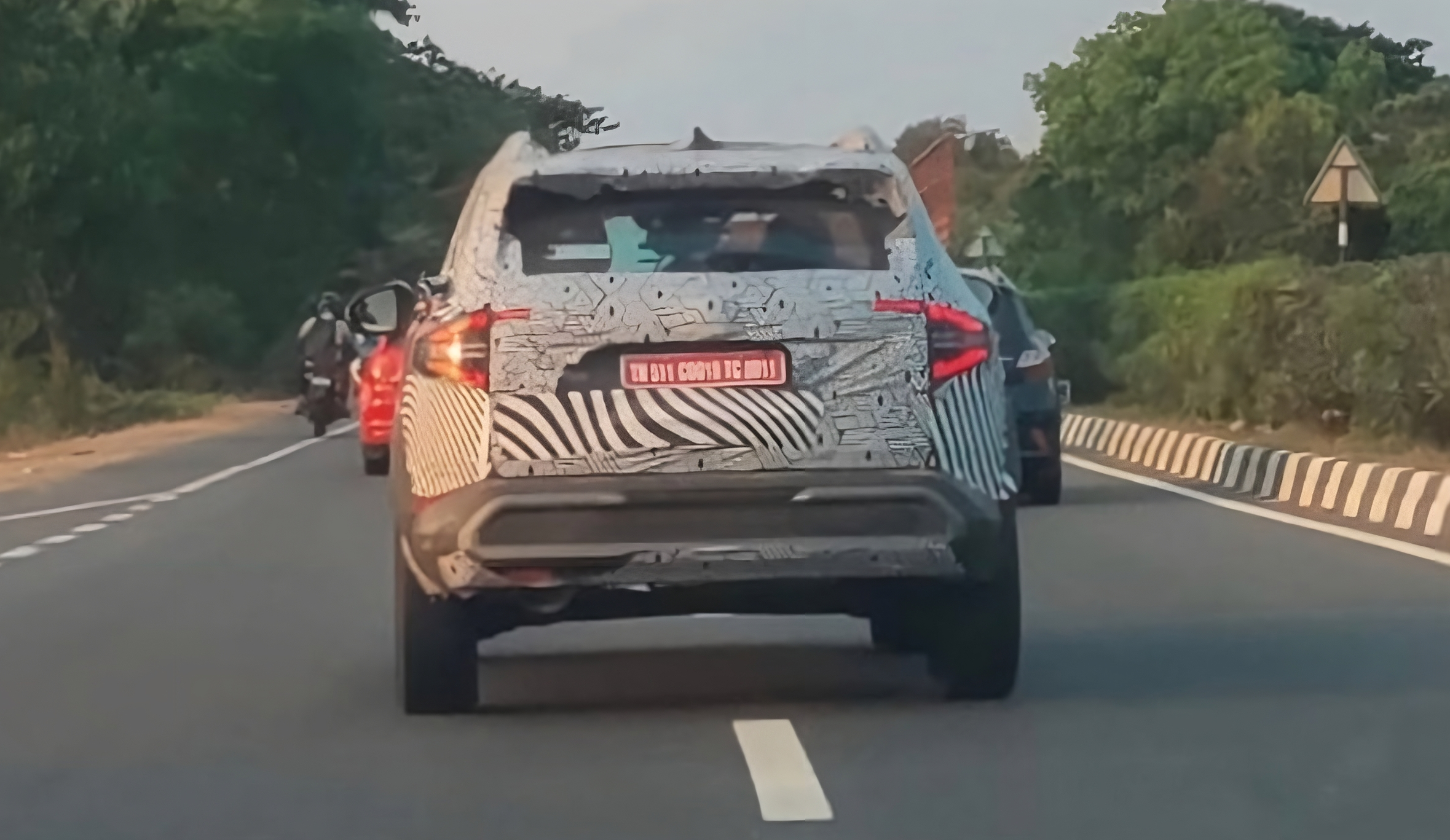
A heavily camouflaged test mule of the next-generation Renault Duster has just been spotted in Tamil Nadu — and it’s triggering more questions than answers.
What looks like a routine road test may actually be something far more significant for India’s SUV market.
Because this isn’t just another Duster on trial… it may be the long-rumoured strong hybrid version finally stepping out in public.
And if that’s true, the midsize SUV segment could be about to shift again.
Table of Contents
ToggleWhat Just Happened
The test prototype was spotted near Villupuram in Tamil Nadu, not far from Renault Nissan Automotive India manufacturing operations.
At first glance, it looks familiar — almost too familiar.
Key visual clues stand out:
- Rear tailgate design closely matches the recently launched Duster
- Y-shaped tail lamp signature remains unchanged
- Bumper treatment appears consistent with current styling
- Camouflage differs from earlier three-row Duster test mules
But here’s the twist — this mule doesn’t behave like the expected 7-seater derivative spotted earlier.
That difference is what has sparked the hybrid speculation.
Must Read: Scorpio-N Facelift Spied in 2026 — Mahindra’s Bold Design Shift Sparks Buzz
Why This Test Mule Matters More Than It Looks
The current India-spec Duster already comes with two turbo-petrol engines:
- 1.0-litre turbo petrol (100 hp, 160 Nm, manual, ~19.41 kmpl ARAI)
- 1.3-litre turbo petrol (163 hp, 280 Nm, manual & DCT options)
But this spotted mule hints at something beyond petrol power.
According to details linked to the prototype, the upcoming strong hybrid system may use:
- 1.8-litre naturally aspirated petrol engine
- Dual electric motors
- Compact battery pack
- Combined output: ~160 hp
That’s not just a mild efficiency tweak. It’s a full hybrid architecture capable of electric-only movement at low speeds.
And that changes the equation in a segment where fuel economy anxiety is rising fast.
Key Takeaway
If this is indeed the hybrid version, Renault isn’t just updating the Duster —
it is entering a battlefield currently dominated by Toyota and Maruti Suzuki hybrids.
Market Impact: A Quiet but Serious Disruption
India’s midsize SUV segment is already crowded, but hybrids remain rare.
That’s why this development matters:
- Buyers want lower running costs but aren’t ready for full EVs
- Petrol prices remain a long-term pressure point
- Strong hybrids are becoming the “middle solution”
If Renault launches this around the festive season (expected October 2026), it could position the Duster as:
- A fuel-efficient alternative without charging anxiety
- A tech-forward SUV in a value-heavy segment
- A direct challenger to established hybrid players
But there’s a catch — expectations are already high.
Industry Reaction: Quiet Interest, Loud Speculation
While Renault hasn’t confirmed anything officially, the test mule’s timing aligns with growing hybrid momentum in India.
Automotive observers note a pattern:
- Hybrid adoption is accelerating globally
- Renault Group already uses similar systems internationally
- India is becoming a strategic hybrid expansion market
And that’s where things get interesting — because the Duster name carries legacy weight in India.
The original Duster built the compact SUV segment’s early momentum. This new version may be trying to revive that influence in a very different market.
Contrarian View: Is This Really a Hybrid Breakthrough?
Not everyone is convinced this mule is what it appears to be.
A competing interpretation suggests:
- It could still be a variant test of the 7-seater Duster derivative
- The camouflage difference may simply reflect body configuration changes
- Mechanical hybrid components are not visually confirmed in spy shots
In other words, what looks like a breakthrough hybrid could still be a standard development mule for another body style.
And if that’s true, expectations may be running ahead of reality — again.
What Happens Next
The next few months will be crucial.
If this is the hybrid Duster, expect:
- More frequent road testing sightings
- Increased component-level camouflage changes
- Possible interior tech leaks (ADAS, screens, cluster updates)
- Gradual confirmation closer to festive 2026 launch window
If it isn’t, Renault still has a larger strategy unfolding with multiple Duster derivatives in play.
Either way, something is clearly moving under heavy disguise.
Hidden Shift in the SUV Battle
Even without official confirmation, one thing is already clear:
The midsize SUV segment is entering a new phase where:
- Petrol dominance is no longer unquestioned
- Hybrids are becoming mainstream considerations
- Efficiency is as important as performance
And the Duster — once known for simplicity — may be trying to reinvent itself in the most complex way yet.
Final Thought
Is this camouflaged SUV a quiet revolution in Renault’s India strategy…
or just another test mule being misread in a crowded automotive spy-shot ecosystem?
The answer could redefine how the next wave of SUVs competes in India.
Disclaimer: This article is based on publicly available information and reported observations of camouflaged test vehicles. No facts, outcomes, or specifications have been independently verified beyond the source material. Interpretations may evolve as new information emerges.