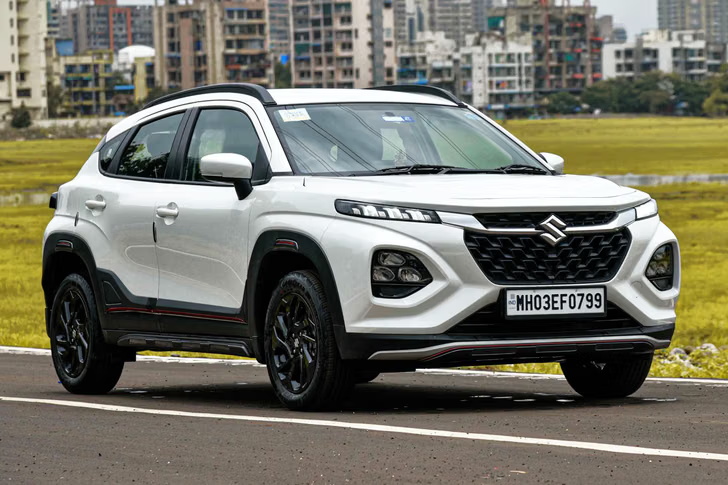
The Indian SUV market just got a reality check.
A compact crossover has done what no other Nexa product managed before it — hit 5 lakh sales in just over three years.
And yes, it’s the Maruti Suzuki Fronx.
What makes this even more intense? It didn’t just enter a crowded segment — it walked straight into a warzone dominated by heavyweights like the Tata Nexon, Hyundai Venue, Kia Sonet, Mahindra XUV 3XO, Toyota Taisor, Nissan Magnite, Skoda Kylaq and Renault Kiger.
Yet somehow, it didn’t just survive. It accelerated.
Table of Contents
ToggleWhat Happened: A Quiet Entry, Then a Sales Explosion
When the Maruti Suzuki Fronx first hit Indian roads in 2023, nobody expected this kind of trajectory.
But the numbers tell a very different story:
- 2023: 94,393 units (limited availability, launched in April)
- 2024: 1,56,236 units
- 2025: 1,79,894 units
- Jan–May 2026: 82,306 units already
In less than three years, it didn’t just scale — it snowballed.
And that’s where things start getting interesting.
Must Read: 2026 Renault Duster Hybrid Spy Shock Raises Big Questions
Why It Matters: Timing + Identity Shift Changed Everything
The Fronx didn’t behave like a traditional compact SUV.
Instead, it blurred categories — hatchback practicality wrapped in SUV styling.
That hybrid identity is exactly what the Indian market seems to be chasing right now inside the Maruti Suzuki ecosystem, especially through its premium Nexa retail network.
Key design triggers behind its rise:
- Coupe-like sloping roofline
- Wide SUV stance
- Higher ground clearance
- Hatchback-like usability
It didn’t force buyers to choose between “city comfort” and “SUV presence.” It simply offered both.
That combination is quietly reshaping expectations.
Market Impact: The Numbers Got Loud in 2025–2026
At first, growth looked steady.
Then it started spiking.
- Feb 2025: 21,461 units (first big breakthrough month)
- Dec 2025: 20,706 units
- May 2026: 20,686 units (peak consistency continues)
These are not “niche success” numbers anymore. These are mainstream leadership signals.
Key Takeaway: The Fronx didn’t rise because of one strong month — it built a repeatable demand engine.
Under the Hood: Powertrain Flexibility Became a Silent Weapon
The Fronx didn’t rely on styling alone.
It brought a multi-engine strategy that widened its buyer base:
- 1.2-litre NA petrol: 89 hp, 113 Nm
- 1.0-litre Boosterjet turbo petrol: 99 hp, 147.6 Nm
- CNG variant also available
Transmission choices include manual, AMT, and torque converter automatic depending on engine.
That’s not just variety — it’s market segmentation done aggressively.
Feature Stack: More “Premium Feel” Than Expected
Depending on variant, buyers get:
- 9-inch infotainment system
- Wireless Android Auto / Apple CarPlay
- 360-degree camera
- Head-up display
- Wireless charging
- Cruise control
- Connected car tech
Safety includes up to six airbags in select trims, ESC, hill hold assist, and ABS with EBD.
For its price bracket of ₹6.85 lakh to ₹11.98 lakh (ex-showroom), it hits a very specific psychological sweet spot.
Contrarian View: Is This Growth Sustainable or Just Timing Luck?
Not everyone is convinced the Fronx story is purely product genius.
Some industry observers argue the spike is heavily influenced by:
- India’s shift toward SUV-style vehicles across all segments
- Buyers upgrading from premium hatchbacks
- Nexa network advantage and pricing positioning
In other words — the Fronx may not have created demand, but perfectly caught it.
And that raises a harder question:
If the SUV boom slows, does the Fronx still look this dominant?
That uncertainty is now part of the conversation.
What Happens Next: Export Push + Internal Cannibalization Risk
With exports adding volume and domestic demand still strong, the growth story isn’t slowing yet.
But internally, another challenge is emerging inside Nexa:
- Does the Fronx start eating into Baleno volumes?
- Can it stay differentiated if rivals refresh aggressively?
- Will new SUVs dilute its “unique crossover” positioning?
The bigger issue may not be competition outside — but overlap within its own ecosystem.
Final Thought
The Maruti Suzuki Fronx didn’t just become a best-seller. It became a case study in timing, positioning, and market psychology.
But the real question now is uncomfortable:
Is this the beginning of a long-term leadership story — or the peak of a perfectly timed surge?
Disclaimer: This article is based on publicly available information. No facts, figures, or outcomes have been fabricated. Interpretation and analysis may evolve as new data becomes available.