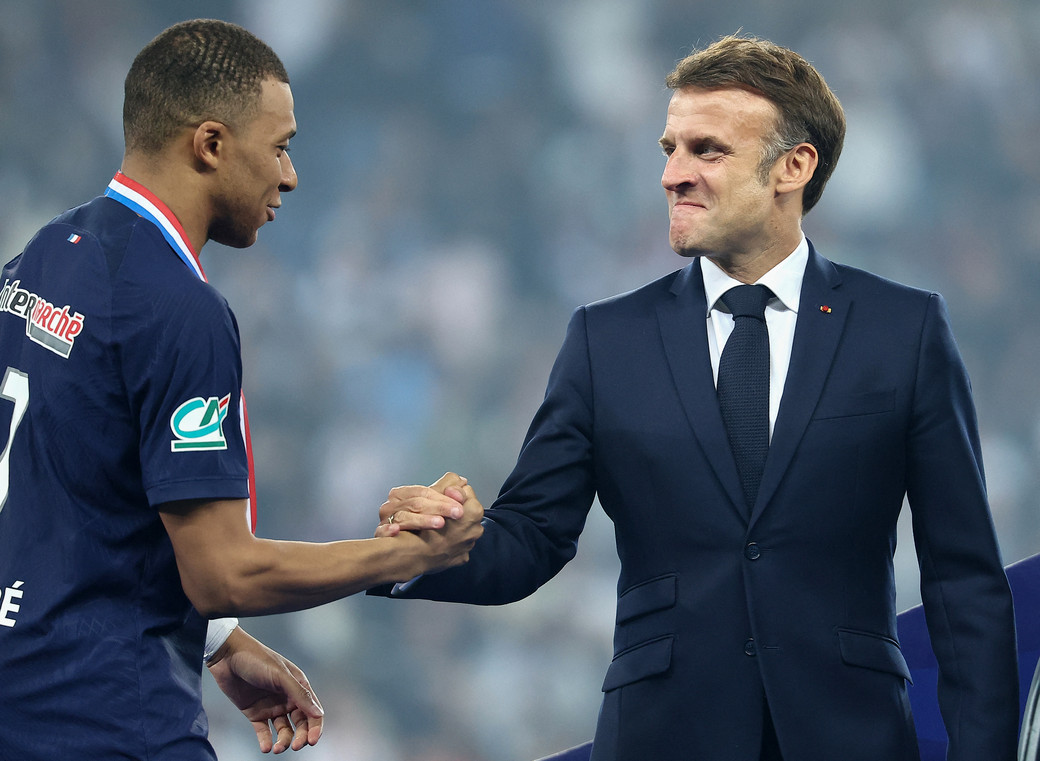
The World Cup hasn’t kicked off yet, but in Paris, Emmanuel Macron’s political clock is already ticking loudly.
As France prepares for another global football run in 2026, a strange question is resurfacing: can a trophy actually save a presidency?
For French President Emmanuel Macron, the tournament is more than sport. It’s one of the last remaining chances to attach his legacy to a moment the entire nation actually celebrates together.
And that’s where things get complicated.
Table of Contents
ToggleA PRESIDENT CHASING A MOMENT HE CAN’T CONTROL
France’s football golden generation, led by superstar Kylian Mbappé, has delivered everything except the one thing Macron seems to want most — political lift-off from sporting glory.
The irony? France has already lived this story.
- 2018 World Cup win → global celebration
- Political turbulence followed almost immediately
- 2024 Olympics success → quickly swallowed by domestic unrest and political fallout
Each time, the pattern repeats: celebration first, instability right after.
Even Macron’s supporters admit it. As one lawmaker close to him put it, football is one of the few moments where France briefly forgets its divisions.
But that moment rarely lasts.
Must Read: AI Revolt Inside GOP in 2026 Sparks Explosive Party Split
WHY FOOTBALL GLORY DOESN’T TRANSLATE INTO POLITICAL POWER
The expectation is simple: win big, feel unified, gain approval.
Reality has been the opposite.
Despite France’s repeated football success under Macron’s leadership, his political capital hasn’t followed the same trajectory. Analysts say the “bounce effect” from sport in modern democracies is shrinking fast.
A quick snapshot of the pattern:
| Event | Result | Political Impact |
|---|---|---|
| 2018 World Cup win | National euphoria | Short-lived |
| Post-2018 protests | Yellow Vest movement | Overshadowed win |
| 2024 Olympics | Global spotlight | Domestic tension remained |
Even inside the Élysée, there’s quiet acknowledgment: sport unites briefly, but doesn’t reset political reality.
THE FIFA FACTOR: A DIFFERENT KIND OF POWER GAME
While Macron hopes for unity, football’s global governance is dealing with its own chaos.
FIFA president Gianni Infantino is navigating a World Cup spread across North America, where authority is fragmented across federal, state, and city levels.
Unlike past tournaments in more centralized political systems, the 2026 edition is proving harder to control.
Local officials across the United States, Mexico, and Canada are actively shaping how the tournament unfolds — sometimes clashing directly with FIFA decisions.
That has created a surprising dynamic:
- No single political “power center” to negotiate with
- Local governments influencing operational decisions
- FIFA forced into constant compromise mode
One official compared the situation to discovering that global football authority has limits — especially in decentralized democracies.
CONTRARIAN VIEW: WHAT IF MACRON DOESN’T NEED THE WIN?
Not everyone agrees that Macron is chasing a meaningful political payoff.
Some political observers argue the entire idea of “sport as political capital” is outdated.
Their argument is blunt:
- Modern voters separate entertainment from governance
- Football victories create emotion, not long-term approval
- Political identity is now driven more by economics and culture wars than national sport
In this view, even a French World Cup win in 2026 would barely register beyond headlines and celebrations.
A supporter of this perspective summarized it sharply: national joy doesn’t automatically translate into political forgiveness.
THE REAL RISK: MOMENTS THAT DISAPPEAR TOO FAST
This is where Macron’s dilemma becomes clearer.
Sport creates mass attention — but attention today moves faster than politics can absorb it.
A World Cup win would likely trigger:
- Massive social media spikes
- Temporary national unity
- Short-term approval bump
But history suggests something else follows just as quickly: the return of unresolved political tensions.
And France has no shortage of those.
WHAT HAPPENS NEXT
If France goes deep in the 2026 tournament, Macron will almost certainly be visible — celebrating, appearing on podiums, and trying to capture a unifying moment.
But the bigger question isn’t whether France wins.
It’s whether modern politics can still borrow meaning from global sport in a world where attention resets every 24 hours.
For Macron, the gamble is simple but brutal: one more chance to turn football glory into something lasting — or another reminder that even the biggest wins fade fast.
And as kickoff approaches, one question hangs over everything:
Can a World Cup still change a country… or just its mood for a weekend?
Disclaimer: This article is based on publicly available information from reporting on the 2026 World Cup and French political context. No facts, quotes, or outcomes have been fabricated. Interpretations reflect analysis at the time of writing and may evolve as new information emerges.