Something unusual is happening inside the Republican Party — and it’s not about elections, immigration, or even the economy.
It’s about artificial intelligence.
And the split forming now could define the GOP for decades.
On one side: populist conservatives warning AI could erase jobs, destabilize society, and hand power to Big Tech.
On the other: pro-growth Republicans aligned with President Donald Trump’s “move fast” tech strategy.
The tension is no longer theoretical. It’s loud, public, and increasingly personal.
Table of Contents
ToggleWhat Happened
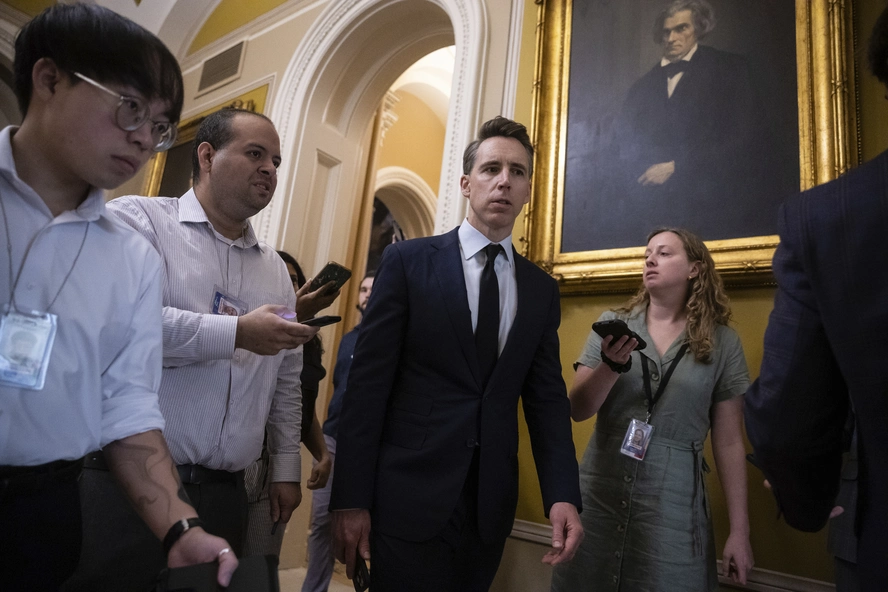
The fight burst into the open as Sen. Josh Hawley escalated his criticism of unchecked AI development.
In a recent speech at a Washington think tank hosted by American Compass, Hawley framed AI as a moral and economic crossroads. He warned the GOP must choose between “donor class politics” and defending workers, families, and small towns.
In parallel, Florida Gov. Ron DeSantis intensified his attacks on federal efforts to limit state-level AI regulation, calling Washington’s approach “bad policy” and “even worse politics.”
Florida’s attorney general, James Uthmeier, even escalated matters further by filing a lawsuit against OpenAI and its CEO Sam Altman, arguing the company prioritized speed over safety.
At the same time, the Trump administration has been trying — unsuccessfully so far — to push federal rules that would block states from creating their own AI regulations.
And that’s where the real fracture begins.
Must Read: 2026: Trump’s 1 SDNY Pick Sparks Shock Questions in Manhattan
Why It Matters
AI is no longer a niche tech debate inside Washington. It’s becoming a full political identity test for Republicans.
The emerging divide looks like this:
- Populist right: AI threatens workers, families, and social stability
- Tech-aligned conservatives: AI is essential to beating China and protecting economic dominance
- State-rights conservatives: Washington shouldn’t override state AI laws
And the conflict is spreading fast.
States like Texas, Tennessee, and Utah are already pushing or blocking AI-related legislation in different directions, often clashing with federal priorities.
A key concern shared across factions: data centers, deepfakes, job displacement, and the speed of AI deployment.
But agreement stops there.
Inside the GOP Split
Sen. Hawley has become the most visible voice of resistance inside the party. His message blends economics, religion, and labor politics — even invoking moral language about “laws of God versus the gods of capitalism.”
Meanwhile, Ron DeSantis has focused on practical risks: job loss, manipulated media, and what he calls a “potential existential crisis for self-government.”
Other Republicans are entering the arena too:
- Ken Paxton campaigned on taking on Big Tech
- Greg Abbott has floated restrictions on data center expansion
- Several GOP candidates are pushing moratoriums or tighter controls
Even within Trump-aligned circles, the messaging is not fully unified. The administration continues to prioritize global AI competition, especially with China, while also exploring targeted regulatory tools.
A key flashpoint is federal preemption — the idea that Washington should block states from creating their own AI rules. Many Republicans are rejecting it outright.
Industry Reaction & Public Sentiment
The tech sector is watching closely — and not everyone is worried.
One AI lobbyist described the political push as overstated, suggesting fears may ease as people become more familiar with the tools.
But polling shows a more complicated picture.
- 43% of Americans believe AI risks outweigh benefits
- 37% support building data centers locally
- 80% say AI regulation is “extremely” or “very” urgent
That tension is shaping everything from elections to infrastructure fights over data centers in multiple states.
Even within conservative circles, messages tied to AI safety and family protection are outperforming pro-industry talking points in surveys referenced by policy groups.
Contrarian View
Not everyone agrees this is a crisis.
Some conservatives — and parts of the tech industry — argue the backlash is overstated and emotionally driven.
Their case is simple:
- AI is already improving productivity
- Fear will fade as everyday benefits become visible
- Overregulation could slow U.S. competition with China
- Innovation, not restriction, is the real safeguard
From this perspective, the GOP divide isn’t a philosophical transformation — it’s a temporary cultural reaction to rapid technological change.
But critics counter that once regulation lags behind innovation, it rarely catches up.
What Happens Next
The real test may come in 2026 and beyond, when AI policy becomes a defining campaign issue.
Three forces are now colliding:
- Federal attempts to set uniform AI rules
- State governments pushing their own restrictions
- A Republican Party split between populist caution and tech acceleration
The outcome could reshape not just AI policy — but the ideological identity of the GOP itself.
And the biggest unanswered question remains:
Will Republicans become the party that restrains AI — or the party that races to dominate it?
Key Takeaway
The GOP’s AI divide is no longer theoretical policy debate. It is becoming a full political realignment in real time — with elections, lawsuits, and state rebellions already underway.
Disclaimer: This article is based on publicly available reporting and statements. No facts, quotes, or outcomes have been fabricated. Analysis reflects information available at the time of writing and may evolve as new developments emerge.