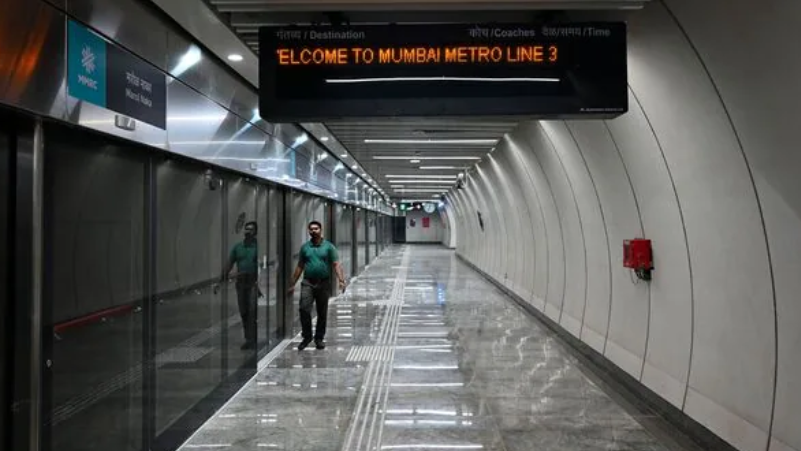
Underground Mumbai just got a signal boost—but the comeback wasn’t smooth.
After months of dead zones, complaints, and a bitter pricing standoff, mobile connectivity has finally started returning to Mumbai Metro’s Aqua Line 3. But here’s the twist: not everyone is back online yet, and the real battle may not be over.
For commuters who’ve been stuck in signal-free tunnels, this is more than a tech update—it’s a long-awaited relief.
Table of Contents
ToggleWhat Happened: The Quiet Return of Network Bars
Telecom giants have started restoring services inside Mumbai Metro’s underground stretch after a prolonged dispute over costs and infrastructure control.
Vodafone Idea confirmed that its network is now live across 16 stations, from Aarey JVLR to Acharya Atre Chowk on the Aqua Line 3 corridor.
At the same time,
Bharti Airtel has restored connectivity across 10 stations, according to company updates.
But one major player is still silent.
Reliance Jio Infocomm has not yet made any public announcement on restoration.
And that silence is raising questions.
Must Read: 2026 Shock: Nadella AI Energy Warning Sparks Massive Debate
Why It Matters: The Underground Connectivity Gap
Mumbai’s Aqua Line 3 is fully underground in key stretches—meaning no mobile signal unless infrastructure is actively deployed inside stations and tunnels.
This led to a months-long blackout triggered by a pricing clash involving:
- Telecom operators
- Mumbai Metro Rail Corp. Ltd (MMRCL)
- Third-party infrastructure vendor ACES Infrastructure
Operators had earlier refused to pay “unviable rates” demanded by the vendor appointed to manage in-building solutions.
The result?
Passengers entered stations expecting connectivity—and got nothing.
The Breaking Point: When Money Stalled Connectivity
At the center of the dispute was a commercial disagreement.
Operators argued that metro connectivity should follow government Right of Way (RoW) norms—not inflated third-party pricing.
A joint pushback from Airtel, Vodafone Idea, and Jio last year made their position clear: they would not deploy services under the proposed cost structure.
That standoff froze progress for months.
Hidden Problem: A System Built on a Fault Line
Here’s where things get more complicated.
Mumbai Metro Rail Corporation had earlier appointed Saudi Arabia-based ACES Infrastructure as a “neutral host” to manage in-building connectivity.
But that model became the flashpoint.
A simplified breakdown:
| Stakeholder | Position |
|---|---|
| Metro authority | Outsourced infrastructure via vendor |
| Telecom operators | Opposed high access costs |
| Government (DoT) | Pushed for RoW-based pricing |
Eventually, the contract with ACES India was terminated, and a fresh attempt to reboot the system began.
What Changed Now: The Quiet Reset
The breakthrough came after regulatory and policy pressure intensified.
Officials reportedly intervened, reinforcing a key principle:
Public infrastructure cannot be turned into a high-margin revenue model for connectivity access.
Following this, Mumbai Metro issued new acceptance letters to operators, opening the door for phased restoration.
And slowly, the lights—well, signals—came back.
Industry Reaction: Relief, but Not Celebration
Telecom insiders say this isn’t a victory lap—it’s a compromise.
Yes, services are returning.
But the ecosystem remains fragile.
Key concern points:
- Long-term pricing structure still unclear
- Reliance on multiple vendors creates friction
- Expansion to Phase 2 still ongoing
- Full network parity not yet achieved across all operators
Even Vodafone Idea noted that Phase 2 rollout (Science Centre to Cuffe Parade) is still in progress.
Contrarian View: Was the Disruption Actually Necessary?
Not everyone sees the outage as a failure.
Some industry voices argue the standoff exposed a deeper issue:
What if metro connectivity should not be treated as a free public utility for private telecom deployment?
From that lens, the conflict forced a long-overdue reset on:
- Infrastructure monetization rules
- Vendor dependency models
- Cost-sharing between public and private sectors
In other words, the disruption may have been uncomfortable—but strategically necessary.
But critics push back hard: commuters were the ones who paid the price.
And that’s the uncomfortable truth sitting beneath the resolution.
What Happens Next: The Bigger Question Looming
For now, connectivity is returning in phases across Mumbai’s underground metro system.
But the bigger uncertainty remains:
Will India’s growing metro networks avoid repeating this conflict—or is this just the first of many underground battles over digital access?
Because as cities go deeper underground, the fight for signal strength may become just as important as the trains themselves.
Key Takeaway
- Airtel and Vodafone Idea have begun restoring services on Mumbai Metro Aqua Line 3
- 16 stations (Vi) and 10 stations (Airtel) are now partially live
- Jio has not yet confirmed rollout
- Dispute stemmed from pricing via third-party vendor ACES
- Government intervention helped unlock resolution
Disclaimer
This article is based on publicly available information. No facts, outcomes, or figures have been fabricated. Interpretations may evolve as new developments emerge.