The spacecraft made it around the Moon.
The astronauts came home safely.
But behind one of NASA’s biggest missions in years, another system was quietly being pushed to its limits.
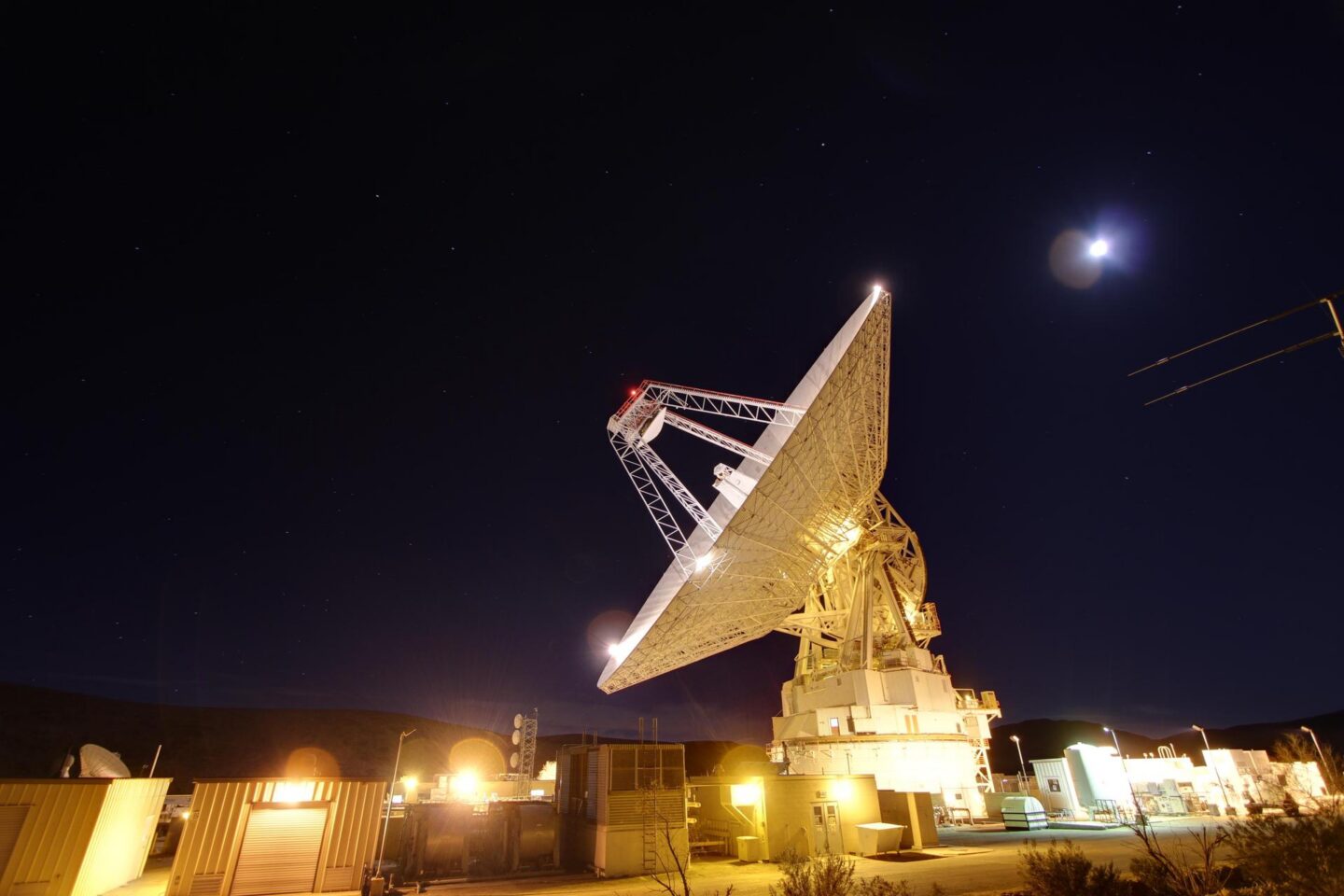
NASA says its Deep Space Network (DSN)—the communications backbone connecting Earth to spacecraft across the Solar System—handled the crewed Artemis II mission well. Yet the agency is also warning that demand on the network keeps growing, old missions are consuming more resources than expected, and a critical antenna remains offline after a damaging accident.
And that’s where the story becomes far more interesting.
Table of Contents
ToggleArtemis II Put NASA’s Space Internet Under Pressure
When Artemis II launched on April 1, NASA needed constant communication with the Orion spacecraft as it traveled more than 250,000 miles from Earth.
Unlike Artemis I, this mission carried four astronauts.
That meant more data, more communication needs, and much less room for error.
The challenge wasn’t theoretical.
NASA had already experienced major strain during Artemis I in 2022, when Orion’s communications demands forced the agency to reduce or delay downlinks from several science missions, including the James Webb Space Telescope and Mars rovers.
This time, officials say lessons learned paid off.
Greg Heckler, deputy program manager for capability development in NASA’s Space Communications and Navigation Program, said new coordination and scheduling processes were implemented before Artemis II.
According to NASA, those changes worked.
Must Read: AcuRite’s 2026 Controversial App Reversal Raises 1 Big Question for Loyal Users
Quick Snapshot
| Mission | Key Challenge |
|---|---|
| Artemis I | Heavy Orion demand plus 10 CubeSats |
| Artemis II | Higher crew communication needs |
| DSN Today | Roughly 40 active missions competing for resources |
| Next Decade | Around 40 additional missions expected |
But solving one problem doesn’t eliminate the next one.
The Bigger Problem Is What Happens Next
NASA’s Deep Space Network isn’t just supporting Moon missions.
It also connects with spacecraft at Mars, Jupiter, deep-space observatories, and numerous scientific missions operating far beyond Earth.
Many of those spacecraft have exceeded their original lifespans.
That’s great news for science.
It’s much harder news for network planners.
NASA says many older missions are still drawing heavily on DSN resources years—or even decades—after launch.
Some aren’t even using the network according to their originally documented requirements.
As Heckler bluntly acknowledged:
“Some missions are using more than what their paperwork would say.”
That creates a growing competition for limited communication time.
And demand isn’t slowing down.
A Wave of New Missions Is Coming
NASA, commercial companies, and international partners are preparing a growing number of lunar missions.
Meanwhile, the agency expects approximately 40 additional missions to require DSN support over the next decade.
One upcoming mission stands out.
The Nancy Grace Roman Space Telescope, scheduled for launch in August, is expected to generate more data through the DSN than all previous NASA astrophysics missions combined.
That’s a staggering figure.
And it arrives while the network is already facing capacity concerns.
Key Takeaway
- More Moon missions are coming.
- Existing spacecraft remain active.
- New telescopes will generate unprecedented amounts of data.
- The same network must somehow handle all of it.
That’s why NASA is already looking for alternatives.
NASA Is Building New Infrastructure
Officials are working to reduce pressure on the Deep Space Network by creating additional communications pathways.
Among the initiatives:
- Lunar Exploration Ground Sites (LEGS)
- Commercial lunar communications networks
- Data relay satellites around the Moon
- High-bandwidth optical laser communications
NASA also successfully tested a laser communications terminal aboard Orion during Artemis II.
The goal is simple: move future lunar traffic away from the DSN wherever possible.
But not everyone sees that as a complete solution.
Contrarian View: Is NASA Solving Capacity Problems Fast Enough?
NASA says it has learned important lessons from Artemis I and Artemis II.
Yet the underlying trend remains difficult to ignore.
The agency currently supports roughly 40 active missions through the Deep Space Network.
Another 40 are expected in the coming decade.
At the same time, aging spacecraft continue operating longer than planned, while future missions are expected to transmit dramatically larger volumes of data.
From that perspective, Artemis II may not have demonstrated that the problem is solved.
It may simply have demonstrated that the network can still manage under increasing strain—for now.
The real test could arrive when multiple major lunar missions, next-generation telescopes, and deep-space probes are all competing for access simultaneously.
One Of NASA’s Biggest Antennas Is Still Offline
Adding to the challenge is a major infrastructure setback.
A crucial 70-meter antenna at NASA’s Goldstone Deep Space Communications Complex in California has been out of service since an accident in September 2025.
The antenna was tracking the Juno spacecraft at Jupiter when it over-rotated, damaging equipment and triggering flooding caused by approximately 200,000 gallons of water containing glycol.
Investigators identified multiple causes, including bypassed safeguards, inadequate training, insufficient written procedures, and deficiencies in control systems.
NASA estimates repairs will cost between $4.1 million and $4.6 million.
The antenna is expected to remain unavailable during a broader upgrade effort extending into 2028.
The Question NASA Can’t Ignore
Artemis II proved the Deep Space Network could support a crewed mission around the Moon without repeating the disruptions seen during Artemis I.
That’s the good news.
The harder question is whether the network can keep pace with the next decade of exploration.
With more lunar missions, more spacecraft, more data, and one major antenna still sidelined, NASA’s communications infrastructure may become one of the most important—and least visible—battlegrounds of the new space age.
And as humanity pushes deeper into space, the challenge may no longer be building spacecraft.
It may be finding enough bandwidth to hear them.
Editorial Disclaimer: This article is based entirely on publicly available information from the cited source material. No facts, quotes, statistics, timelines, outcomes, or insider information have been added or fabricated. Analysis and interpretation may evolve as new information becomes available.