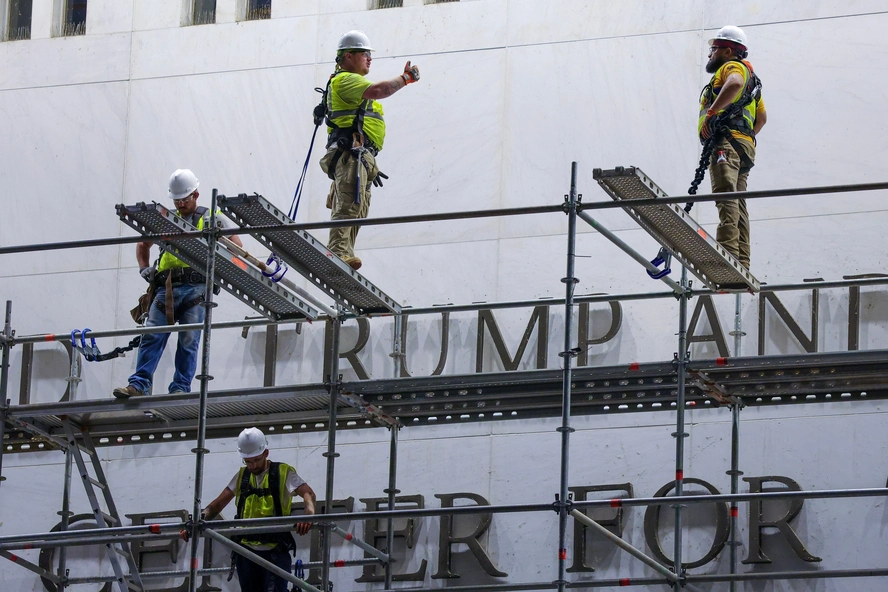
A name that once briefly appeared on one of Washington’s most iconic cultural landmarks is now gone again.
And this time, it wasn’t a quiet redesign—it followed a legal battle that ended in courtrooms, rulings, and emergency appeals.
On Saturday in Washington, crews physically removed “Trump” from the Kennedy Center facade.
But the bigger story isn’t just what disappeared—it’s how it got to this point at all.
Something as symbolic as a building’s name turned into a full-scale legal and political fight in 2026.
Table of Contents
ToggleWhat Happened
The Kennedy Center confirmed in a court filing that workers removed all physical signage from the building and grounds that had renamed the institution after President Donald Trump or any other individual besides President John F. Kennedy.
By Saturday morning, crews had already begun dismantling the exterior lettering. A large white tarp covered the work area as the removal continued behind it.
According to the filing by Matthew Floca, the center’s chief operating officer and executive director, the work included:
- Removing all exterior signage referencing Trump’s name
- Updating internal systems, including email signatures and ID cards
- Rolling back trademark applications tied to the renamed branding
The institution also confirmed that earlier attempts to keep the name in place failed after court intervention and appeals were denied.
Must Read: 3 Shocking Twists in Trump–Iran Deal 2026 That Left Markets on Edge
Why It Matters
The Kennedy Center is not just a building—it is one of the most visible cultural institutions in the United States.
So when a court rules that its naming cannot be altered outside of congressional authority, it becomes more than a branding dispute. It becomes a question of legal limits on institutional control.
A federal judge ruled in May that the rebranding effort violated federal law and overstepped authority granted by Congress. The court also blocked a broader plan that would have temporarily closed the center for renovations.
The result:
A symbolic reversal that unfolded in public view, step by step.
Timeline of Key Moves
| Date | Event |
|---|---|
| May 2026 | Federal judge blocks renaming and closure plan |
| Late May 2026 | Ruling declares rebranding illegal |
| June 2026 | Appeals and emergency requests denied |
| June 13–14, 2026 | Physical removal of signage completed |
Each step tightened the legal constraints until only one outcome remained: reversal.
Hidden Problem Behind the Fight
The surface story is about a name being removed.
But the underlying issue is authority—specifically, who controls federally tied cultural institutions and how far executive influence can stretch.
Court filings also show that after the ruling:
- Website references were removed
- Internal branding systems were updated
- Trademark filings were rescinded
That level of rollback suggests the legal decision didn’t just stop a name change—it triggered a full institutional reset.
And that raises a quieter question: how easily can symbolic control over national landmarks shift in the first place?
Contrarian View
Not everyone sees this as a simple legal correction.
Supporters of the renaming effort argue the episode reflects a deeper tension: whether cultural institutions should evolve under executive direction or remain strictly bound to congressional intent.
From that perspective, the court ruling is not just enforcement—it is also a limitation on modernization efforts inside federally supported arts institutions.
Critics of the ruling quietly frame it differently:
- Was the dispute about legality
- Or about political influence over cultural identity?
The answer depends on where the line is drawn between governance and symbolism—and that line remains unsettled.
What Happens Next
With signage removed and appeals denied, the Kennedy Center appears to be reverting fully to its original legal identity under John F. Kennedy’s name.
But the broader implications are still unfolding.
Questions remain about:
- Whether future administrations will attempt similar rebranding efforts
- How tightly courts will define institutional naming authority
- And whether cultural landmarks will continue to become political flashpoints
Even after the physical letters came down, the debate over control is far from settled.
Key Takeaway
A building’s name changed—and then changed back—but the real conflict was never about letters on a wall. It was about who gets to define national symbols in the first place.
And that question hasn’t gone away.
Disclaimer
This article is based on publicly available reporting and court filings. No facts, outcomes, or quotations have been fabricated. Interpretation and framing reflect editorial analysis and may evolve as new information becomes available.