Imagine driving through a quiet American town.
There’s a hospital treating patients. A grocery store serving customers. Traffic lights changing at busy intersections. A power company keeping the lights on.
Now imagine hackers launching a ransomware attack that suddenly brings parts of that town to a halt.
That scenario is exactly what the FBI is practicing inside one of its most unusual cybersecurity projects.
And the scale of it is raising eyebrows.
The FBI Built an Entire Town for Cybercrime Training
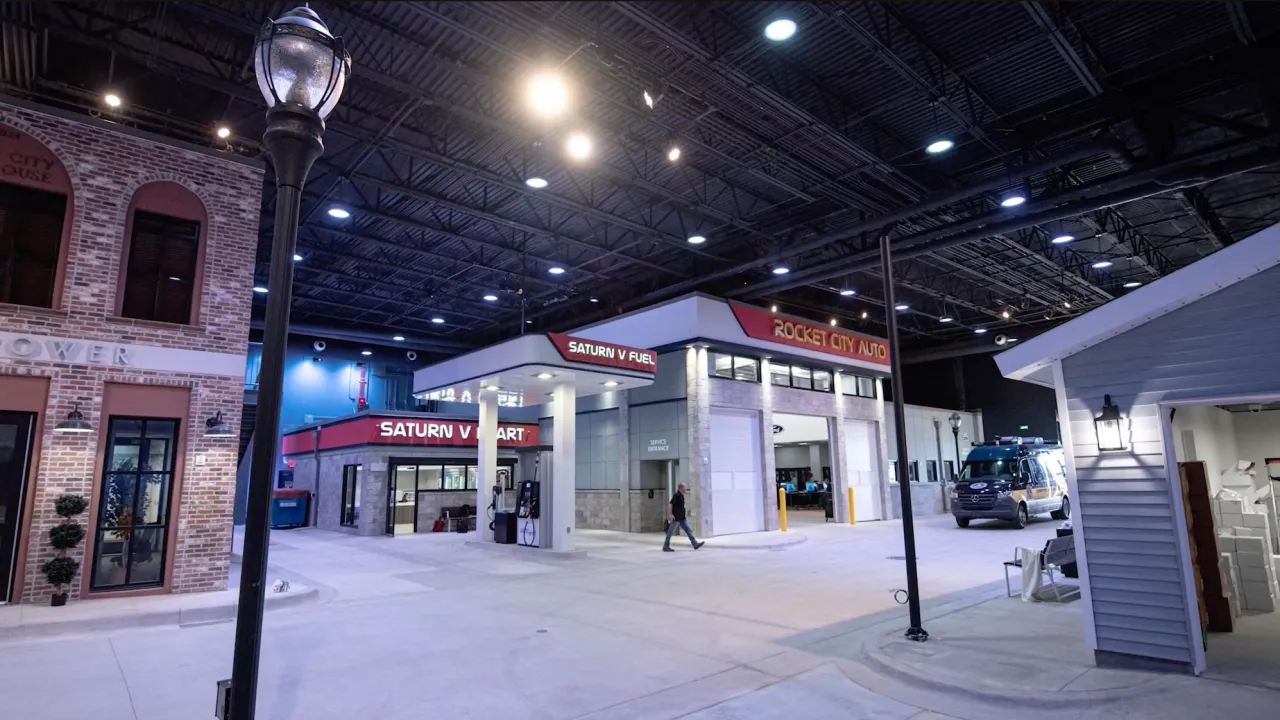
The Federal Bureau of Investigation has revealed details about a purpose-built training environment known as the Kinetic Cyber Range, a 22,000-square-foot replica town located on the agency’s campus in Huntsville, Alabama.
The facility officially opened in February 2025.
Its purpose is simple: give investigators hands-on experience dealing with the kinds of cyberattacks increasingly disrupting businesses, governments, and critical infrastructure across the United States.
But this is far more than a classroom exercise.
The miniature community includes:
- Fully furnished homes
- A hotel
- A gas station
- A grocery mart
- A courthouse
- A hospital
- A power company
- Roads and traffic lights
Everything is designed to behave like a real-world community.
The difference?
The entire environment is isolated so simulated cyberattacks cannot spread outside the facility.
That allows investigators to experience realistic attack scenarios without creating real-world risks.
Must Read: Andrew Yang’s Controversial 2026 Startup Bet Could Dramatically Change Cost of Living
Why the Timing Matters
The FBI’s latest cybercrime figures help explain why such a facility exists.
According to the agency’s 2025 Internet Crime Report:
| Metric | 2025 |
|---|---|
| Complaints Received | More than 1 million |
| Reported Losses | $20.9 billion |
| Year-over-Year Increase | 26% |
| Major Threat | Ransomware |
Cybercrime is no longer just an IT problem.
Attacks can impact hospitals, utilities, transportation systems, local governments, and private businesses.
That’s where the Kinetic Cyber Range becomes particularly interesting.
Investigators can practice responding to situations where digital disruptions create real-world consequences.
A ransomware attack against a hospital, for example, isn’t merely about encrypted files. It can quickly become a public safety issue.
And that pressure is exactly what the FBI wants trainees to experience before facing a real incident.
The Hidden Detail That Stands Out
But the replica town is only part of the story.
One of the most realistic components sits behind the scenes.
The facility contains a data center with more than 200 physical servers running both Windows and Linux systems.
According to Dave Beachboard, the range’s program manager, the environment intentionally mirrors the uncomfortable reality investigators often encounter.
As he described it, real data centers are often cold, cramped, noisy, dark, and unpleasant places to work.
That realism matters.
When law enforcement responds to cyber incidents, they’re rarely operating in ideal conditions.
The goal is to make training feel as close to reality as possible.
Key Takeaway
The FBI isn’t just simulating cyberattacks.
It’s simulating the stress, uncertainty, and operational challenges that come with investigating them.
Digital Forensics Is Another Major Focus
The facility also serves another critical role: training investigators in digital forensics.
Modern criminal investigations increasingly depend on extracting data from smartphones, computers, and other devices.
That process can involve specialized tools capable of bypassing security protections on encrypted devices.
And this is where the conversation becomes more controversial.
Some of these forensic tools rely on undisclosed software vulnerabilities to gain access to devices.
Technology companies such as Apple and Google generally patch vulnerabilities once they become known.
Critics argue that keeping certain vulnerabilities undisclosed creates security concerns because those flaws remain unpatched while they are being used for investigative purposes.
Supporters counter that these capabilities can be essential in criminal investigations.
The debate has existed for years, and the FBI’s training facility highlights just how important those capabilities remain to modern law enforcement.
The Contrarian View
Not everyone will see the Kinetic Cyber Range as an unquestioned success.
Supporters view it as a necessary response to escalating cyber threats and increasingly sophisticated ransomware attacks.
Others may argue that expanding offensive investigative capabilities raises difficult questions about privacy, digital security, and government access to encrypted devices.
Neither side disputes one reality, however:
Cybercrime continues to grow.
The disagreement centers on how governments should respond.
And that debate is unlikely to disappear anytime soon.
What Happens Next?
Since opening, the FBI says the facility has already trained more than 1,400 students, including FBI personnel and partners from federal and local agencies.
As cyberattacks become more disruptive and expensive, realistic training environments like the Kinetic Cyber Range may become increasingly important.
The bigger question is whether cyber threats will continue evolving faster than the people tasked with stopping them.
The FBI has built an entire town to prepare for that possibility.
Whether it’s enough may be one of the most important cybersecurity questions of the next decade.
Editorial Disclaimer: This article is based entirely on publicly available information reported by the FBI and TechCrunch. No facts, statistics, quotes, timelines, or outcomes have been fabricated. Analysis and interpretation may evolve as additional information becomes available.