The display industry has spent years chasing bigger screens, brighter colors, and sharper images.
Now, one company is arguing that the next battle isn’t just about pixels.
It’s about combining AI, sustainability, eye comfort, and display engineering into a single ecosystem — and TCL CSOT believes that shift is already underway.
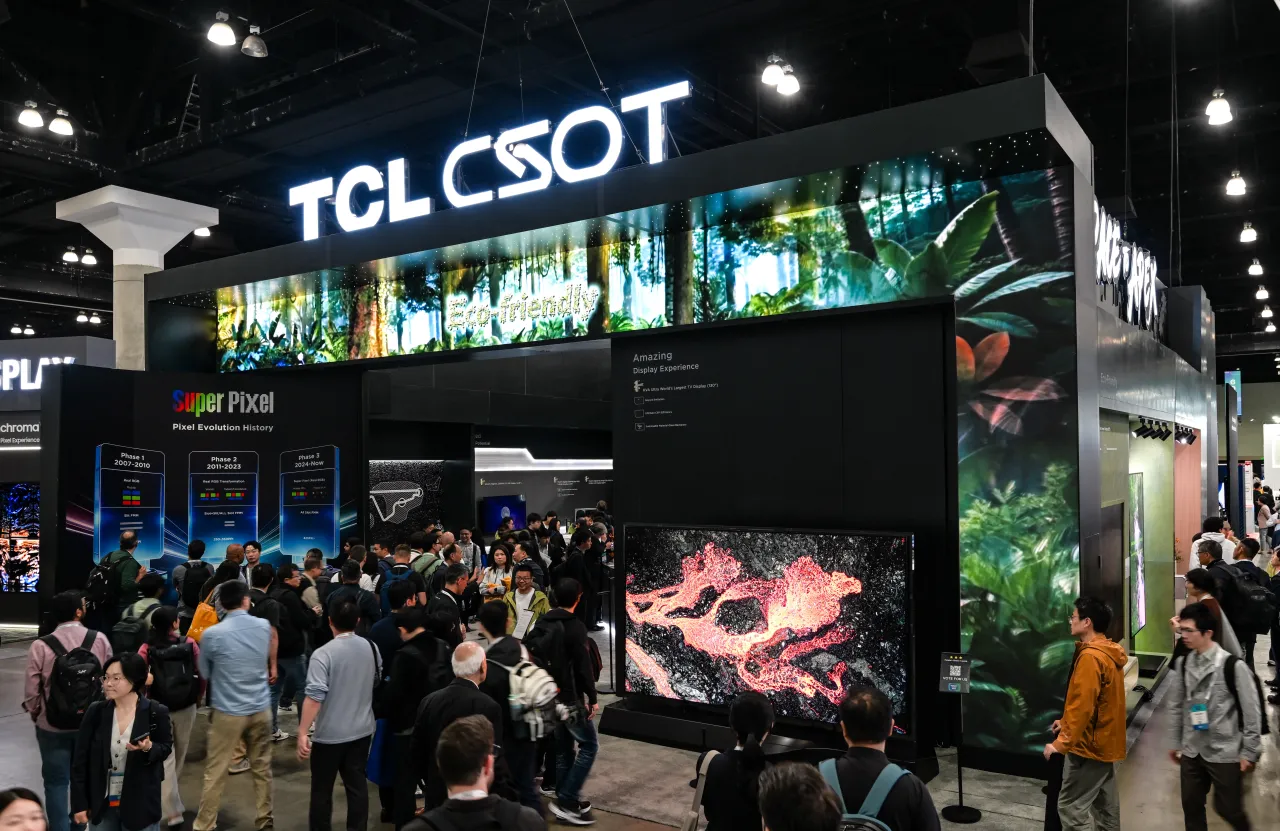
At SID Display Week 2026 in Los Angeles, TCL CSOT unveiled a wave of new technologies under its APEX framework, a strategy that places human experience at the center of display development while using AI throughout the creation process.
And some of the numbers behind that effort are turning heads.
Table of Contents
ToggleWhat Happened
TCL CSOT, a subsidiary of TCL Technology and a major display manufacturer, used SID Display Week 2026 to showcase innovations spanning televisions, smartphones, automotive displays, AR/VR devices, and advanced OLED manufacturing.
The centerpiece was APEX, the company’s human-centric display philosophy.
According to Ming-Jong Jou, Chief of Technology Planning Center, R&D Platform at TCL CSOT, AI is not being treated as a feature added later.
Instead, it’s becoming part of the infrastructure behind product development.
That distinction matters.
Many companies talk about AI-powered products.
TCL CSOT is talking about AI-powered engineering.
Must Read: 2026’s Most Worrying AI Shock? Anthropic’s Move Just Changed India’s AI Debate
AI Is Quietly Changing How Displays Get Built
One of the most notable aspects of the announcement wasn’t a screen at all.
It was the company’s use of AI digital twins.
These virtual simulations allow engineers to test products before physical prototypes are manufactured.
According to TCL CSOT:
- Average R&D cycles have been shortened by up to two months per project
- Product issue analysis efficiency improved by 20%
- Material development efficiency increased by 30%
- AI-powered inspections reduced missed defects by 85%
Those improvements could have significant implications in an industry where development costs continue rising.
But that’s only part of the story.
The bigger question is what happens when AI becomes embedded across every stage of manufacturing rather than simply enhancing finished products.
A New Pixel Structure Takes Aim at a Long-Standing Display Problem
Display technology often advances through small improvements that consumers barely notice.
This isn’t one of those cases.
TCL CSOT introduced an RGBC pixel structure that adds a dedicated cyan subpixel to the traditional red, green, and blue configuration.
The goal?
Improve color accuracy and image realism, particularly in blue and cyan portions of the spectrum where conventional RGB systems face limitations.
The technology is featured in the company’s 85-inch World’s Highest Image Quality WHVA Ultra LCD TV Display.
The additional subpixel also increases overall subpixel density, helping create sharper rendering and more natural-looking visuals.
And this is where things become interesting.
Instead of simply increasing brightness or resolution, TCL CSOT is targeting how humans actually perceive images.
The OLED Manufacturing Bet That Could Matter
Another major focus was inkjet printing OLED technology.
Traditional OLED manufacturing relies heavily on fine metal masks, a process that can waste significant amounts of material.
TCL CSOT says inkjet printing places materials precisely where needed, reducing waste and improving efficiency.
Quick Comparison
| Traditional OLED | Inkjet OLED |
|---|---|
| Uses fine metal masks | No mask required |
| Higher material waste | More precise placement |
| Expensive production process | Potential efficiency gains |
According to Jou:
- Factory production currently reaches 300 PPI
- Laboratory demonstrations have achieved 400 PPI
The company also highlighted a transition toward inorganic emitting materials, which could offer longer lifespan and lower power consumption.
For consumers, that could eventually translate into displays that last longer while using less energy.
Why the Automotive Industry Is Paying Attention
Not all of TCL CSOT’s announcements targeted televisions or smartphones.
Some of the most ambitious products were designed for vehicles.
The company introduced:
- World’s First IJP OLED Sliding Central Control Display (28″)
- World’s First IJP OLED Curved Armrest Display (28″)
- Ultra High Brightness Micro LED AR-HUD Display
- High Brightness, Low-Power P-HUD Display
The common theme is clear: bringing more information into a driver’s field of view while aiming to improve usability and safety.
As software-defined vehicles become increasingly important, displays are rapidly becoming one of the most critical components inside modern cars.
Contrarian View: Is the Industry Getting Too Focused on Screens?
Not everyone sees constant display innovation as an unquestioned win.
A growing conversation across technology circles asks whether the industry is prioritizing more screens, brighter screens, and larger screens while consumers simultaneously worry about screen fatigue and digital overload.
TCL CSOT appears aware of that tension.
Its APEX strategy repeatedly emphasizes visual comfort, eye health, natural light technologies, and energy efficiency alongside image quality.
Whether that balance satisfies critics remains to be seen.
But it highlights a broader challenge facing the entire display sector.
The next generation of screens may need to be not only more powerful—but also less intrusive.
What Happens Next
The announcements from SID Display Week 2026 reveal an industry moving beyond simple hardware competition.
AI-assisted engineering, advanced pixel structures, energy-efficient manufacturing, automotive integration, and immersive AR/VR displays are increasingly converging into a single ecosystem.
For TCL CSOT, the bet is straightforward.
The future of displays won’t be defined solely by resolution, brightness, or size.
It will be defined by how intelligently those technologies adapt to human needs.
The question now is whether consumers—and the broader industry—embrace that vision as quickly as display makers are building toward it.
Editorial Disclaimer: This article is based entirely on publicly available information from TCL CSOT’s presentation and statements shared during SID Display Week 2026. No facts, quotes, outcomes, or timelines have been fabricated. Analysis reflects currently available information and may evolve as new details emerge.