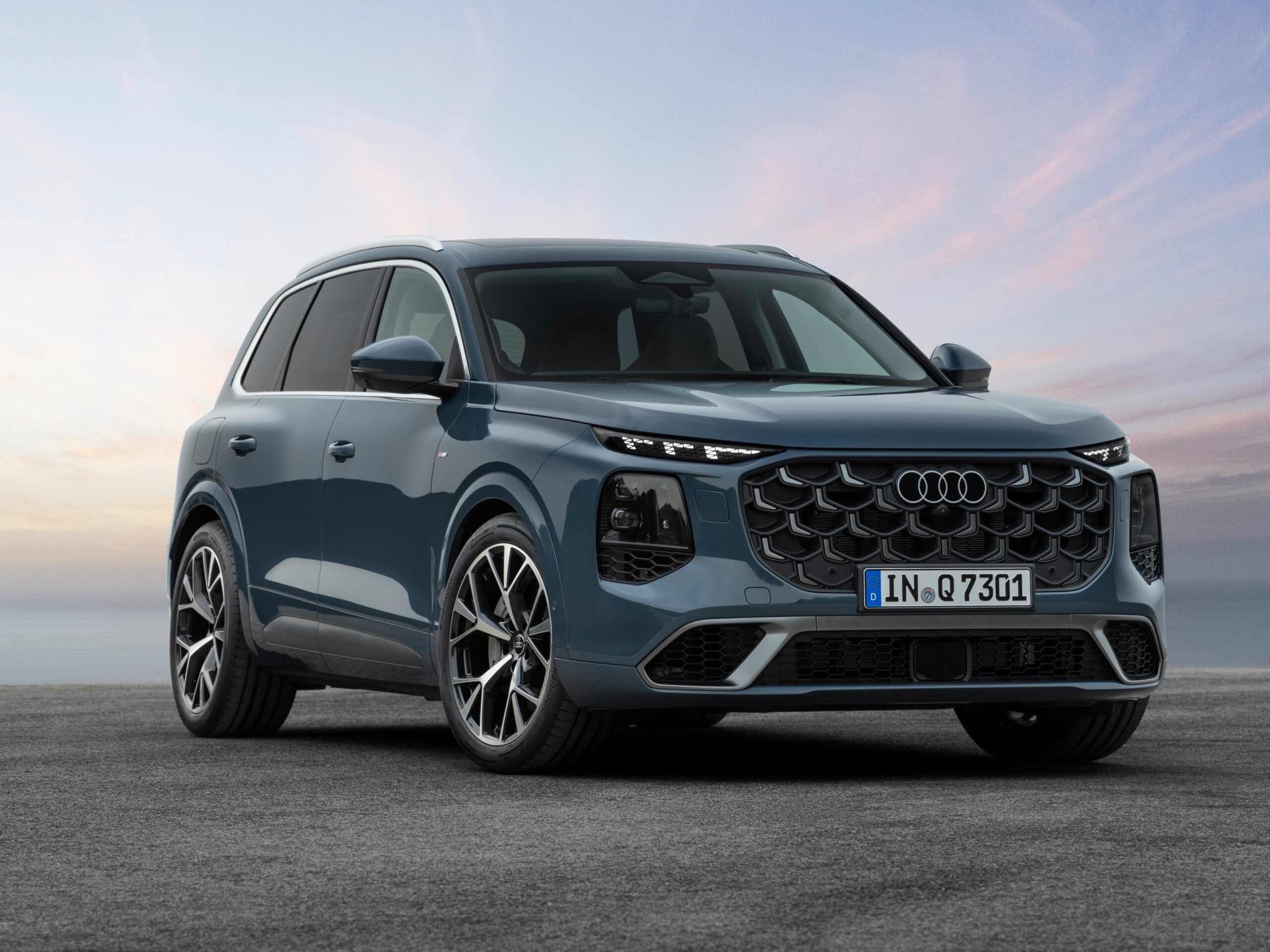
Something unusual is happening in the luxury SUV world.
While many automakers are rushing toward full electrification, Audi has just doubled down on diesel power with an all-new third-generation Q7. And it isn’t a minor update.
The flagship three-row SUV arrives with up to 630 Nm of torque, a heavily upgraded mild-hybrid system, smarter quattro all-wheel-drive hardware, and some of the most advanced lighting technology Audi has ever put into a production vehicle.
For buyers who thought large diesel luxury SUVs were slowly fading away, the new Q7 sends a very different message.
What Changed?
Audi has officially revealed the third-generation Q7, introducing a comprehensive redesign of its luxury SUV ahead of its global market launch later in 2026.
At the heart of the update is a 3.0-litre V6 turbo diesel engine offered in two states of tune.
| Specification | New Audi Q7 |
|---|---|
| Engine | 3.0L V6 Turbo Diesel |
| Power Output | 241 hp / 295 hp |
| Torque | 500 Nm / 630 Nm |
| Hybrid System | MHEV Plus |
| Additional Boost | Up to 24 hp |
| Transmission | 8-Speed Automatic |
| Drivetrain | Permanent Quattro AWD |
The headline figure is undoubtedly the 630 Nm torque output.
That’s the kind of number luxury SUV buyers tend to notice immediately, especially those who regularly travel with families, luggage, or long highway journeys.
But that’s only part of the story.
Audi has paired the diesel engine with its latest MHEV Plus mild-hybrid technology, allowing the powertrain generator to contribute up to 24 hp during acceleration.
An electrically powered compressor has also been added to reduce turbo lag and improve low-speed responsiveness.
In simple terms, Audi is trying to make a large SUV feel quicker and more responsive without sacrificing efficiency.
Must Read: Maruti’s Massive 2026 Move Protects 4 Popular Cars From a ₹30,000 Price Shock
The New Quattro System Could Be The Bigger Story
Most headlines will focus on the diesel engine.
The more interesting development may actually be underneath the vehicle.
Audi has introduced a new limited-slip centre differential with preload as part of its permanent quattro all-wheel-drive system.
The goal is improved traction and more effective torque distribution across different road conditions.
For a vehicle of this size and weight, that upgrade could significantly influence how the SUV behaves in real-world driving situations.
And for a brand whose identity is deeply connected to quattro technology, that matters.
Key Highlights
- New limited-slip centre differential
- Permanent quattro AWD
- Updated mild-hybrid assistance
- Improved acceleration response
- Better traction management
- Enhanced efficiency focus
And this is where things become interesting.
Audi isn’t just chasing technology headlines. It appears to be refining the fundamentals that luxury SUV buyers use every day.
A Cabin Designed Around Comfort
Inside, Audi has focused heavily on practicality and passenger experience.
The new Q7 comes standard with seven seats, while selected markets will also receive a six-seat version featuring second-row captain chairs.
Every seat gets electric adjustment.
Storage has improved as well.
The luggage compartment offers:
- 581 litres with seats in place
- Up to 1,980 litres with rear seats folded
Additional storage areas have been integrated into the cabin, while the redesigned centre console adds larger cupholders, dual Qi2 wireless charging pads, and extra everyday usability features.
But Audi didn’t stop there.
A new panoramic glass roof now features switchable transparency technology, allowing occupants to electronically alternate between transparent and opaque modes.
It’s the kind of feature that sounds futuristic until you actually use it.
Lighting Technology Takes Centre Stage
Audi has long treated lighting as a competitive advantage.
The new Q7 pushes that philosophy even further.
Optional Digital Matrix LED headlamps now use micro-LED technology capable of projecting high-resolution light patterns directly onto the road surface.
At the rear, third-generation Digital OLED tail lamps introduce communication lighting functions and active digital light signatures.
Owners can choose from as many as eight different lighting signatures.
Another noteworthy feature is the animated directional projection system, which can project indicators onto the road during turns or lane changes to improve awareness for cyclists and pedestrians nearby.
That’s a level of lighting sophistication rarely seen outside the premium luxury segment.
The Contrarian View
Not everyone will celebrate Audi’s latest strategy.
Some critics may question whether launching a new diesel-focused flagship SUV is the right move at a time when much of the automotive industry is accelerating toward electrification.
Others could argue that advanced lighting systems, digital signatures, and electronic features risk overshadowing the fundamentals that many buyers care about most: reliability, ownership costs, and long-term value.
However, Audi’s approach suggests there is still meaningful demand for high-torque diesel luxury SUVs, particularly among customers who prioritize long-distance touring, towing capability, and real-world usability.
The debate is unlikely to disappear anytime soon.
What Happens Next?
The third-generation Audi Q7 is expected to reach global markets toward the end of 2026.
When it arrives, it will continue battling some of the biggest names in the luxury SUV segment, including the BMW X5, Mercedes-Benz GLE, Volvo XC90, and Range Rover Sport.
India is expected to receive the new model in late 2026 or early 2027.
The specifications look impressive on paper.
The technology list is longer than ever.
The torque figures are headline-grabbing.
But the biggest question remains surprisingly simple:
In a luxury market increasingly dominated by electrification, can Audi’s bold new diesel-powered Q7 still win over the next generation of SUV buyers?
Editorial Disclaimer: This article is based entirely on publicly available information regarding the newly revealed third-generation Audi Q7. No facts, figures, outcomes, or future developments have been fabricated. Analysis and interpretation may evolve as additional official information becomes available.