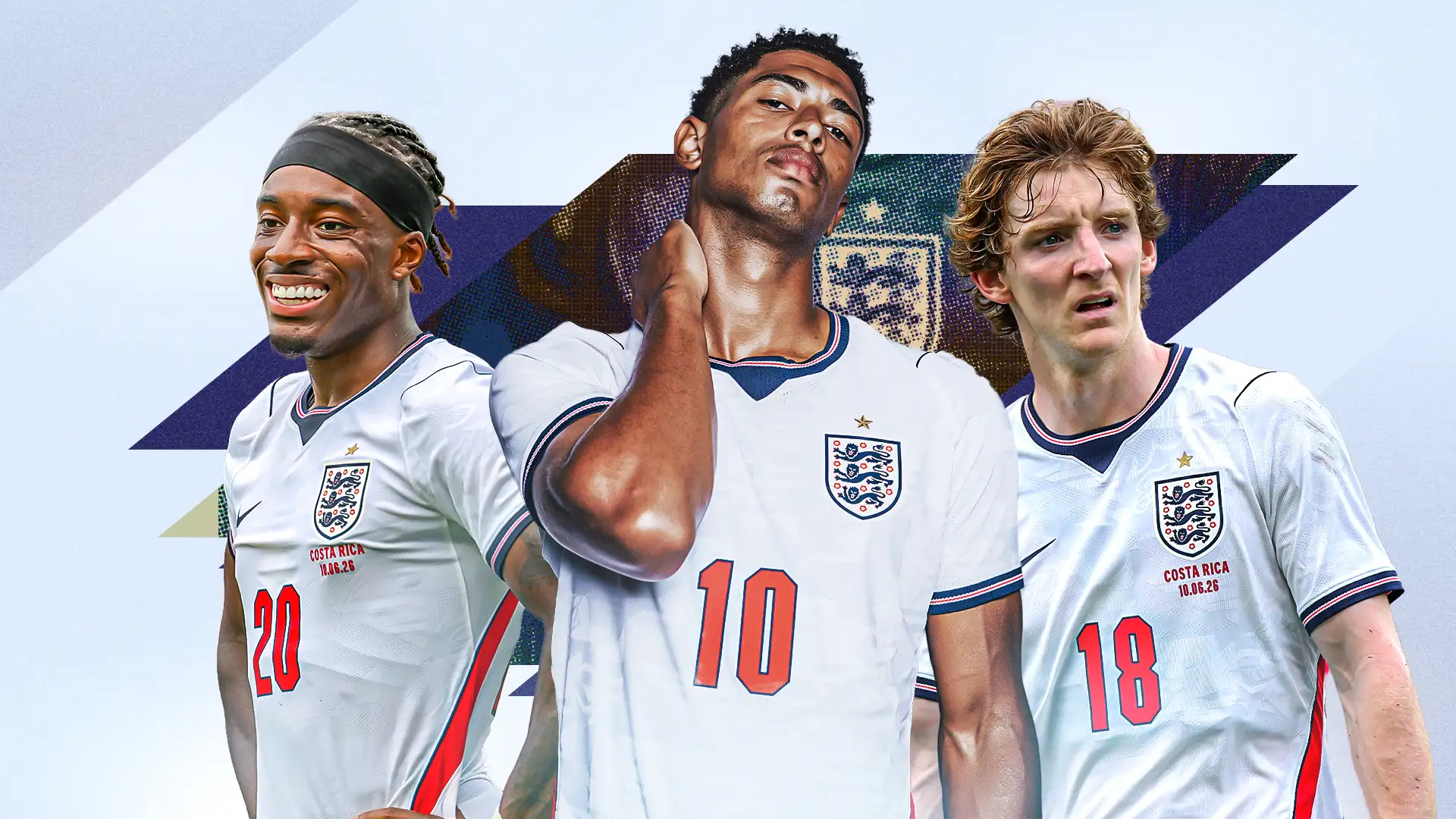
England’s starting XI for the 2026 World Cup opener vs Croatia is already dividing opinion — and not in a quiet way.
A reshaped defence, an injured star winger, and a bold Thomas Tuchel call in midfield have turned a “routine selection” into a full-blown tactical argument before a ball is even kicked.
The message from camp is clear: reputation won’t guarantee a starting spot anymore.
And that’s where things get interesting.
Table of Contents
ToggleWhat’s Happening Inside the England Setup
At the heart of the debate is England boss Thomas Tuchel, who has reportedly been juggling up to 14–15 potential starters ahead of facing Croatia national football team in Dallas.
The biggest shift? A defence that feels more experimental than settled.
Early indications suggest a backline featuring:
- RB: Reece James
- CB: Ezri Konsa
- CB: Marc Guehi
- LB: Nico O’Reilly (naturally a converted midfielder)
It’s a back four that mixes elite potential with clear uncertainty — especially on the left side, where O’Reilly’s attacking instincts raise as many questions as they solve.
But Tuchel’s camp seems comfortable taking that risk.
For now.
Must Read: Ronaldo 2026 World Cup Gamble Sparks Dramatic Legacy Debate
Why It Matters More Than It Looks
Midfield is where England’s identity is being shaped.
There’s no debate about one name: Declan Rice remains the anchor.
But beside him, the choice of Elliot Anderson signals something subtle — balance over flash.
Ahead of them sits the real headline act: Jude Bellingham in the attacking midfield role.
This is where England expect control, creativity, and chaos — all in one player.
But even here, there’s a tension running through the squad: Morgan Rogers was considered internally, but Bellingham’s influence has essentially ended that debate before it started.
And that says a lot about England’s hierarchy heading into the tournament.
The Attack: Injury Chaos and Tough Calls
The biggest disruption comes on the right flank.
Bukayo Saka would normally be undroppable — but fitness concerns have opened the door.
That has pushed Noni Madueke into a starting role.
It’s a downgrade on paper. But Tuchel’s system values energy, pressing, and vertical running — and Madueke fits that profile better than most.
On the left, the battle is just as tight:
- Anthony Gordon brings pressing intensity and directness
- Marcus Rashford offers experience and explosiveness
Gordon gets the nod here — not because Rashford lacks quality, but because tactical discipline is being prioritized over individual brilliance.
At striker, there is no debate.
Harry Kane remains the central figure — the system revolves around him, not away from him.
Full England XI Taking Shape
A simplified snapshot of the projected lineup:
| Position | Player |
|---|---|
| GK | Jordan Pickford |
| RB | Reece James |
| CB | Ezri Konsa |
| CB | Marc Guehi |
| LB | Nico O’Reilly |
| CM | Declan Rice |
| CM | Elliot Anderson |
| CAM | Jude Bellingham |
| RW | Noni Madueke |
| LW | Anthony Gordon |
| ST | Harry Kane |
It’s a blend of stability and experimentation — but not everyone is convinced it holds together under tournament pressure.
Contrarian View: England Might Be Overthinking Everything
Here’s the uncomfortable argument inside analyst circles: England may be over-optimizing.
Leaving out more natural defensive balance in favour of positional experiments like O’Reilly could create structural instability. Similarly, benching Saka — even if partially justified by fitness — removes England’s most consistent wide threat.
And then there’s the bigger concern:
This XI prioritizes system fit over peak individual quality in key areas.
That can work in theory.
But international tournaments rarely reward theory.
They reward certainty.
What Happens Next Could Define England’s Tournament
If Tuchel’s structure clicks, England suddenly look like a modern, pressing machine built for knockout football. Quick transitions, compact midfield control, and Kane as the finishing piece.
But if it misfires against Croatia, the questions will come fast:
- Is the defence too experimental?
- Is Saka’s absence too costly?
- Has system-thinking gone too far?
One match might not define England’s World Cup — but it will define the conversation around them.
And that’s where all eyes now shift.
Because in tournaments like this, the line between bold and reckless is usually very thin.
Disclaimer: This article is based on publicly available information and analysis of reported team selection discussions. No facts, outcomes, or future events have been fabricated. Interpretations may evolve as new information emerges.