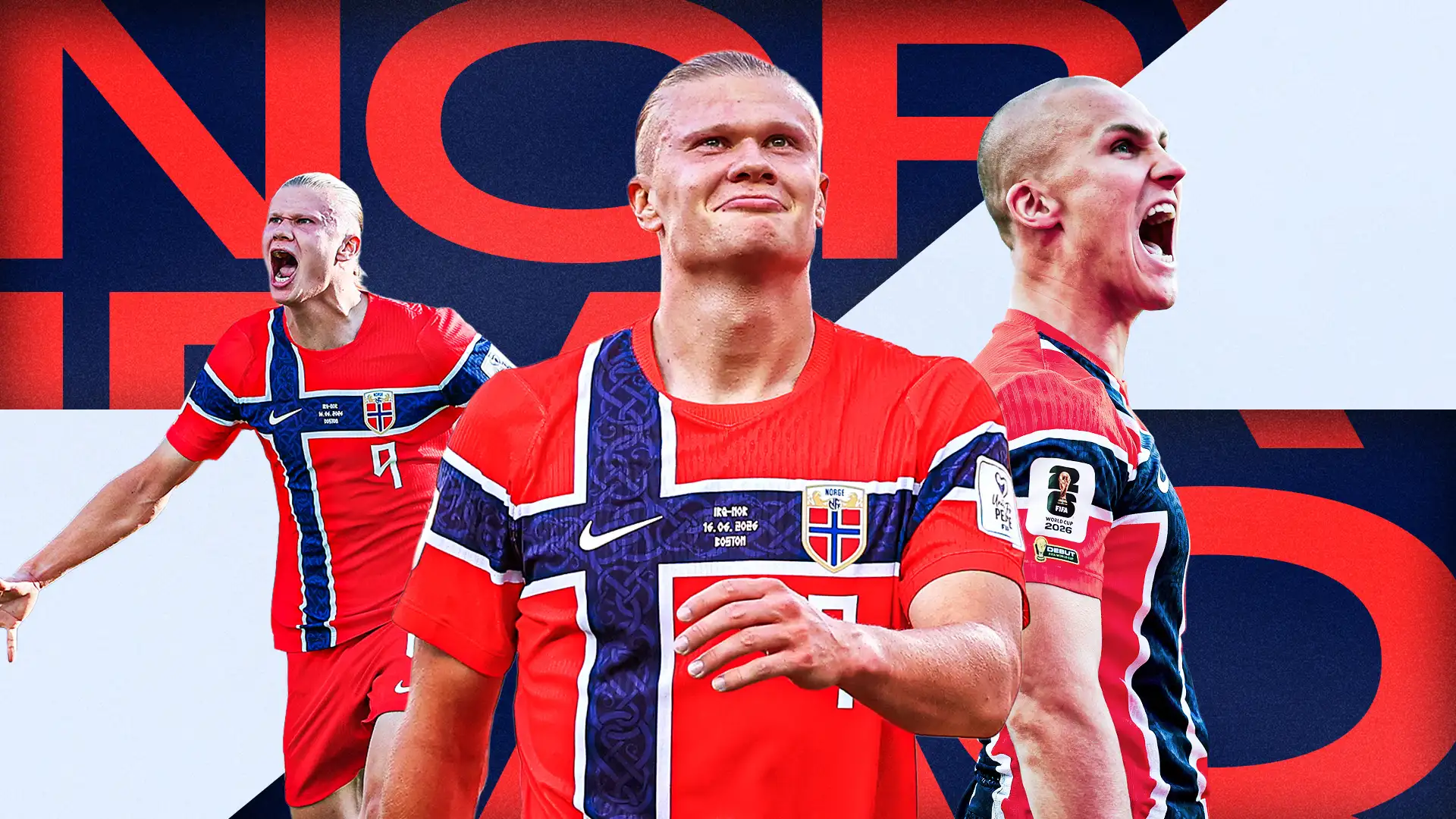
Norway had barely settled into their long-awaited World Cup return when the match flipped into something unavoidable.
Within minutes, the script was rewritten — and it had one name all over it.
Erling Haaland didn’t just score. He tilted the entire game.
And by the time the whistle confirmed a 4-1 win over Iraq, the message was loud: Norway are not here to participate. They are here to disrupt.
Table of Contents
ToggleWhat Happened: A Return 28 Years in the Making
Norway’s first World Cup appearance since 1998 began with nerves — and it showed.
Iraq actually struck first in terms of rhythm, testing a shaky Scandinavian back line early. But the turning point arrived just before the half-hour mark when Haaland reacted like a striker operating on pure instinct, turning home a cross at the back post.
Then came the moment that changed everything.
A defensive mistake. A loose back-pass. A split-second press.
Haaland pounced — and the ball ricocheted off him into the net. No elegance. No buildup. Just inevitability.
Quick Match Snapshot
- Iraq equalized via Ayman Hussein’s header
- Norway regained control through Haaland’s pressing chaos
- Late goals sealed by Leo Østigård and an own goal
- Final score: Norway 4–1 Iraq
That scoreline, however, hides how fragile the game felt for long stretches.
Must Read: Mbappé’s Dramatic 2026 Turnaround Sparks Debate After France’s 3-1 Win
Why It Matters: Norway’s “Dark Horse” Label Suddenly Feels Real
This wasn’t supposed to be comfortable. Not in a “Group of Death” scenario. Not after a 28-year absence.
But the presence of Haaland changes everything.
Norway didn’t dominate possession. They didn’t dominate creativity. In fact, much of the midfield — including Martin Ødegaard — struggled to impose themselves.
Yet the scoreboard tells a different truth.
Because when you have Haaland, control is optional.
The Haaland Effect: Two Chances, Two Goals, Total Collapse
This is where the match becomes uncomfortable for opponents.
Haaland didn’t need volume. He needed moments.
- First shot on target → goal
- First pressing trigger → goal
- Minimal involvement second half → still decisive outcome
Even when quiet, he distorted Iraq’s defensive structure simply by existing.
And that’s the problem teams will face all tournament.
Hidden Problem: Norway Still Don’t Look Fully Stable
For all the headlines, Norway’s performance wasn’t clean.
Early defensive shakiness gave Iraq belief. The midfield lacked control. Even wide transitions looked rushed.
Players like Kristoffer Ajer and David Møller Wolfe had moments of quality, but the structure wobbled under pressure.
Concern List for Norway:
- Slow defensive reactions under pressure
- Midfield creativity inconsistent
- Over-reliance on Haaland’s efficiency
- Vulnerability to fast counter-attacks
That’s the tension: Norway look dangerous, but not necessarily dominant.
Industry Reaction: “One-Man Momentum Shift”
Early reactions across analysts focused on a simple idea — Norway don’t need many chances to win games.
Some highlighted how substitute impact also mattered:
- Leo Østigård scored shortly after coming on
- Kristian Thorstvedt influenced the late own goal
- Antonio Nusa showed flashes of unpredictability
But the conversation always circled back to one point: Haaland changes geometry, not just results.
Contrarian View: Are Norway Being Overhyped Too Early?
Here’s the uncomfortable question nobody wants to ask:
What if Norway are being carried by finishing, not dominance?
Because for long spells, Iraq looked capable of exploiting gaps. They created chances. They pressed. They unsettled Norway’s structure.
And yet the narrative instantly became “Norway are contenders.”
That might be premature.
A brutal truth in tournament football is this:
Clinical finishing can mask structural weakness — until it doesn’t.
If Haaland has a quiet match, do Norway still control games? That remains unanswered.
What Happens Next: A Test Far Beyond Iraq
The road doesn’t get easier.
With tougher opponents ahead, Norway’s balance will be tested far more severely than in Boston.
Key question marks:
- Can Ødegaard dictate games under pressure?
- Can Norway defend without retreating too deep?
- Can Haaland maintain this conversion rate against elite defenses?
Because while this win feels statement-like, the next matches will decide whether Norway are truly dark horses — or just a team leaning heavily on one generational striker.
Final Word: A Beginning That Feels Like a Warning
Norway’s return to the World Cup didn’t arrive quietly. It arrived with goals, chaos, and inevitability wrapped around one player.
But beneath the excitement lies something more fragile — a team still searching for control in the biggest moments.
And that leaves one lingering question hanging over the tournament:
If Haaland stops scoring twice a game… how far can Norway really go?
Disclaimer: This article is based on publicly available match information and reports. No facts or outcomes have been altered or fabricated. Interpretations reflect analysis at the time of writing and may evolve as the tournament progresses.