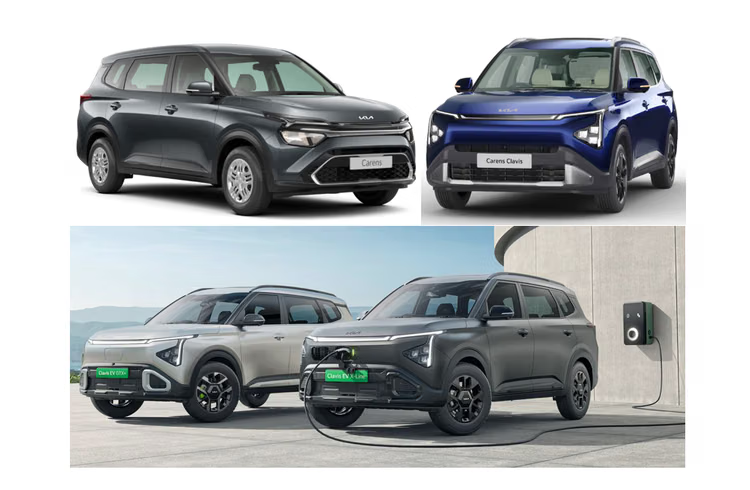
It’s not every day an MPV quietly crosses a 3 lakh sales milestone in India.
But the Kia Carens just did exactly that in 2026—and the timing is what’s turning heads.
Because behind the headline number… the real story is far more complicated than it looks.
Table of Contents
ToggleWhat Happened: The 3 Lakh Milestone
The Kia Carens, along with its Clavis and Clavis EV variants, has crossed 3,01,657 cumulative units in India as of May 2026.
Since its 2022 debut, the MPV has slowly but steadily built momentum for Kia Corporation in one of the most competitive segments in the country.
And here’s the kicker:
- Over 32,000 units exported
- Strong demand spike after 2025 refresh and Clavis expansion
- Over 11,500 units already sold in FY27 (till May 2026)
At first glance, it looks like a clean success story.
But dig deeper—and the curve isn’t as smooth as it seems.
Must Read: 2026 Le Mans & Barcelona GP Shock Schedule Clash Raises Big Questions
The Sales Story Isn’t Linear (And That’s the Twist)
Carens didn’t grow in a straight line. It zig-zagged.
| Fiscal Year | Sales (Units) | YoY Change |
|---|---|---|
| FY22 | 12,692 | — |
| FY23 | 70,314 | +454% |
| FY24 | 63,167 | -10% |
| FY25 | 64,609 | +2% |
| FY26 | 79,202 | +23% |
| FY27 (till May) | 11,673 | +19% |
That dip in FY24? Still echoes in the market.
Even though FY26 bounced back strongly, the momentum shift came only after Kia expanded the lineup with Clavis and later the EV version.
That raises a question few are asking out loud:
Was the Carens actually slowing down before it was “saved” by variants?
Why This Matters More Than the Number
The MPV space in India isn’t just crowded—it’s brutal.
Carens is fighting directly against giants:
- Maruti Suzuki India Limited with the Ertiga
- Toyota Motor Corporation with Innova Crysta and Innova Hycross
And yet:
- Ertiga still dominates volume leadership
- Innova continues to command premium trust
- Carens sits in a tricky middle zone—feature-rich, but identity-shifting
Despite that, Kia’s MPV became its third-best-selling nameplate after Seltos and Sonet.
That’s not just growth.
That’s survival in a segment where most players fade out quietly.
The Real Market Impact (What No One Says Out Loud)
Carens now contributes 26% of Kia India’s total cumulative utility vehicle sales.
That’s massive dependency on a single MPV line.
And there’s another layer:
- Carens price range: ~₹11–13 lakh
- Clavis range: ~₹11–21 lakh
- Clavis EV: up to ~₹25 lakh
The overlap is intentional—but it also creates internal competition.
So while the portfolio looks stronger on paper, the segmentation is getting messy underneath.
Hidden Problem: Too Many Identities in One Nameplate?
Here’s where things get interesting.
Carens started as:
- A practical 6/7-seater family MPV
Then evolved into:
- A “budget-friendly” fleet option (Carens)
- A more premium lifestyle MPV (Clavis)
- A mass-market EV experiment (Clavis EV)
That’s three identities under one umbrella.
And it’s not clear yet whether that’s brilliance—or confusion.
Because buyers don’t always want “choices.”
They want clarity.
Contrarian View: Is This Really a Success Story?
On paper, 3 lakh sales sounds like dominance.
But some industry watchers argue something different:
The Carens didn’t just grow—it expanded to avoid stagnation.
In other words:
- Growth may be variant-driven, not demand-driven
- Momentum may be supported by segmentation tricks
- The base MPV might not be as strong as headline numbers suggest
This is where debate splits sharply.
One side sees a successful multi-powertrain strategy.
The other sees a product stretched across too many roles to maintain momentum organically.
Both can’t be fully wrong.
But both can’t be fully right either.
What Happens Next: The Real Pressure Point
The next phase is where things get harder, not easier.
Carens now faces three pressures:
- Keeping ICE demand stable in a shifting market
- Scaling EV acceptance without cannibalizing itself
- Holding ground against established MPV leaders
And with electrification accelerating in India, the Clavis EV might become the real test—not the original Carens.
Because the question is no longer “Can it sell?”
It’s now:
Can it stay relevant in three different directions at once?
Final Thought
3 lakh units is a milestone most automakers would celebrate loudly.
But for Kia, it also marks something more subtle—a turning point where success starts demanding tougher decisions about identity, positioning, and long-term direction.
And the biggest question now is simple:
Is the Carens still one product… or already three competing stories inside one badge?
Disclaimer: This article is based on publicly available information from the provided source. No facts, figures, or outcomes have been fabricated. Interpretations and analysis may evolve as new industry data emerges.