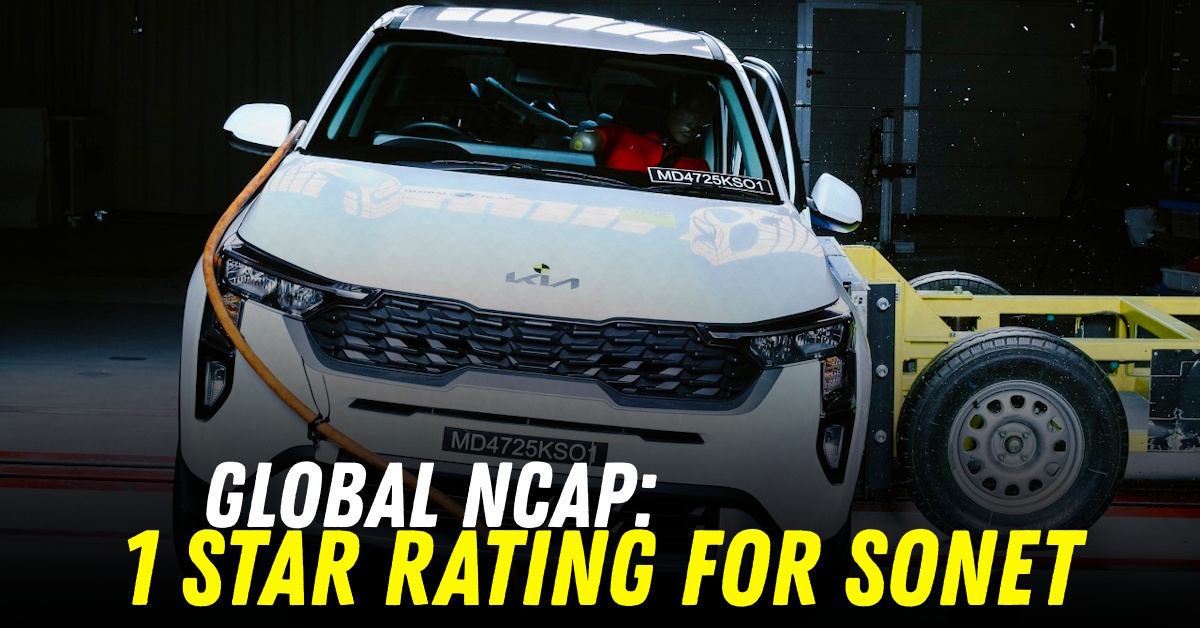
India-made Kia Sonet lands a 1-star Global NCAP rating in 2026, and the result is already shaking trust in one of the most popular compact SUVs across global markets.
But here’s the twist: the same SUV behaves very differently depending on where and how it’s sold.
That contradiction is what’s now setting off a much bigger conversation.
Table of Contents
ToggleWhat Happened: The Crash Test That Changed the Conversation
The India-made Kia Sonet, tested by Global NCAP, has returned a 1-star Adult Occupant Protection rating and a 3-star Child Occupant Protection rating.
But the version tested wasn’t the fully equipped Indian model.
It was a dual-airbag variant made in India for the South African market, missing key safety equipment like standard ESC and side airbags.
That single detail becomes the center of the entire controversy.
Must Read: QJ Motor SRV 600 V2 Spotted in 2026 Testing Sparks Surprising India Buzz
The Numbers That Raised Eyebrows
The test results weren’t just low—they were sharply uneven across categories.
Key Safety Scores:
- Adult Occupant Protection (AOP): 21.29 / 34 → 1 star
- Child Occupant Protection (COP): 28.57 / 49 → 3 stars
- Frontal offset score: 9 / 16
- Side pole test: not conducted (no curtain airbags)
And the biggest red flags:
- Unstable bodyshell
- Unstable footwell area
- Poor protection for driver’s feet
- Knees exposed to “dangerous structures behind fascia”
That’s not just a weak result—it signals structural limitations under crash load.
Why This Rating Is Stirring Debate
On paper, the result looks alarming.
But in India, the story is more complicated.
The Indian-spec Kia Sonet comes with:
- 6 airbags as standard
- Electronic Stability Control (ESC) as standard
That’s a major difference from the tested version.
So the question becomes uncomfortable:
Is the 1-star rating actually about the Sonet—or about the specific low-spec export variant?
And that’s where opinions start splitting sharply.
Hidden Problem: Same Name, Different Safety Reality
This is where things get messy for buyers.
The same model name can represent very different safety setups depending on market:
- South Africa version: dual airbags, no standard ESC
- India version: six airbags + ESC standard
This disconnect creates a perception gap that’s hard for average buyers to decode.
Even more concerning:
- Side pole test wasn’t conducted due to missing curtain airbags
- Body shell integrity flagged as unstable under stress
- Driver footwell rated “poor” protection
In crash testing, those are structural concerns—not just equipment gaps.
Child Safety: A More Stable Picture, But Not Perfect
Interestingly, child occupant protection tells a different story.
The Sonet performed much better here:
- 24/24 dynamic score
- Full protection in frontal and side crash tests for child dummies
- ISOFIX-supported rearward-facing child seats performed well
But points were lost due to:
- Limited CRS installation flexibility in rear center seat
- No option to deactivate co-driver airbag for child seat setup
So while children are relatively safer, flexibility remains an issue.
Industry Context: How Rivals Stack Up
The compact SUV battlefield is already crowded—and safety is becoming a defining factor.
Some competitors have already moved ahead:
- Tata Nexon → 5-star Global NCAP
- Nissan Magnite → 5-star Global NCAP
Meanwhile, rivals in India like the Venue, Syros, Kylaq, and XUV 3XO have also secured 5-star ratings under Bharat NCAP testing.
That makes the Sonet’s result feel even more polarizing in comparison.
Contrarian View: Is the Rating Being Misread?
Here’s where things get controversial.
Some argue the 1-star rating is being interpreted too aggressively because:
- The tested version is not the fully equipped Indian model
- ESC is technically available but not standard in that export trim
- Structural concerns may reflect low-spec configuration impact, not the entire platform
In that sense, critics say:
The rating may reflect “what was tested,” not “what Indian buyers actually get.”
But safety advocates counter that consumers rarely differentiate by export spec—they see one name, one result.
And that perception is what ultimately sticks.
Market Impact: The Reputation Pressure Is Real
Even with clarification, the damage risk is real.
The compact SUV segment in India is brutally competitive:
- Maruti Suzuki Brezza
- Hyundai Venue
- Kia Syros
- Skoda Kylaq
- Mahindra XUV 3XO
- Renault Kiger
- Maruti Suzuki Fronx
- Toyota Urban Cruiser Taisor
In this crowd, safety ratings are no longer optional marketing points—they are deal breakers for many buyers.
What Happens Next?
The big unanswered question now is perception vs reality.
Will buyers:
- Trust the India-spec safety package upgrade?
- Or remember the “1-star Sonet” headline first?
And more importantly:
If Global NCAP tests a fully loaded India-spec version next, will the story change completely—or not change much at all?
That’s the uncertainty now hanging over one of Kia’s most important models.
Final Thought
The Kia Sonet story in 2026 isn’t just about a crash test result.
It’s about how one name can represent two very different safety realities—and how quickly public perception can lock in before all versions are tested equally.
And the industry is now left with a difficult question:
Should safety ratings reflect the variant tested—or the badge on the hood?
Disclaimer
This article is based on publicly available information from Global NCAP testing reports and related automotive disclosures. No facts, figures, or outcomes have been fabricated. Interpretation and analysis may evolve as new information becomes available.