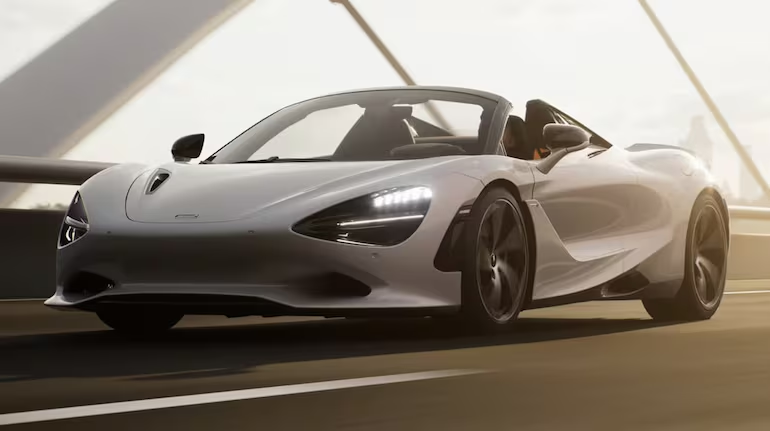
India’s supercar market just got hit with a number that feels almost unreal.
A price cut of up to Rs 3.3 crore on a McLaren. Not a discount season. Not a clearance event. A structural reset.
And it’s tied to something much bigger than cars.
The India–UK trade deal is starting to reshape what luxury looks like on Indian roads.
Table of Contents
ToggleWhat Happened
British supercar maker McLaren Automotive is preparing a dramatic price reduction across its India lineup—as much as 38%.
The cuts are being rolled out in anticipation of the India–UK Free Trade Agreement, which is expected to slash import duties on high-end British cars.
But here’s the twist: the deal isn’t even active yet.
Still, brands are already pricing in the future.
And the impact is immediate.
New vs Old Prices (India)
| Model | New Price | Old Price | Drop |
|---|---|---|---|
| 750S Coupe | Rs 4.94 Cr | Rs 7.94 Cr | ~Rs 3.0 Cr |
| 750S Spider | Rs 5.46 Cr | Rs 8.78 Cr | ~Rs 3.32 Cr |
| GTS | Rs 3.83 Cr | Rs 6.15 Cr | ~Rs 2.32 Cr |
The 750S Spider takes the biggest hit. A car that once sat firmly in “ultra-exclusive” territory is suddenly… slightly less unreachable.
But not everyone is celebrating.
Must Read: Kia Discounts Shake 2026 Market: Up to ₹1.5 Lakh Off—But There’s a Catch
Why This Matters
This isn’t just a McLaren story. It’s a tariff story disguised as a luxury headline.
The India–UK deal is expected to reduce duties on British petrol cars above 3,000cc from 110% down to 30% in year one, eventually dropping to 10% by year five, within a quota system.
That alone rewrites pricing logic for brands like:
- Jaguar Land Rover
- Bentley
- Rolls-Royce
- Aston Martin
- Lotus
And McLaren is simply the first to move aggressively.
The Bigger Shift in the Market
India’s luxury car space has always been duty-heavy, status-driven, and tightly priced.
Now that structure is wobbling.
What’s changing fast:
- Supercars entering “lower crore bands”
- Faster buyer decision cycles
- Early imports priced on future tax assumptions
- Quota-based competition between British brands
And there’s another layer most people miss.
McLaren entered India only in 2021, opened its Mumbai showroom in 2022, and has delivered about 50 cars by early 2025.
So this pricing shift is happening in a market that is still very young—and still forming its identity.
Industry Reaction: Quiet but Tense
While McLaren is moving first, others are watching closely.
Jaguar Land Rover already trimmed prices earlier in May—between 15–18% on select Range Rover models—but explicitly said it may not pass on full benefits.
That signals something important:
Not every brand wants to fully transmit tariff gains to buyers.
Some may hold pricing power instead of triggering a race to the bottom.
And that’s where tension begins building under the surface.
Contrarian View: Is This Even a “Price Cut”?
Here’s the uncomfortable question nobody in marketing wants to answer.
What if this isn’t really a discount?
Because the India–UK FTA hasn’t been implemented yet. No final ratification. No operational quota clarity.
So what’s happening instead is:
- Forward pricing based on expectation
- Competitive positioning before rivals act
- Risk-sharing shifted to early buyers
In other words, buyers aren’t just getting cheaper McLarens.
They might be absorbing uncertainty disguised as savings.
And that changes the narrative completely.
Key Implication Nobody Can Ignore
If the agreement stalls or changes:
- pricing assumptions could break
- quota allocation could tighten supply
- “discounted” models may suddenly feel mispriced
But if it proceeds smoothly?
India could become one of the most aggressively repriced luxury car markets in the world.
That’s the gamble.
What Happens Next
The real pressure now shifts to timing.
- When the India–UK agreement is formally ratified
- How quotas are distributed among British brands
- Whether competitors match McLaren’s aggressive cut
- And whether demand spikes faster than supply
For now, McLaren has done something subtle but powerful—it has forced the entire luxury segment to re-evaluate what a “normal price” even means in India.
And once that expectation resets, it rarely goes back.
Final Thought
A Rs 3.3 crore price drop sounds like good news on paper.
But underneath it sits a more complicated reality—trade policy, timing risk, and strategic positioning all colliding at once.
The real question isn’t whether McLarens are cheaper in 2026.
It’s whether this is the beginning of a permanent shift in how luxury is priced in India—or just a temporary illusion created before the rules fully take effect.
Disclaimer: This article is based on publicly available information. No facts or outcomes have been fabricated. Interpretations and market implications may evolve as new details emerge.