India’s electric car market just delivered another surprise.
EV passenger vehicle registrations surged 81.2% year-on-year in May 2026, but the biggest story isn’t simply that electric cars are growing. It’s how quickly the battle for dominance is changing.
While Tata Motors remains firmly on top, several rivals are moving faster than many expected. And some of the industry’s biggest names are now facing uncomfortable questions.
That’s where things get interesting.
Tata Still Rules, But the Gap Is Getting More Competitive
According to FADA retail data, electric passenger vehicle registrations reached 26,682 units in May 2026, up sharply from 14,725 units during the same month last year.
Tata Motors once again led the market with 10,340 retail registrations.
That’s a staggering 103.4% jump from 5,083 units recorded in May 2025.
The continued popularity of the Tiago EV, Punch EV and Nexon EV helped Tata maintain its commanding position, accounting for nearly 39% of all EV passenger vehicle retail sales during the month.
But while Tata remains the king of the hill, competitors are no longer standing still.
Must Read: Massive 63% EV Surge in 2026: TVS Overtakes Rivals as Ola Faces Tough Questions
The Real Shock? Mahindra’s Relentless Climb
If Tata dominated the market, Mahindra delivered one of the most eye-catching performances.
The company registered 6,210 electric vehicles in May 2026, more than doubling its May 2025 figure of 2,891 units.
That translates to a remarkable 114.8% year-on-year growth.
Much of this momentum came from the XEV 9e, BE 6 and the newly introduced three-row XEV 9S.
For years, Tata largely controlled the EV conversation in India.
Today, Mahindra is making that conversation far more competitive.
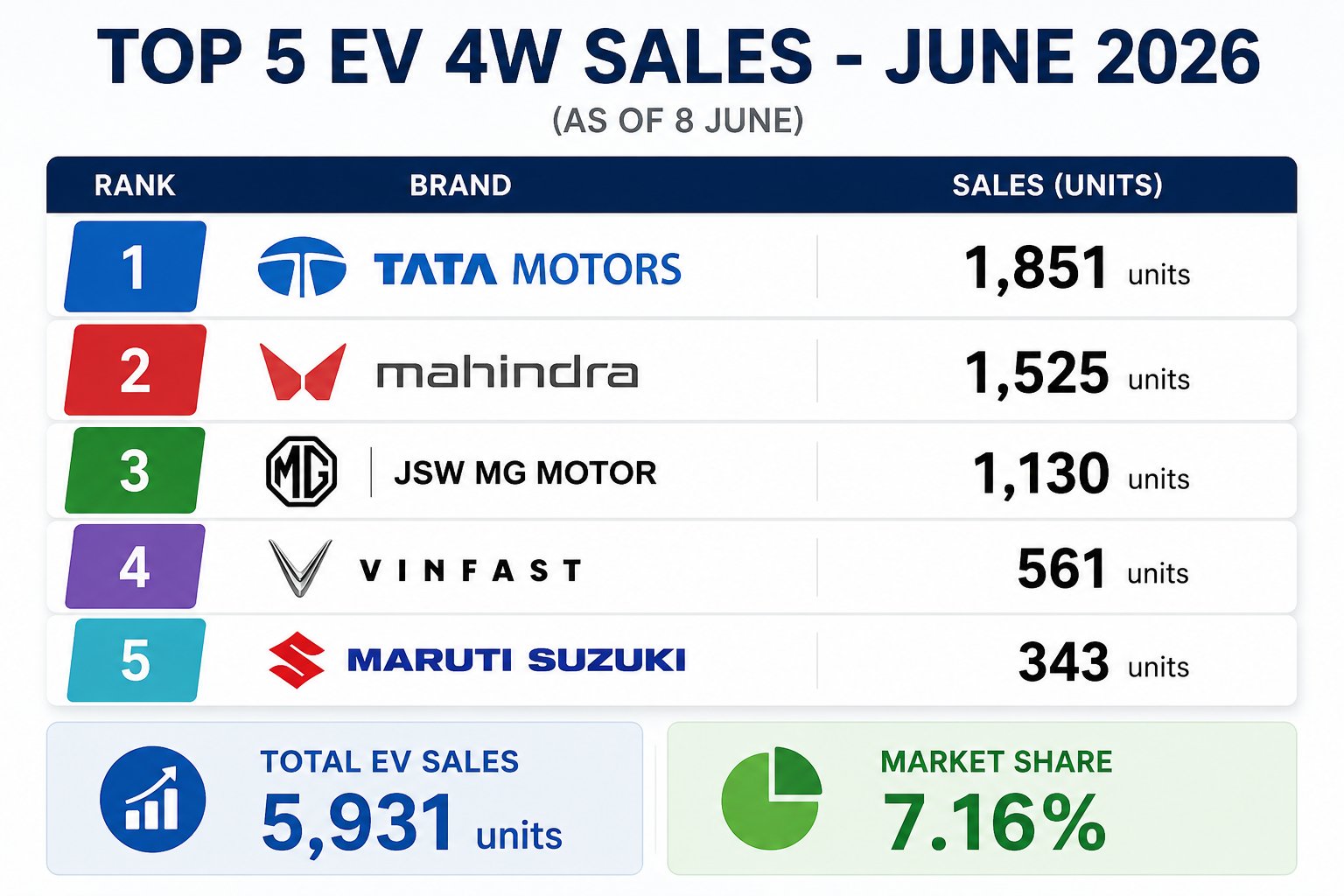
Quick Snapshot: Top 5 EV Brands in May 2026
| Brand | Retail Sales |
|---|---|
| Tata Motors | 10,340 |
| Mahindra | 6,210 |
| JSW MG Motor | 4,984 |
| Maruti Suzuki | 1,591 |
| VinFast | 1,238 |
But that’s only part of the story.
MG Holds Strong While New Players Make Noise
JSW MG Motor India secured third place with 4,984 retail registrations.
The Windsor EV continued to be the brand’s key volume driver.
Although sales slipped compared to April 2026, MG still posted an 8.4% year-on-year increase, proving it remains one of the strongest players in India’s growing EV ecosystem.
Meanwhile, Maruti Suzuki entered fourth position with 1,591 units.
The recently launched e Vitara appears to be gaining traction quickly, giving India’s largest carmaker a meaningful presence in the electric segment.
And then there’s VinFast.
The Vietnamese manufacturer recorded 1,238 registrations, enough to secure fifth place as it expands its footprint through the VF electric SUV lineup.
For a relatively new entrant, that’s a number competitors cannot ignore.
Premium Brands Tell a Very Different Story
While mass-market brands grabbed most headlines, premium manufacturers produced some fascinating results.
BYD registered 686 units and grew 10.5% year-on-year.
BMW delivered one of the strongest premium performances with 352 units, up 75.1%.
Mercedes-Benz followed with 208 units and recorded a significant month-on-month improvement.
However, not everyone celebrated.
Hyundai recorded 460 units, down 36% compared to May 2025.
Volvo slipped to 29 units.
Stellantis saw registrations fall sharply to just 22 units.
The EV boom may be real, but it’s clearly not benefiting every automaker equally.
Biggest Winners by Growth Rate
- Kia India: +751.2%
- Mahindra: +114.8%
- Tata Motors: +103.4%
- BMW India: +75.1%
- Mercedes-Benz: +70.5%
Those numbers highlight how rapidly market positions can change in the electric era.
Contrarian View: Is Market Growth Hiding a Bigger Battle?
At first glance, an 81.2% surge in EV registrations looks like a clear victory for the industry.
But beneath the headline growth lies a tougher reality.
A handful of brands continue to account for the overwhelming majority of sales, while several established automakers struggle to gain meaningful traction.
The market is expanding rapidly, yet competition is becoming more concentrated around a few successful products.
That raises an important question:
As EV adoption accelerates, will more manufacturers break through, or will a small group of brands dominate the next phase of growth?
The answer could shape India’s electric vehicle landscape for years.
What Happens Next?
May 2026 reinforced one major trend: India’s EV transition is speeding up.
Tata remains the benchmark.
Mahindra is emerging as a serious challenger.
MG continues to hold its ground.
Maruti Suzuki is finally entering the conversation.
And new players like VinFast are proving they cannot be dismissed.
The bigger story may not be who leads today.
It’s whether the companies chasing Tata can keep growing at this pace—and whether India’s EV market is heading toward broader competition or a new era of dominance by just a few powerful brands.
That question may define the next chapter of India’s electric vehicle revolution.
Editorial Disclaimer: This article is based entirely on publicly available retail sales data and information reported by industry sources. No facts, figures, outcomes, or claims have been fabricated. Analysis and market interpretation may evolve as new data becomes available.