Something unusual just happened on one of the most dangerous roads in motorsport history.
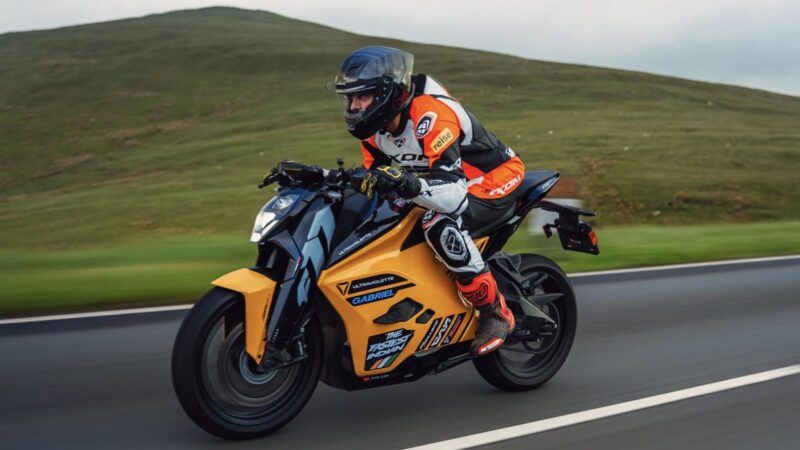
An Indian electric motorcycle didn’t just show up at the Isle of Man TT — it finished a lap.
And that alone is rewriting expectations in 2026.
Because this wasn’t a closed circuit test track.
This was 60.72 km of public roads… 219+ turns… brutal elevation shifts… and zero forgiveness.
What Happened: A Run That No One Expected From an EV Brand
Bengaluru-based Ultraviolette brought five F77 MACH 2 electric motorcycles to the Isle of Man TT course.
The goal was simple on paper, almost intimidating in reality:
Complete the legendary TT circuit.
And they did.
The run took place on June 6, 2026, and later earned recognition from both the Asian Book of Records and the Indian Book of Records on June 8, 2026.
But the headline isn’t just “they participated.”
It’s this:
Ultraviolette became the first Indian manufacturer to complete a lap at the Isle of Man TT course.
That changes the conversation entirely.
The key numbers behind the run:
- Distance: 60.72 km
- Turns: 219+ (over 260 corners mentioned in terrain complexity context)
- Elevation change: over 1,300 feet
- Bikes used: 5 Ultraviolette F77 MACH 2 units
- Date of achievement: June 6, 2026
And the riders weren’t casual testers either.
They included:
- James Hillier
- Ranvijay Singha
- Abhishek Vasudev
Must Read: Jawa 42 Bobber in 2026: Why This Factory-Custom Bike Is Turning Heads—and Raising Questions
Why It Matters: This Isn’t Just a PR Moment
On the surface, it looks like a milestone run.
But underneath, it hits a much bigger nerve in the global motorcycle industry.
Electric motorcycles have long faced a stubborn perception problem:
“Fast on paper. Fragile in extreme real-world conditions.”
The Isle of Man TT is the opposite of controlled testing. It’s chaos disguised as a road.
So when an Indian EV manufacturer completes even a lap attempt there, it forces a rethink.
The symbolic impact:
- EV credibility in extreme endurance conditions gets tested publicly
- Indian engineering steps into a global motorsport benchmark
- Performance EV branding gets a new reference point beyond spec sheets
But that’s only part of the story.
The bigger question now is: what comes after validation?
Market Impact: Ultraviolette’s Global Ambition Gets Sharper
Ultraviolette isn’t new to ambition.
The company entered the UK market in November 2025, quietly building its international footprint before this moment turned attention toward it.
Now the F77 MACH 2 has done something marketing budgets struggle to buy:
Global visibility tied to a legendary motorsport stage.
Why investors and competitors are watching closely:
| Area | Impact |
|---|---|
| Brand perception | Moves from domestic EV maker → global performance contender |
| Product positioning | High-performance EV credibility strengthened |
| Market expansion | UK entry now backed by motorsport relevance |
| Consumer interest | Likely spike in aspirational EV buyers |
Still, visibility doesn’t automatically translate into dominance.
And that’s where things get interesting.
Industry Reaction: Admiration… and Quiet Skepticism
The reaction has been a mix of excitement and restraint.
On one side, the achievement is undeniably historic for Indian EV engineering.
On the other, the TT course is still not the same as full-speed competitive racing conditions.
And this is where the debate begins.
Because endurance completion ≠ race performance benchmarking.
But not everyone is focusing on that distinction right now.
Many are seeing something simpler:
India has finally shown up on one of motorsport’s most unforgiving stages.
Contrarian View: Is This Milestone Bigger Than the Reality?
Here’s where the excitement gets challenged.
Some critics argue:
- The run was not a competitive TT race entry
- Completion doesn’t equal racing validation
- Real-world endurance stress still needs broader datasets
- Marketing narrative may outpace technical proof
And there’s a fair point buried in that skepticism.
Because completing a lap at the Isle of Man TT is impressive — but it’s not the same as surviving competitive race conditions at full throttle.
So the uncomfortable question emerges:
Is this a breakthrough in capability… or a breakthrough in perception?
The answer may not be immediate.
What Happens Next: The Pressure Just Increased
This is the part Ultraviolette can’t ignore.
Once a brand touches a global benchmark like the TT course, expectations don’t reset — they escalate.
What to watch next:
- Whether Ultraviolette expands international motorsport testing
- If F77 MACH 2 evolves into endurance-focused variants
- How UK and European markets respond to the credibility boost
- Whether other EV manufacturers attempt similar benchmark runs
Because now the reference point exists.
And competitors know it.
Final Takeaway
An Indian EV motorcycle didn’t just launch overseas.
It completed a lap at one of the most feared road circuits in the world — the Isle of Man TT course — and forced the global conversation on electric performance to shift slightly.
Not because it won a race.
But because it survived the stage.
And in motorsport, sometimes that’s the statement that echoes the longest.
Disclaimer: This article is based on publicly available information. No facts, timelines, or outcomes have been fabricated. Interpretations and analysis are for contextual understanding and may evolve with future updates.