BYD’s India play just got a lot more aggressive.
A plug-in hybrid SUV promising over 1,200km range, EV-only driving up to 200km, and near-EV efficiency from a petrol engine is heading to Indian roads by end-2026.
And it’s not coming quietly.
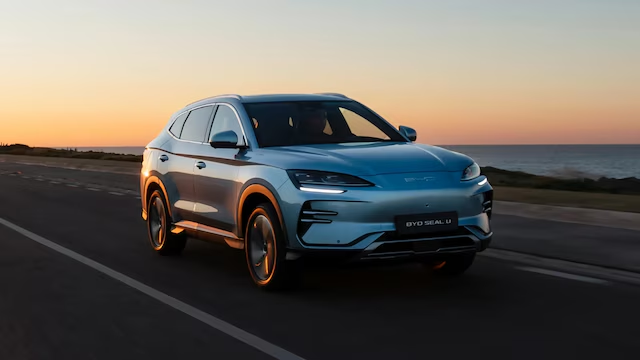
The BYD Seal U — the brand’s first DM-i plug-in hybrid for India — is already stirring debate before even touching tarmac.
Table of Contents
ToggleWhat just happened
Chinese EV giant BYD has officially showcased its DM-i Super Plug-in Hybrid EV system in India.
This isn’t just another hybrid setup. It’s BYD’s attempt to blur the line between EV and petrol efficiency completely.
The first model expected to carry it?
The BYD Seal U SUV — also known globally as Sealion 6.
BYD Seal U is set for India launch by the end of 2026, marking BYD’s shift beyond pure electric cars in the country.
And the timing matters.
India’s EV market is expanding fast — but charging infrastructure still isn’t evenly spread. That gap is exactly what BYD is trying to exploit.
Must Read: 2026 Audi Q7 Shock: 3 Seating Layouts & New Platform Shake Luxury SUVs
Why this SUV is getting attention
The numbers behind the DM-i system are what’s causing all the noise.
The setup includes:
- 1.5-litre turbo-petrol engine
- Two electric motors (traction + starter-generator)
- 18.3kWh Blade battery
Now the bold claims:
- Over 1,200km total driving range
- Up to 200km pure EV mode
- 4.8 litres/100km fuel consumption
- 43.04% claimed thermal efficiency (engine)
- 97.5% motor efficiency
That last number is what engineers are raising eyebrows at.
This is the core of BYD DM-i Super Plug-in Hybrid EV system — a system designed to prioritise electric drive first, with the petrol engine acting more like a range extender than a traditional power source.
What it feels like in real use (on paper)
BYD says the system behaves in three modes:
- EV-first driving in cities
- Series hybrid for efficiency cruising
- Parallel hybrid during heavy acceleration
Translation: it tries to act like an EV almost all the time.
But here’s the twist — the petrol engine only fully engages when power demand spikes.
That means long highway runs could still feel electric-heavy, with fuel quietly backing things up in the background.
Performance and size snapshot
The Seal U isn’t a small crossover.
- Length: 4,775mm
- Width: 1,890mm
- Height: 1,670mm
- Wheelbase: 2,765mm
Depending on variant:
- Up to 323hp
- Up to 550Nm torque
- 0–100 km/h in 5.9 seconds
That puts it squarely in the same mental category as premium mid-size SUVs, not budget hybrids.
Inside, BYD is loading it with:
- 19-inch alloys
- 15.6-inch rotating infotainment screen
- ADAS suite
- 360-degree cameras
- Premium audio system
Market impact: the uncomfortable question
The expected price band is where things get interesting.
BYD is targeting roughly ₹45–50 lakh (ex-showroom) for India.
At that level, it walks straight into a crowded luxury-adjacent space — where brand perception often matters more than specs.
And that’s where competition shows up.
One of its early rivals will be JSW Motor’s upcoming Jetour T2 PHEV SUV, expected around the same time window.
Industry reaction: excitement… and skepticism
On paper, the Seal U sounds like a breakthrough for long-distance driving in India.
But industry voices aren’t fully convinced yet.
Some engineers point out a recurring issue in plug-in hybrid claims:
real-world efficiency depends heavily on charging discipline.
If users don’t charge regularly, the system behaves more like a heavy petrol SUV with extra battery weight.
And that changes everything.
Contrarian view: is this actually a “bridge tech”… or a delay tactic?
Not everyone sees DM-i as a revolution.
A growing counter-argument is simple:
Plug-in hybrids like this may slow down full EV adoption instead of accelerating it.
The reasoning:
- Drivers rely on petrol fallback
- Charging habits don’t fully develop
- Manufacturers get longer ICE lifecycles
In that view, the Seal U isn’t just a stepping stone — it might become a comfortable middle ground that reduces urgency to go fully electric.
That’s where the debate gets sharp.
Is BYD solving India’s infrastructure gap… or designing around it?
What happens next
The Seal U is expected to enter India by end-2026, but specs may differ from global versions.
The big unknowns:
- Final India-specific tuning
- Real EV range in Indian conditions
- Charging behaviour adoption
- Pricing strategy against luxury ICE SUVs
For now, BYD has done something important — it’s forced a conversation Indian auto buyers can’t ignore anymore.
Not just electric or petrol.
But what happens when both are fused so tightly, the difference almost disappears?
Editorial disclaimer
This article is based on publicly available information from official and media reports. No facts, specifications, or timelines have been fabricated. Analysis and interpretations may evolve as new official updates emerge.