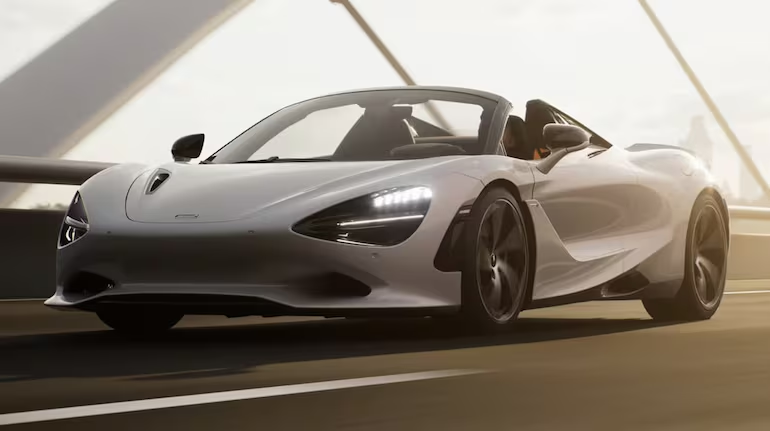
India’s supercar market just got a jolt no one really expected this early.
McLaren prices in India are set to fall by as much as 38%, wiping out crores overnight from some of its most desirable machines.
And the trigger isn’t a festive offer or demand slowdown.
It’s something far bigger — the ripple effect of the upcoming India–UK trade agreement.
Table of Contents
ToggleWhat Happened
British supercar maker McLaren is preparing to slash India prices across its lineup, including the 750S Coupe, 750S Spider, and GTS.
The cuts are massive:
- 750S Coupe: ₹7.94 crore → ₹4.94 crore (↓ ₹3 crore)
- 750S Spider: ₹8.78 crore → ₹5.46 crore (↓ ₹3.32 crore)
- GTS: ₹6.15 crore → ₹3.83 crore (↓ ₹2.32 crore)
That’s not a discount. That’s a full-blown reset of the supercar pricing structure in India.
And the reason sits inside a long-gestating trade deal: the
India–UK Comprehensive Economic and Trade Agreement.
Why This Matters More Than Just Luxury Cars
On paper, it’s about customs duty.
But in reality, it’s about power pricing.
The agreement is expected to cut import duties on British petrol cars with large engines from 110% to 30% initially, and potentially down to 10% over five years, within quota limits.
That single shift changes everything for brands like McLaren.
Because suddenly, India is no longer “too expensive” — it becomes strategically viable.
Must Read: 2026 BYD Seal U Is a Game-Changing SUV With 1,200 Km Range — And That Changes Everything
Key Detail Most People Miss
Only certain cars qualify:
- Petrol cars above 3,000cc
- Diesel cars above 2,500cc
That’s why McLaren’s Artura hybrid stays untouched — hybrids don’t benefit under the current structure.
A quiet exception… but a financially important one.
Market Impact: A Domino Effect Begins
McLaren is the first to move aggressively — but not the only one watching closely.
Other British luxury giants sitting in the same tariff basket include:
- Jaguar Land Rover
- Bentley
- Rolls-Royce
- Aston Martin
- Lotus Cars
But here’s the twist:
None of them has followed McLaren yet.
That silence is loud.
Industry Reaction: Early Shock, Quiet Strategy
JLR already dipped its toe in earlier this year, cutting prices by up to 15–18% on select models. McLaren’s move, however, is on another level — nearly double the scale.
Industry insiders suggest this isn’t a reaction to demand. It’s anticipation.
Because the duty cuts haven’t even kicked in yet.
The agreement still needs full ratification, and implementation timelines have already slipped beyond early expectations.
So what we’re seeing is not policy impact — it’s pre-policy positioning.
Hidden Problem: Quotas Could Change Everything
Here’s where the excitement hits a wall.
Even if duties fall, imports will be capped under annual quotas.
That means:
- Limited number of eligible cars
- Brand-level competition for allocation
- Potential artificial scarcity
So while prices may drop on paper, availability could tighten in reality.
A rare case where cheaper doesn’t necessarily mean easier to buy.
Contrarian View: “This Isn’t a Price Drop — It’s a Gamble”
Not everyone is convinced this is a consumer win.
Some analysts argue McLaren is taking a calculated risk:
- The India-UK deal is not fully active yet
- Quota allocation remains uncertain
- Policy timelines have already slipped once
- Demand for ultra-luxury cars in India is still niche
So the question emerges:
Are these real price cuts… or strategic placeholders designed to lock early positioning?
If the agreement gets delayed again, brands may be stuck between two realities:
- promised low-tax pricing expectations
- and old high-duty economics
That tension could reshape luxury car pricing stability in India entirely.
What Happens Next
The biggest unanswered question isn’t about McLaren anymore.
It’s about timing.
When the agreement fully activates, will:
- prices fall further?
- or will quotas limit real-world access so tightly that pricing becomes secondary?
And more importantly — will other luxury brands rush in to match McLaren’s aggressive cuts, or wait for policy clarity?
For now, India’s supercar market is sitting in a strange in-between zone:
prices already changing… but rules still not fully live.
And that uncertainty might be the most powerful force of all.
Final Thought
McLaren’s move feels like the opening scene of a much larger shift — not just in luxury cars, but in how global trade deals instantly rewrite consumer reality before the ink is even fully dry.
But the real story begins when the agreement actually kicks in… and the market discovers whether this was a price revolution or just a pre-emptive illusion.
One question remains: when policy finally lands, will these prices hold — or shift again just as fast?
Disclaimer: This article is based on publicly available information. No facts, figures, or outcomes have been fabricated. Interpretations may evolve as new updates emerge.